
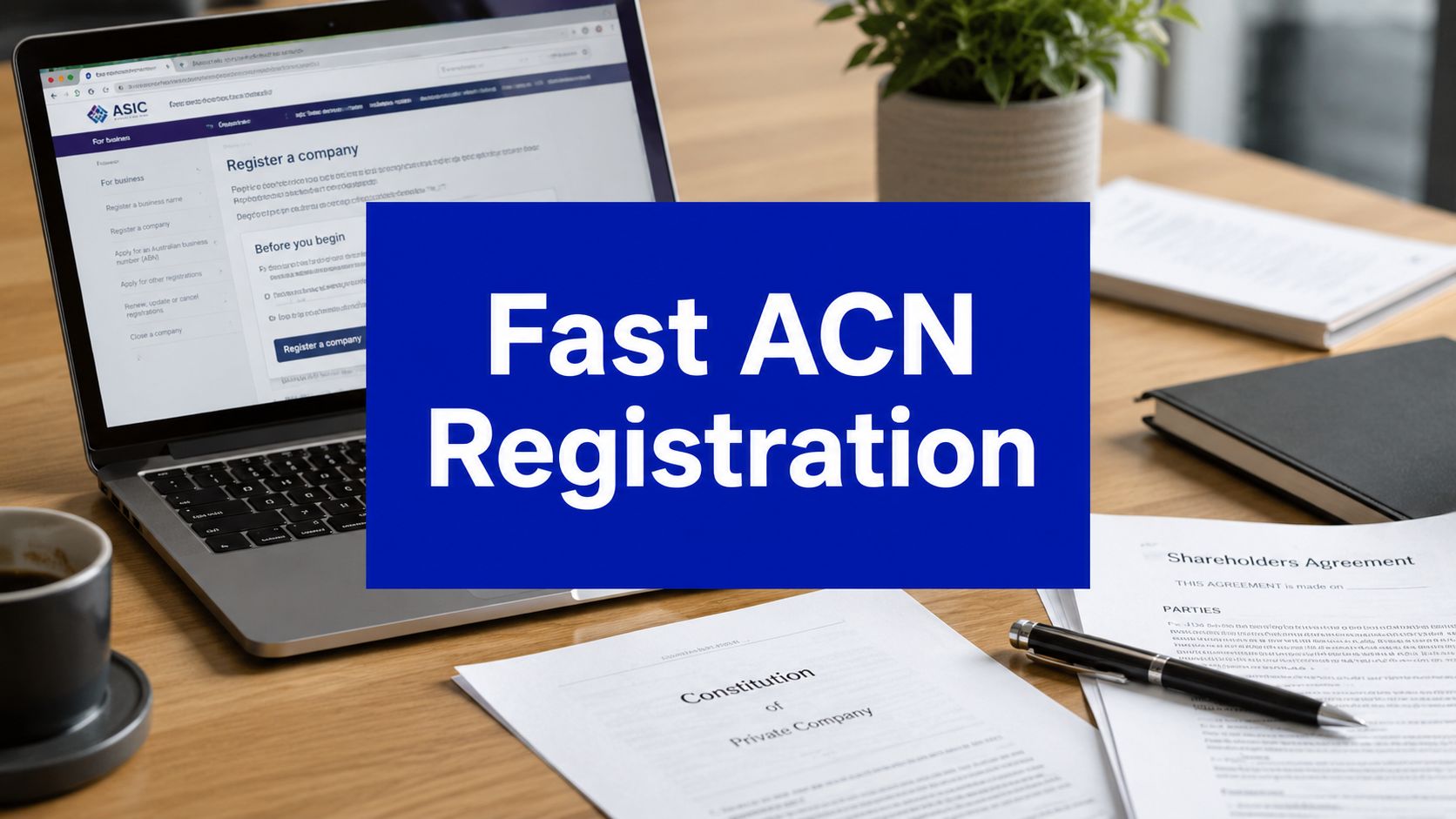
Fast ACN Registration Australia is easier when you prepare your ASIC requirements, company structure and director details before lodging the application. You can often complete the ASIC company registration application online in about 15 minutes and, if everything is correct, receive confirmation within 2 business days. An ACN is a unique nine-digit number ASIC issues when a company is registered in Australia, and businesses using a Pty Ltd structure need it for legal identification and ASIC compliance.
If you’re starting a business, you’ve probably already run into the usual confusion. ACN, ABN, business name, director ID, registered office. Many owners assume getting an ACN is just filling in one online form, then trading the same day. In practice, ACN Registration in Australia: How to Get Your Company Registered Fast comes down to doing the setup work properly before you lodge anything.
The biggest mistakes usually happen before the ASIC application starts, or after the ACN arrives. A company can be incorporated quickly, but that doesn’t automatically mean it’s ready to invoice, register for GST, hire staff, or open a bank account. That’s where careful preparation saves time and avoids expensive rework.
ACN Registration in Australia How to Get Your Company Registered Fast
A fast company registration isn’t about rushing the lodgement. It’s about removing the reasons applications stall.
Many Australian business owners mix up an ACN, an ABN, and a business name. That confusion causes real compliance problems. Some people try to get an ACN when they are operating as a sole trader. Others register a company first, then realise a director still needs a director ID, or the trading name isn’t available.
Practical rule: The fastest ACN registration is usually the one with the least fixing afterwards.
ASIC’s process sits inside a broader setup path. The company registration gives you the ACN, but tax registrations such as ABN, TFN and GST are separate entitlement-based processes, not automatic inclusions with the ACN, as outlined in ASIC’s company registration guidance. If you want speed, prepare the structure, names, officeholder details and addresses first.
Key Takeaways for Fast Company Registration
- ACNs are issued by ASIC: An ACN is the company identifier issued when a company is registered.
- Pty Ltd companies need an ACN: Sole traders and partnerships don’t receive ACNs.
- Director IDs matter early: Director identification is a compliance step that can delay registration if left too late.
- ACN and ABN are different: One identifies the company with ASIC. The other is a separate tax and business registration.
- Online setup can be quick: Correct preparation gives you the best chance of a smooth online registration.
- Clean setup prevents future problems: Good records, correct addresses and complete officeholder details make later ASIC and tax compliance easier.
What Is an ACN in Australia
An ACN, or Australian Company Number, is the company’s legal identifier. ASIC issues it when the company is registered.
Think of it as the company’s official identity on the corporate register. It is not the same thing as an ABN, and it isn’t a business name. Those are separate parts of the broader business setup.
Where the ACN fits
An ACN is tied to the company itself. If you’re incorporating a company, ASIC allocates the ACN as part of that registration.
An ABN is used for business and tax dealings. A business name is the trading name if you operate under a name different from the legal company name.
The ACN tells ASIC who the company is. It doesn’t replace the tax registrations needed to operate day to day.
Who Needs an ACN
Not every business in Australia needs an ACN. Companies do.
If you’re setting up a Pty Ltd company, you’ll need an ACN because ASIC registers companies, not sole traders. This usually applies to founders starting a company from day one, existing sole traders moving into a company structure, and owners creating a separate entity for commercial or liability reasons.
Who doesn’t get one
A common misunderstanding is thinking every business gets an ACN. That’s not how the system works.
As noted in this ACN registration guide, ACNs are exclusive to companies. Sole traders and partnerships don’t receive ACNs. If you’re not creating a company, you’re in the wrong registration path.
ACN vs ABN vs Business Name
Many setups encounter issues here. These three terms are related, but they aren’t interchangeable.
| Feature | ACN | ABN | Business Name |
|---|---|---|---|
| Purpose | Company identification | Tax/business identification | Trading name |
| Issued by | ASIC | ABR | ASIC |
| Required for Pty Ltd company | Yes | Usually | Optional |
| Public register | Yes | Yes | Yes |
Check current ASIC and ABR guidance.
A company can have all three. For example, a Pty Ltd company receives an ACN at registration, applies separately for an ABN for tax and business dealings, and may register a business name if it trades under a name different from its legal company name.
If you’re still sorting out the tax side after incorporation, ABN registration support for Australian businesses is the next step to look at.
What You Need Before Registering a Company
Preparation is what makes registration fast. If you start the application before you’ve gathered the essentials, you’re far more likely to hit avoidable delays.
The details to have ready
Before you lodge, have these sorted:
- Company name: Check that the name is available and suitable.
- Director details: Full legal names and personal details must be correct.
- Shareholder details: Ownership details need to match the intended structure.
- Registered office: You need an Australian registered office and principal place of business address.
- Entity choice: Decide whether you’re setting up a company and whether it’s proprietary or public.
The Australian Government’s company registration pathway says you should choose a company name, decide whether the entity will be proprietary or public, and understand your legal obligations before lodging the application.
Don’t leave director ID until the end
A major delay point is the Director Identification Number, often called a director ID or DIN. All company directors need one, and that identity check step can slow things down if nobody has dealt with it yet.
As explained in ASIC’s video guidance on the registration flow, all company directors must have a director ID, and that requirement is often missed by founders chasing a quick same-day setup.
If you’re also deciding whether to trade under the company name or a separate brand, business name registration guidance helps avoid mixing up the two.
For online sellers, this planning stage matters even more because payment, fulfilment and tax setup all connect to the legal structure. Founders launching ecommerce stores often benefit from practical startup planning like this Wistec online store advice before they commit to a structure.
How to Get an ACN Fast
The fastest compliant path is usually the most organised one.
The registration sequence that works
- Choose your company structure
Make sure a company is the right structure. An ACN only comes from company registration, so this decision has to come first. - Check company name availability
Name issues are one of the most common reasons applications slow down. If the name is unavailable or problematic, fix that before lodgement. - Obtain director IDs
Every proposed director should complete this step early. Leaving it until the day of registration is a common own goal. - Prepare company details
Gather director, shareholder and address details. If any of this is incomplete, the application can become messy very quickly. - Lodge ASIC registration
The quickest compliant route is through the Business Registration Service. The Business Registration Service allows applicants to register a company, apply for a company name, and obtain an ACN in a single workflow. - Receive ACN confirmation
Once approved, the ACN is issued with the Certificate of Registration. At that point, the company exists. - Apply for ABN and tax registrations
This is the step many owners underestimate. The ACN creates the company, but additional registrations may still be needed before trading smoothly.
What works and what doesn’t
What works is preparing every input before opening the form. What doesn’t work is treating ASIC registration like a casual sign-up page.
If you’d rather have the setup handled in one process, company registration support can help coordinate the ASIC and follow-on registration steps in the right order.
How Long Does ACN Registration Take
There are two different timelines to think about. One is the incorporation timeline. The other is the trade-ready timeline.
For incorporation, the Australian Government says registration can be completed online in about 15 minutes and is typically confirmed within 2 business days if all documents are provided, according to business.gov.au company registration guidance.
The practical timeline most owners should expect
In practice, the full setup often takes longer than the ACN itself. Straightforward cases commonly take a few days to 1 to 2 weeks once you include ABN registration, banking and readiness to trade, while more complex setups can take longer, as outlined in the same business.gov.au company registration guidance.
Check current ASIC guidance.
The reason is simple. ASIC registration may be quick, but readiness to invoice, bank, employ staff or register for GST depends on the rest of the setup being complete and correct.
Worked Example ACN Registration
A common real-world scenario is a sole trader consultant moving into a Pty Ltd structure.
The consultant has been invoicing in their own name but now wants a separate company for contractual clarity and stronger separation between personal and business affairs. Because they are changing from sole trader to company, they now need an ACN.
How the setup unfolds
First, the consultant applies for a director ID and confirms the proposed company name and addresses. Then the company is registered through ASIC’s online pathway. Once ASIC approves the registration, the new company receives its ACN and Certificate of Registration.
After that, the consultant applies for an ABN for the company and considers GST registration depending on the business’s tax position and activities. Banking also shifts to the company so income and expenses are kept separate from personal transactions.
Why this structure change matters
The practical benefit is that the company becomes the operating entity. That gives cleaner administration, clearer contracts and a more formal structure for growth.
It also changes the compliance load. The owner isn’t just “getting an ACN”. They’re stepping into company rules, ASIC obligations, record-keeping and ongoing reviews. That’s why getting the setup right at the beginning matters more than shaving a few minutes off the application.
Common ACN Registration Mistakes
Most delays aren’t caused by ASIC moving slowly. They’re caused by poor inputs.
Mistakes that create rework
As noted in this ACN registration article, common delays usually come from avoidable errors such as unavailable company names, incomplete director information, and confusion about whether the applicant is even registering the right type of entity.
- Mistake: Choosing a company name that’s already registered or not suitable.
Quick Fix: Check name availability before lodging the application. - Mistake: Confusing an ACN with an ABN.
Quick Fix: Treat company registration and tax registration as separate steps. - Mistake: Missing director ID requirements.
Quick Fix: Make sure each director completes that identity step before or during the setup process. - Mistake: Incorrect registered office details.
Quick Fix: Confirm the address is valid and appropriate before submission. - Mistake: Using a residential address without thinking about privacy.
Quick Fix: Decide deliberately whether you want that address connected to the company’s public details. - Mistake: Incorrect shareholder details.
Quick Fix: Match names, holdings and structure decisions before you lodge. - Mistake: Forgetting ongoing ASIC obligations.
Quick Fix: Treat registration as the start of compliance, not the end.
Small errors at registration create bigger administrative problems later. Fixing structure early is usually cheaper than unwinding it after contracts, invoices and tax registrations are already in place.
Company Registration Checklist
Use this as a practical pre-lodgement list:
- Company name available
- Director IDs completed
- Registered office confirmed
- Shareholder details ready
- ASIC application submitted
- ACN issued
- ABN and GST registrations completed where needed
If you’re hiring soon after setup, it also helps to line up your internal admin early. A simple new employee onboarding checklist template can be useful once the company is in place and employer registrations are being organised.
Australia Specific Compliance Considerations
Registering the company is only one part of the job. Running it properly is the bigger one.
What new directors need to keep in mind
Under ASIC’s framework, a company needs a registered office and proper company records. You also need to think about governance documents such as the company constitution, and keep records that support the company’s legal and tax position. Check current ASIC and ABRS guidance.
The Australian Business Register states that ABN applications are generally reviewed within 20 business days, which can become a bottleneck after incorporation, and a public officer must be appointed within 3 months of incorporation, according to ABR guidance on applying for an ABN.
Ongoing obligations don’t wait
A new company also needs to stay on top of ASIC annual review obligations, address updates, officeholder records and tax registrations. A business bank account normally follows ASIC registration as part of becoming operational.
Owners often underestimate the workload. Getting the ACN is a milestone. Staying compliant is the ongoing responsibility.
Frequently Asked Questions About ACN Registration
What is an ACN?
An ACN is the nine-digit company identifier ASIC issues when a company is registered in Australia.
How do I get an ACN in Australia?
You get an ACN by registering a company through ASIC’s registration pathway, usually using the Business Registration Service.
How long does ASIC company registration take?
The online application can often be completed quickly, and straightforward applications are commonly confirmed within a short period if the details are correct. Check current ASIC guidance.
Is ACN the same as ABN?
No. An ACN identifies the company on ASIC’s register. An ABN is a separate business and tax identifier.
Do sole traders need an ACN?
No. Sole traders don’t receive ACNs because an ACN is for companies.
What is a director ID?
A director ID is the identification number company directors need as part of the director identity process.
Can I register a company myself?
Yes, many owners do. The main issue isn’t whether you can do it yourself. It’s whether the structure, details and follow-on registrations are correct.
Do I need a business name if I have an ACN?
Not always. If you trade under a name different from the company’s legal name, you may need a separate business name registration.
Can I use my home address?
Sometimes, but you should think carefully about privacy and suitability before using a residential address for company records.
What happens after I get an ACN?
You may still need an ABN, tax registrations, banking setup and internal compliance processes before the business is fully operational.
If you want help getting the structure, registration and post-setup steps right, book a consult with Nanak Accountants and Associates. Book a consult with Nanak Accountants & Associates, 1300 NANAK TAX (626 258).
This article provides general information only for Australia. It doesn’t consider your objectives, financial situation or needs. ASIC registration rules, director ID requirements and company obligations can change, check current ASIC and ABRS guidance and seek professional advice before acting.
