
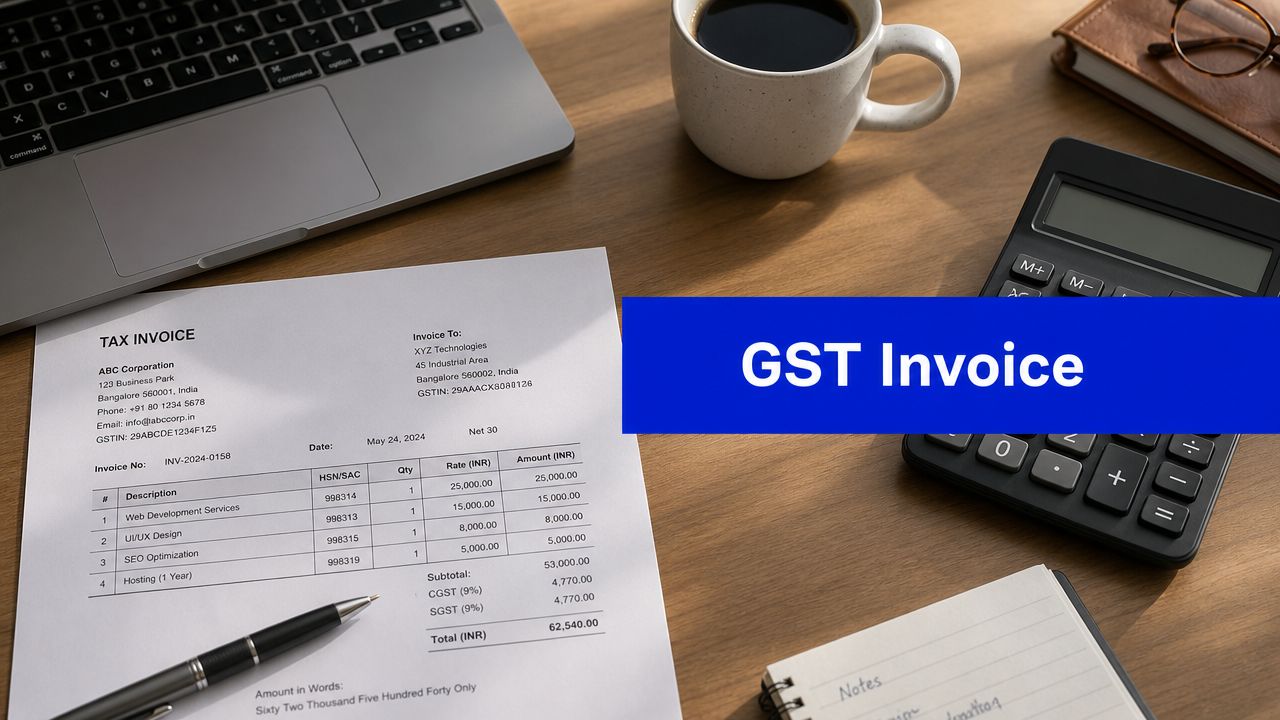
Getting your GST invoice requirements right is more than just paperwork, it’s fundamental to getting paid, helping your clients claim GST credits, and staying on the right side of the Australian Taxation Office (ATO). While a standard invoice might get money in the door, only a compliant tax invoice unlocks GST credits and keeps your business records clean for the ATO. This guide explains exactly what you need to know.
What Are GST Invoice Requirements in Australia?
For any Australian business registered for Goods and Services Tax (GST), understanding GST invoice requirements is non-negotiable. A tax invoice is a specific document with mandatory details set by the ATO. Without a compliant one, your business customers cannot claim a GST credit on their purchases from you, which can damage a good professional relationship.
Think of a compliant tax invoice as the official proof that GST was charged on a sale. It’s the primary record you and your customers rely on when it’s time to prepare and lodge a Business Activity Statement (BAS).
This guide walks you through what you need to create accurate, professional, and audit-proof invoices. We’ll cover:
- The difference between a regular invoice and a tax invoice.
- When you must issue a tax invoice.
- The specific details required on a compliant GST invoice.
- The different rules for sales under and over the ATO threshold.
- How to handle common errors and what buyers need to claim GST credits.
Getting this right from day one protects your cash flow, builds your reputation, and ensures you meet your ATO tax invoice requirements.
GST Invoice vs Tax Invoice: What Is the Difference?
In Australia, the terms “invoice” and “tax invoice” are often used interchangeably, but they are not the same thing in the eyes of the law.
- An invoice is simply a bill, a commercial document that requests payment for goods or services. It doesn’t have to meet any specific legal requirements beyond being a clear request for payment.
- A tax invoice is an official document that meets specific criteria set by the ATO. Its primary purpose is to provide proof that GST was charged, allowing the buyer to claim a GST credit.
If your business is not registered for GST, you must not issue a document called a “tax invoice” or charge GST. You would simply issue a standard invoice.
Key Takeaway: Only a GST-registered business can issue a tax invoice. This document is essential for the buyer to claim back the GST they paid.
When Do You Need to Issue a Tax Invoice?
If your business is registered for GST, you must provide a tax invoice for any taxable sale if your customer asks for one. The rules depend on the sale value.
The ATO requires you to provide a tax invoice within 28 days of a customer’s request for any taxable sale of more than $82.50 (including GST). You can find the latest rules on the ATO’s guidance page.
For sales of $82.50 or less, you are not legally required to provide a tax invoice, even if asked. However, providing a receipt or docket that meets the less strict requirements for low-value sales is good customer service and common practice.
You do not need to issue a tax invoice for sales that are GST-free (like most basic foods) or input-taxed (like residential rent or financial services), as no GST is charged on these.
What Must Be Included on a GST Tax Invoice?
To be compliant, a tax invoice must contain specific information. The ATO has different requirements depending on the total sale amount. The key threshold is $1,000.
Invoice Requirements for Sales Below and Above the ATO Threshold
For a document to be valid for your customer’s GST claims and your own records, it must meet minimum standards. The main difference is that invoices for $1,000 or more must identify the buyer.
Here is a breakdown of the ATO tax invoice requirements at a glance.
| Required Information | Sales Under $1,000 (incl. GST) | Sales of $1,000 or More (incl. GST) |
|---|---|---|
| The words ‘Tax Invoice’ stated clearly | Yes | Yes |
| Your business identity (legal or trading name) | Yes | Yes |
| Your Australian Business Number (ABN) | Yes | Yes |
| The date the invoice was issued | Yes | Yes |
| A brief description of the items sold (including quantity) | Yes | Yes |
| The total GST amount (or a statement like ‘Total price includes GST’) | Yes | Yes |
| The buyer’s identity (name or ABN) | No | Yes |
Key Compliance Point: Even if you use accounting software like Xero or MYOB, your business is responsible for ensuring its invoices are accurate and compliant. Regularly check your invoice templates against current ATO rules.
As the table shows, the only extra requirement for a tax nvoice over $1,000 is including the buyer’s identity—either their business name, trading name, or ABN. It’s a small detail, but getting it wrong can cause compliance headaches for you and your clients.
How to Show GST on an Invoice
Correctly showing GST on an invoice is critical. If it’s wrong, your customer can’t claim their GST credit, and you create a mess for your own BAS lodgement. The ATO allows two main methods.
Method 1: Show GST Separately for Each Item
This is the clearest approach, especially if you sell a mix of taxable and GST-free goods. You simply list the GST amount for each individual line item. This gives your customer full transparency.
Method 2: Show a Single GST Total
Alternatively, you can show one total GST amount for the entire invoice, usually as a separate line near the bottom before the final total.
For invoices under $1,000 that only include taxable sales, a simple statement such as “Total price includes GST” is sufficient. However, for any invoice of $1,000 or more, you must show the exact dollar amount of GST payable.
What Buyers Need to Claim GST Credits
For a buyer to claim a GST credit, they must hold a valid tax invoice. If you provide them with a non-compliant document (e.g., one missing your ABN or the words “Tax Invoice”), the ATO can deny their claim. Ensuring your invoices are correct is a key part of good customer service for your business clients.
GST-Free, Input-Taxed, and Mixed-Supply Invoices
Invoices get more complex when they include a mix of supplies, some that are taxable (with GST), some that are GST-free, and some that are input-taxed.
On these invoices, you must:
- Clearly identify which items are taxable.
- Show the total amount of GST for the taxable items.
- Clearly indicate which items are GST-free or input-taxed.
For more general tips, this external guide to creating invoices offers useful insights. If you ever need to double-check your numbers, our free tool can help you calculate GST for any amount quickly.
How to Create a Compliant GST Invoice
Creating a compliant tax invoice is straightforward if you follow a set process.
- Open Your Template: Start with a dedicated “Tax Invoice” template in your accounting software (Xero, MYOB, QuickBooks) or a word processing program.
- Add Your Details: Ensure the words “Tax Invoice” are prominent. Add your business name, address, and ABN.
- Enter Customer Information: Add the customer’s name and address. If the total is $1,000 or more, you must include their business name or ABN.
- Date and Number the Invoice: Include the date the invoice is issued and a unique invoice number.
- List Items: For each good or service, list a clear description, quantity, and price.
- Calculate and Show GST: Calculate the GST (10%) on all taxable items. Show the GST amount clearly, either per item or as a total. Indicate any GST-free or input-taxed items.
- State the Total: Clearly display the final, total amount due.
- Add Payment Details: Include your payment terms (e.g., “Due in 14 days”) and how the customer can pay (e.g., bank account details).
- Review and Send: Before sending, double-check all details against the ATO checklist. Save a copy for your records.
Worked Example: GST Invoice for an Australian Small Business
Let’s look at a practical example. Imagine a graphic designer, “Creative Spark Design,” is invoicing a client, “Best Brew Cafe,” for logo design and business cards. The sale is over $1,000, so it must meet the higher-value invoice requirements.
TAX INVOICE
From: Creative Spark Design 123 Design St, Melbourne VIC 3000 ABN: 12 345 678 910
To: Best Brew Cafe 456 Coffee Lane, Melbourne VIC 3000 ABN: 98 765 432 109
Invoice Number: 105 Date of Issue: 15 July 2026
| Description | Quantity | Unit Price | Amount (ex. GST) |
|---|---|---|---|
| Logo Design Package (Taxable) | 1 | $1,200.00 | $1,200.00 |
| Business Card Printing (Taxable) | 500 | $0.40 | $200.00 |
| Subtotal | $1,400.00 | ||
| GST (10%) | $140.00 | ||
| Total Amount Due | $1,540.00 |
Payment Due: 29 July 2026 Payment Details: Bank: AusBank BSB: 000-111 Account: 12345678
This invoice is compliant because it is labelled “Tax Invoice,” includes seller and buyer details (name and ABN), date, invoice number, item descriptions, and shows the exact GST amount.
GST Invoice Checklist
Use this quick checklist to review your invoices before sending them.
- Does it clearly say “Tax Invoice”?
- Is your business name and ABN correct?
- Is the date of issue included?
- Is there a clear description of the goods or services?
- For sales of $1,000+, is the buyer’s name or ABN included?
- Is the GST amount shown correctly? (Or a statement like “Total price includes GST” for sales under $1,000)
- Are any GST-free or input-taxed items clearly identified?
Common GST Invoice Mistakes and Quick Fixes
Getting GST invoices wrong can delay payments and cause ATO compliance issues. Most mistakes are easy to fix once you know what to look for.
Mistake 1: Forgetting to label it a “Tax Invoice” A document just saying “Invoice” is not compliant for claiming GST credits.
- Quick Fix: Open your accounting software template (e.g., Xero) and change the title to “Tax Invoice.” This is a non-negotiable ATO tax invoice requirement.
Mistake 2: Missing or incorrect ABN A tax invoice without the seller’s Australian Business Number (ABN) is invalid.
- Quick Fix: Add your ABN to a permanent spot on your invoice template. Verify your ABN on the Australian Business Register (ABR) to ensure it’s active and correct.
Mistake 3: Incorrectly fixing a past mistake You can’t just edit and resend an incorrect invoice that has already been issued.
- Quick Fix: You must issue an “adjustment note” (or credit note) that references the original invoice number and date. This new document officially corrects the error. You have 28 days from identifying the error to issue the adjustment note.
Mistake 4: Using a US invoice template Using American templates that refer to “Sales Tax” instead of “GST” will make your invoice invalid in Australia.
- Quick Fix: Ensure your software is set to the Australian region and that your templates use correct Australian terminology like “GST” and “Tax Invoice.”
Electronic Invoices and Accounting Software
Modern accounting software like Xero, MYOB, and QuickBooks are essential tools for managing GST invoice requirements. They come with compliant templates that automate many of the details.
However, a common trap is assuming the software does everything for you. You, the business owner, are ultimately responsible for every tax invoice you issue. A simple setup error can lead to a stream of non-compliant invoices. If you need help, consider our expert Xero setup and training services.
eInvoicing in Australia
Beyond sending PDF invoices, Australia is moving towards eInvoicing, the direct, digital exchange of invoice data between software systems via the Peppol network. This is more secure than email, reduces manual data entry, and protects against invoice fraud. Some platforms, like QuickBooks, can help you improve cash flow with QuickBooks invoicing and eInvoicing features.
Record-Keeping Obligations
Issuing the invoice is just the first step. The ATO requires you to keep copies of all tax invoices you issue and receive for a minimum of five years. These records can be electronic, but they must be secure, legible, and easily accessible for a potential audit. This makes a reliable bookkeeping system non-negotiable.
Frequently Asked Questions
Here are answers to common questions about GST invoice requirements in Australia.
What if a supplier won’t provide a valid tax invoice?
If a supplier doesn’t provide a valid tax invoice for a purchase over $82.50, you cannot legally claim the GST credit on your BAS. You should politely follow up and explain you need it for your tax obligations. If they still refuse, you can request permission from the ATO to claim the credit, but you must prove you made reasonable attempts to get the invoice.
What is the difference between a tax invoice and a receipt?
A receipt is simply proof of payment. A tax invoice is a more detailed document that meets ATO requirements and allows a GST-registered buyer to claim a GST credit. A compliant tax invoice can serve as a receipt if it shows the amount paid.
Do I need a tax invoice for sales under $82.50?
No, you are not legally required to provide a full tax invoice for sales of $82.50 (incl. GST) or less. A cash register docket or receipt is usually sufficient for the buyer to claim a credit, provided it includes your business name, ABN, date, a description of the items, and the GST-inclusive price.
Can I email a tax invoice?
Yes, sending tax invoices as PDF email attachments is perfectly acceptable and a standard business practice in Australia. You just need to ensure you and your customer keep a copy for five years.
What happens if I make a mistake on a tax invoice?
If you’ve issued a tax invoice with an error (e.g., wrong amount, wrong ABN), you must issue an “adjustment note” to the customer within 28 days of discovering the error. Do not simply delete or edit the original invoice.
What is a Recipient Created Tax Invoice (RCTI)?
An RCTI is a special tax invoice that the buyer issues to the seller. This is only allowed in specific industries approved by the ATO (e.g., agriculture), and both parties must be registered for GST and have a written agreement in place.
As a buyer, how long do I have to claim a GST credit?
Generally, you claim GST credits in the BAS period when you receive a valid tax invoice. If you receive it late, you can typically claim it in a later BAS. However, there is a four-year time limit for claiming credits, so good record-keeping is vital.
Do I need to show my ABN on an invoice if I’m not registered for GST?
If you have an ABN but are not registered for GST, you should still show your ABN on your invoices. However, your invoice must not include the words “Tax Invoice” or show a separate GST amount. You are billing for the full amount without any tax component.
What are the invoice requirements for a GST-registered business?
A GST-registered business must issue a tax invoice upon request for sales over $82.50. The invoice must include the words ‘Tax Invoice’, the seller’s name and ABN, the date of issue, a description of the items, and the GST amount (or a GST-inclusive total statement). For sales of $1,000 or more, the buyer’s name or ABN is also required.
How do I handle GST-free sales on an invoice?
If an invoice includes GST-free sales, you should clearly identify them (e.g., by marking them ‘GST-free’). The invoice should only show a GST amount calculated on the taxable items.
What is a tax invoice under $1,000 requirement?
For a tax invoice under $1,000, you must include the words ‘Tax Invoice’, your business identity and ABN, the date, a description of what was sold, and either the GST amount or a statement that the total price includes GST. You do not need to include the buyer’s details.
How do I create a GST invoice template?
The easiest way is to use accounting software like Xero, MYOB, or QuickBooks, which have built-in, compliant Australian templates. You can customise them with your logo and business details.
Need Help with Your GST Invoice Requirements?
Getting your GST tax invoice requirements right is crucial for compliance and healthy cash flow. While the rules are straightforward, mistakes can be costly and time-consuming to fix. If you’re unsure about your obligations or need help setting up a reliable invoicing system, it’s time to speak with a professional.
Book a consult with Nanak Accountants & Associates – 1300 NANAK TAX (626 258).
