
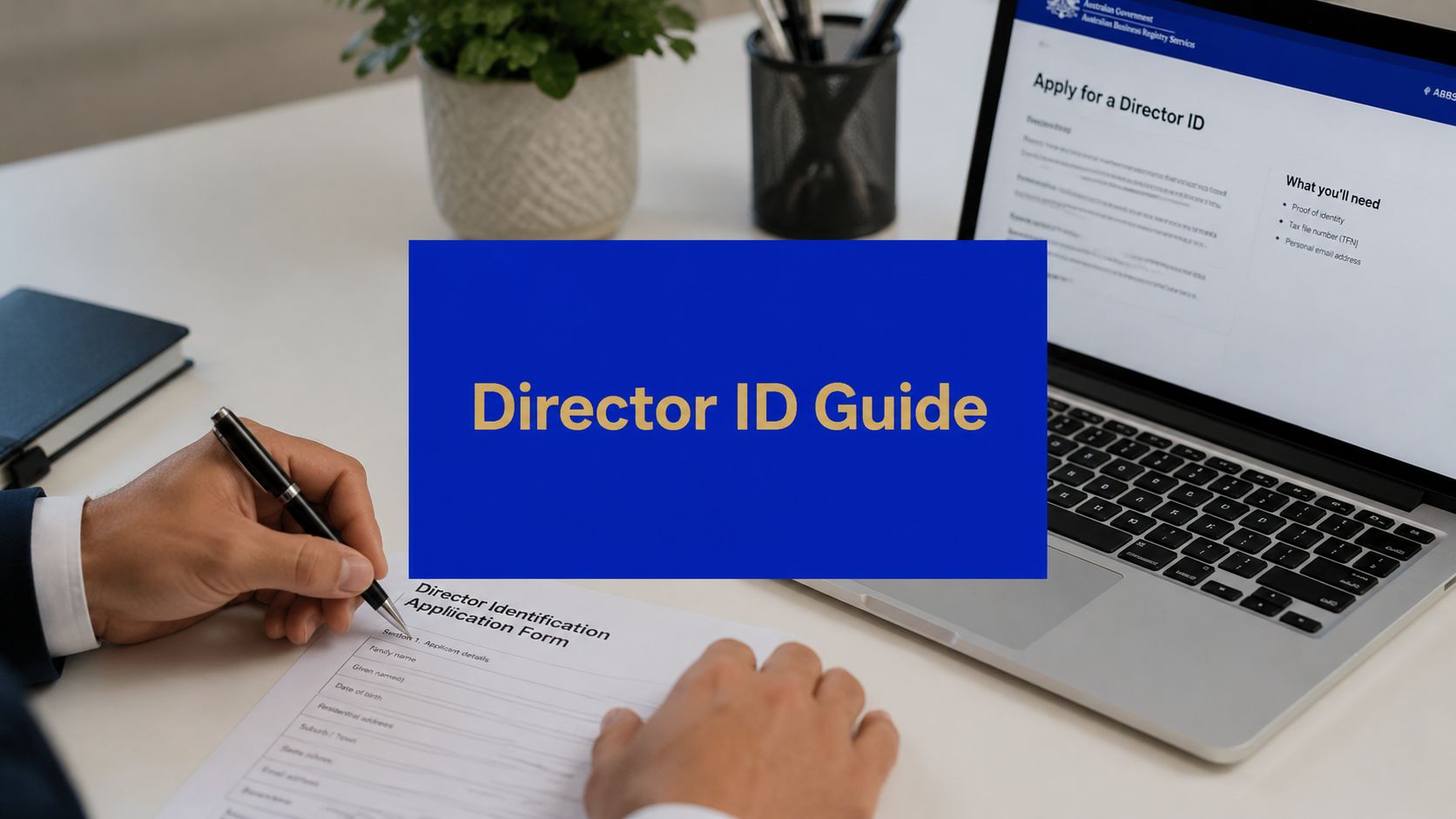
A director identification number is a unique 15-digit identifier issued by the Australian Business Registry Services, and an eligible director applies for it personally before appointment. It stays with that person for life, and it’s required for directors of companies, registered Australian bodies, registered foreign companies, and Aboriginal and Torres Strait Islander corporations.
If you’re about to register a company, take a board seat, or join a family business in Australia, this is often the first compliance item that trips people up. The reason is simple, the director ID sits with the individual, not the entity, so the company can’t “sort it later” once the appointment is meant to happen.
What a Director Identification Number Is and Why It Matters
A lot of founders discover the director ID at the exact wrong moment, usually when they’re ready to lodge company paperwork and realise the appointment can’t be treated like a simple admin step. The corporate secretarial part of the job starts before the board resolution, because the director identification number has to exist first if the appointment is one that falls under the regime.
A director identification number is a 15-digit number issued once to an individual by ABRS, and it is kept for life. It remains the same if you change companies, change your name, move interstate, move overseas, or later stop being a director. That lifetime feature is deliberate, because the policy is meant to improve identity integrity and help trace director relationships across entities, especially where false identities and illegal phoenix activity are a concern. The Australian Business Registry Services explains the regime and its purpose on its director ID guidance page, and ASIC’s company officeholder materials reinforce how the identifier sits within the broader compliance framework. ASIC director ID guidance
Why the regime exists
The practical reason matters more than the legal label. Australian regulators want a stable identifier that follows the person, not the company, so one director can’t appear under multiple identities across different entities. That helps with internal governance too, because a director ID gives boards, accountants and ASIC a consistent reference point when officeholders change or when entities are linked.
Practical rule: if the appointment is real, personal and directorial, the ID should be sorted before the appointment paperwork is executed.
The rollout was staged nationally, beginning for new directors on 1 November 2021. Existing directors had until 30 November 2022 to apply, and anyone appointed on or after 5 April 2022 had to obtain a director ID before appointment. Those dates explain why older company records may still be catching up, especially where firms didn’t build the check into their formation process. ASIC director identification numbers
Who Needs a Director ID and Who Does Not
The mistake I see most often is people treating director ID as a “Pty Ltd owner” issue. It isn’t that narrow. The regime applies to directors of companies, registered Australian bodies, registered foreign companies and Aboriginal and Torres Strait Islander corporations, and ABRS also makes clear that the number is personal and only needs to be obtained once. ABRS director ID overview
The people who do need one
If you’re a director, the question is usually not whether your business is small or large, it’s whether your role falls into one of the covered categories. That can include a newly appointed company director, a foreign director joining an Australian group structure, or a trustee company where the corporate trustee itself is the director of an SMSF arrangement. It also reaches not-for-profit boards where the organisation is structured through a registered body rather than a simple sole trader setup. ABRS who needs a director ID
The important point is that this is an individual obligation. If you sit on three boards, you still have one director ID, not three. If you join a new entity later, you use the same number again.
The people who do not need one
Company secretaries who are not also directors do not need a director ID. Sole traders do not need one either, because they are not directors of a covered entity merely by trading in their own name. A person acting behind the scenes without directorial appointment also doesn’t automatically fall within the regime. The rule turns on the directorship, not on how active the person is in the business. ABRS about director ID
A common trap is assuming the title on the letterhead controls the obligation. In practice, the appointment record does.
For advisers and trustees, that distinction matters. A corporate trustee may need to have its officeholder arrangements checked carefully, and cross-border groups often need a separate review because a foreign director might assume they can wait until they arrive in Australia. That’s exactly the sort of sequencing issue that causes avoidable delays.
How to Apply for a Director Identification Number
The fastest path is online through ABRS using a Digital ID such as myID, but the right channel depends on your circumstances. myID is the digital identity used to access participating government online services, while myGov is the Australian Government online account for services. They are not the same service, and it’s worth checking which one you need before you start. myID guidance ABRS apply online
The application process
- Confirm that you need a director ID.
Check whether your intended role is a directorship under the covered entity types. Don’t guess, because an incorrect assumption here can delay the appointment.
- Set up or check your myID where applicable.
ABRS says online applications require a Standard or Strong identity strength, so make sure your digital identity is ready before you begin. ASIC infocus on director IDs
- Gather the information needed to verify your identity.
ABRS says the online process requires your TFN, residential address and two identity documents. Keep the details consistent with your documents, because mismatches cause delays. ABRS apply online
- Apply personally through the approved ABRS method.
You must apply for your own director ID. No one else can do it on your behalf, including your accountant. ABRS apply online
- Save your director ID securely.
Treat it as a permanent compliance reference, not a password. Your records should be accessible to you and, where appropriate, the company’s record-holder.
- Provide it to the appropriate company or record-holder where required.
That matters when the appointment is being finalised, because the company can’t legally appoint a director who must hold a director ID unless the number has already been obtained.
For directors who can’t use the online channel, ABRS provides a phone pathway, and overseas applicants can contact ABRS on +61 2 6216 1111 or 13 62 50 inside Australia. That makes the system workable for non-residents, but it doesn’t remove the identity check. If you’re stuck on sequencing or record-keeping, a service such as ASIC agent support through Nanak Accountants can help manage the corporate paperwork around the application without taking over the director’s personal obligation.
Director ID vs ACN vs ABN Explained
These three identifiers get mixed up constantly, especially during company setup. They do different jobs, attach to different things and sit in different parts of the compliance stack.
Comparison table
| Identifier | Applies to | Purpose | Example format |
|---|---|---|---|
| Director ID | Individual director | Identifies the director | 15 digits |
| ACN | Company | Identifies registered company | 9 digits |
| ABN | Business/entity | Identifies entity for business/tax dealings | 11 digits |
A director ID is about the person. An ACN is about the company. An ABN is about the business or entity for tax and commercial dealings. If you’re setting up a Pty Ltd company, the director ID sits before the appointment issue, the ACN follows company registration, and the ABN may then be used for business dealings once the entity is registered. ABRS director ID ABR ABN information
A practical example makes this easier. Say you’re about to register a new Pty Ltd company and become its director. You should obtain your director ID before the company appointment is finalised, because the identifier belongs to you and not the company. The company then completes its own registration steps, which are separate from the director ID process, and the ACN and ABN remain entity identifiers rather than personal director identifiers. For company formation work, the registration sequence is often as important as the documents themselves. Nanak company registration guide
Practical rule: don’t treat the director ID as a substitute for company registration. It’s a prerequisite for the person, not a replacement for the entity’s own records.
If you’re planning a new structure, business structuring advice is often worth reviewing before you appoint anyone. The right structure affects who needs to be a director, who can be a trustee and how the compliance flow should be sequenced.
Compliance Risks and Common Director ID Mistakes
Director ID compliance is no longer a once-off setup task. Treasury said in mid-2026 that more than 3 million directors already have a director ID, and new laws are linking director IDs to company records so identities and relationships can be verified more easily across companies, especially for fraud and illegal phoenix activity. Treasury ministerial release
Common mistakes and quick fixes
- Mistake, assuming the accountant can apply for you.
Quick fix: the director must apply personally, then the adviser can help organise the paperwork and timing.
- Mistake, confusing myID with myGov.
Quick fix: use myID for digital identity access where required, and treat myGov as a separate government account.
- Mistake, leaving the application until after appointment.
Quick fix: apply before the board resolution or ASIC appointment step is executed.
- Mistake, thinking you need a new number for each company.
Quick fix: keep one director ID for life and use it for every eligible directorship.
- Mistake, entering identity details that don’t match your documents.
Quick fix: check the TFN, residential address and identity records before you submit.
- Mistake, assuming foreign directors can ignore the process until they arrive in Australia.
Quick fix: use the phone or overseas pathway early so appointment timing doesn’t stall.
- Mistake, misrepresenting or reusing someone else’s details.
Quick fix: correct the record and keep the application strictly personal, because the obligation is non-delegable.
Failing to obtain a director ID when required, missing the required timeframe, applying for multiple director IDs, providing false identity information or misrepresenting a director ID can all create serious compliance problems. Check current ABRS/ASIC guidance for applicable penalties, because enforcement settings can change and penalty units aren’t something to guess at. ASIC company and director requirements
Your Director ID Checklist and Next Steps
Use this as a working checklist before you sign anything.
- Confirm the role: make sure the appointment is one that requires a director ID.
- Check your identity access: verify whether you can use myID or need an alternative channel.
- Prepare documents: have your TFN, residential address and identity documents ready.
- Apply personally: submit your own application through ABRS.
- Store the number safely: save the director ID where you can retrieve it quickly.
- Update records when details change: keep your personal details aligned with the identity record.
- Keep appointment sequencing clean: don’t execute the board step before the director ID is obtained.
- Review special cases: foreign directors, corporate trustees and multi-entity appointments deserve extra attention.
- Use the right support: advisers can organise the entity side, but not the personal application.
ABRS manages the director ID as a regulator-facing identifier, so it is not generally public in ASIC extracts, which helps reduce external exposure while keeping internal accountability intact. For ongoing compliance, company tax returns and bookkeeping support are often the next services people need after setup, especially once the company starts trading.
If you’re unsure whether your structure is correct before appointing anyone, tax planning and ABN registration support can help line up the entity side with the director side. For some businesses, that’s the difference between a smooth incorporation and a delay that pushes the whole launch back.
The best next step is to get the appointment sequence right now, while the paperwork is still flexible.
Nanak Accountants and Associates can help you map the company setup, ASIC, ABN and ongoing record-keeping steps around a director identification number, so the appointment process stays compliant from the start. If you’re registering a company, appointing a director, or sorting out a trustee structure, visit Nanak Accountants and Associates to book a discussion about the right compliance path for your situation.
FAQs
What is a director identification number?
It’s a unique 15-digit identifier issued by ABRS to an eligible director. The number belongs to the person, not the company, and it stays with them for life. ABRS director ID
Who needs a director ID in Australia?
Directors of companies, registered Australian bodies, registered foreign companies and Aboriginal and Torres Strait Islander corporations generally need one. If you’re not a director, the obligation usually doesn’t apply to you. ABRS who needs a director ID
How do I apply for a director ID?
Apply personally through ABRS, usually online using myID where applicable. ABRS says no one can apply on your behalf. ABRS apply online
Is a director ID the same as an ABN?
No. A director ID identifies the individual director, while an ABN identifies a business or entity for tax and business dealings. ABR ABN information
Is a director ID the same as an ACN?
No. An ACN identifies the company itself, while the director ID identifies the person who acts as a director. ASIC director requirements
Can my accountant apply for my director ID?
No. The director has to apply personally. An accountant can explain the process, help with timing and keep the company records aligned. ABRS apply online
Do overseas directors need a director ID?
Yes, if they’re appointed to a covered directorship. ABRS provides alternative pathways, including phone contact options for overseas applicants. Overseas application support
How long does a director ID last?
It lasts for life. You keep the same number even if you change companies, change your name, move interstate or move overseas.
What happens if I don’t apply for a director ID?
You can create a compliance breach if you’re required to hold one and don’t obtain it on time. Check current ABRS/ASIC guidance for applicable penalties.
Do I need a new director ID for each company?
No. One director ID covers you for all eligible directorships. It’s personal and permanent.
This article provides general information only for Australia. It doesn’t consider your individual circumstances. Director ID, company registration and regulatory requirements can change, check current ABRS and ASIC guidance and seek professional advice before acting.
Book a consult with Nanak Accountants & Associates, 1300 NANAK TAX (626 258).
