

Seeing “In progress – Balancing account” when you check your tax return can be confusing, especially when you’re waiting for your refund.
This status generally means the ATO has calculated the result of your tax return and is completing the final checks needed before your outcome is issued. Depending on your circumstances, the final result may be a refund or an amount you need to pay. The ATO may also take relevant balances with it or other Australian government agencies into account at this stage.
So, what happens after balancing? How long does it take? And when should you expect your money?
What Is an ATO Balancing Account?
In plain English, the ATO balancing account is the final calculation stage of your tax return. It’s where the Australian Taxation Office (ATO) squares up all your tax credits and debits for the financial year to determine your final position. You’ll typically see a transaction labelled “balancing account” on your ATO online account right after the initial “processing” phase and just before your final refund or bill is issued.
Think of it like a holding zone where the ATO double-checks all your financial figures. It pulls together information from various sources, such as:
- Your declared income and tax withheld by your employer.
- Any compulsory repayments for debts like HECS/HELP.
- Your entitlement to tax offsets or credits.
- Debts you might have with other government agencies, like Centrelink or Child Support.
The system reconciles all these figures to produce a single outcome: either a tax refund owed to you or a tax debt you need to pay. The length of this stage is a key part of the ATO balancing account how long Australia 2025 timeline.
Where Does “Balancing Account” Fit in Your Tax Return?
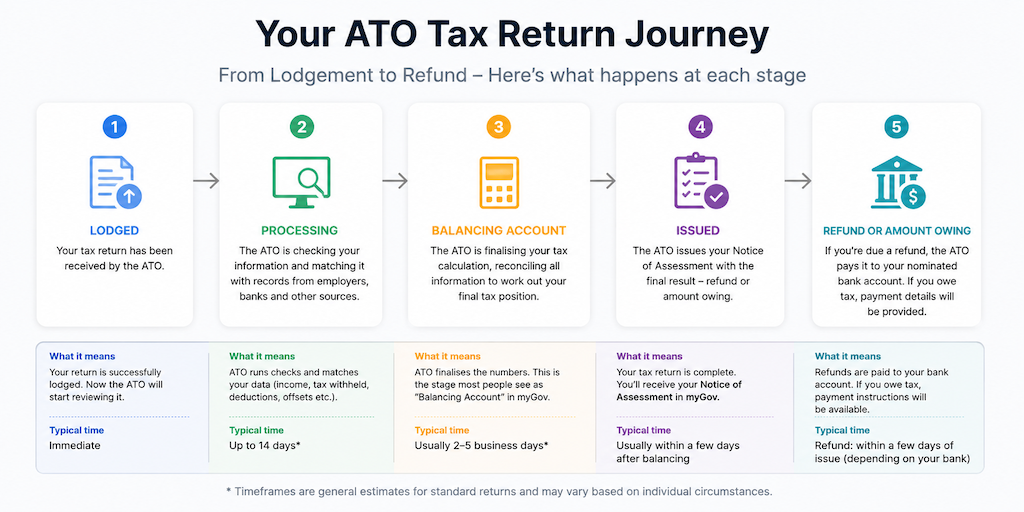
Your tax return normally moves through several stages before the final result is available.
Lodged → Processing → Balancing Account → Issued → Refund or Amount Owing
1. Lodged
Your tax return has been submitted and received by the ATO.
2. Processing
The ATO works through the information in your return and carries out checks before finalising the result.
3. Balancing Account
This is where the ATO brings the numbers together to determine your final position. This may involve reconciling your return with information already held by the ATO and considering relevant balances with government agencies.
4. Issued
Once processing is complete, the ATO issues your final assessment. Your Notice of Assessment will show the outcome of your return.
5. Refund or Amount Owing
Depending on the final calculation, you may receive a refund or need to pay an amount.
Does Balancing Account Mean I Will Get a Refund?
No.
The balancing stage is about determining your final tax position, not confirming that you are entitled to money back.
Your final outcome could be:
A refund — if you’ve paid more tax than you ultimately owe.
An amount owing — if your final tax liability is greater than the tax already paid.
A reduced refund — where an amount that needs to be accounted for affects the final amount payable to you.
That’s why the amount you estimated when lodging your return may not always be the amount shown on your final Notice of Assessment.
Current ATO Processing Times for 2025–26
Once you lodge your tax return, it moves through several stages. Understanding this journey helps set realistic expectations for your refund. For the 2025–26 period, the ATO continues to refine its automated systems, but the core processing timeline for most electronically lodged returns remains around two weeks.
The process generally follows these steps:
- Processing: The ATO receives your return and begins its initial automated checks, cross-checking data against information from employers, banks, and other third parties. This can take up to 14 days.
- Balancing Account: Once initial checks are done, your account moves to the balancing stage. This is usually very quick, often just 2–4 days. Here, the final calculation happens.
- Issued: Your Notice of Assessment is finalised and sent to your myGov inbox. If you’re due a refund, it’s transferred to your nominated bank account.
How Long After Balancing Account Will I Get My Refund?
This is one of the most common questions.
Once the balancing stage is completed, your return still needs to move through the finalisation process and your Notice of Assessment needs to be issued.
The journey is:
Balancing Account
↓
Final calculation completed
↓
Notice of Assessment issued
↓
Refund payment released
↓
Funds arrive in your nominated bank account
The time between these steps isn’t identical for every taxpayer.
As a current practical guide, the ATO has advised that once a refund payment has been sent, taxpayers should generally allow 2–3 business days for the bank to clear the funds. If the payment has not arrived after 5 business days from the payment date shown by the ATO, the ATO recommends contacting them.
This means “Balancing Account” and “money in your bank account” are two different stages.
Why Does Balancing Sometimes Take Longer?
A key reason for an ATO refund delay in 2025 is the application of offsets. If the ATO identifies that you have an existing debt with them or another government agency (like an old tax debt, Centrelink overpayment, or child support), your refund will be used to pay this off first. This additional step requires coordination and can extend the “balancing” phase beyond the typical few days. If your return is flagged for a manual review due to complex claims or data mismatches, the entire process could take up to 30 days or more.
Common Scenarios & What to Expect
The question of how long does ATO balancing take often depends on your individual circumstances. Let’s look at a few common scenarios.
Example 1: Individual Lodges Tax Return with Refund Expected
Sarah is a full-time employee with no other debts. She lodges her simple tax return online. Her myGov status shows “Processing” for about five days, then switches to “Balancing Account.” In her case, this status only lasts for 3-5 days before it changes to “Issued,” and her refund appears in her bank account shortly after. This is a standard, smooth experience.
Example 2: Sole Trader Lodges Return with GST Obligations
David is a sole trader who lodges his income tax return. When his account moves to “balancing,” the ATO isn’t just looking at his income. It’s also reconciling his Business Activity Statement (BAS) lodgements, GST payments, and any PAYG instalments. If there’s an outstanding GST debt, the system will use his income tax refund to offset it. This cross-checking can add a few extra days to the balancing process.
What Happens If…?
- “Balancing account” status stays for too long? If it’s been more than a week, it’s highly likely an offset is occurring. The ATO is coordinating with another agency to settle a debt.
- You owe money vs. you’re owed money? If you are owed a refund, the balancing stage confirms the final amount before payment. If you owe money, this stage calculates your final tax bill, which will be detailed in your Notice of Assessment along with the due date.
- You have offset issues (HECS, child support, Centrelink)? These are the most common causes of delay. The ATO is legally required to use your tax refund to pay off these government debts before sending any remaining amount to you. This administrative step is a primary reason the ATO balancing account how long Australia 2025 timeframe can vary.
Tips, Mistakes to Avoid, and Pro Tips
Navigating tax time can be straightforward if you know what to do (and what not to do). Here are some tips to help you manage the ATO balancing process explained above.
Tips for a Smooth Process
- Don’t panic if you see “balancing account.” It’s a normal part of the process for millions of Australians. For most, it only lasts a few days.
- Keep your details up to date. Ensure your bank account information and contact details on myGov are correct to avoid payment delays.
- Lodge electronically and early. This is the fastest way to get your return processed. The ATO’s large-scale tax operations data shows that electronic lodgements are significantly quicker.
Mistakes to Avoid
- Calling the ATO too early. This is the most common mistake. The ATO staff won’t have any extra information for you within the standard 14-day processing window. Wait until this period has passed before making contact.
- Ignoring myGov messages. Your myGov inbox is the ATO’s primary communication channel. Check it for your Notice of Assessment or any requests for more information.
Pro Tips
- Use the ATO app or myGov for live updates. The ATO app provides a progress tracker for your tax return, giving you the most current information without needing to call.
- A registered tax agent can help. If your tax affairs are complex or you’re facing a significant delay, a tax agent can provide clarity. They have access to dedicated ATO communication channels and can speak to them on your behalf to resolve issues faster.
FAQs
Here are answers to some of the most frequently asked questions about the ATO balancing account process.
1. How long does ATO balancing take in Australia 2025?
There isn’t a guaranteed number of days for the Balancing Account stage itself.
The ATO says most tax returns lodged online take around 2–4 weeks to process overall, although some returns take longer depending on what needs to be checked. Balancing is one part of that overall process.
If the ATO needs to reconcile additional information or check relevant accounts, the status may remain at balancing for longer.
So it is better to think of 2–4 weeks as a general overall processing timeframe, rather than assuming your balancing account should always clear within a specific number of days.
2. Why is my ATO account showing a balancing transaction?
A “balancing” transaction is a standard, automated step. It signifies that the ATO is performing its final calculations to consolidate all your tax credits (like tax withheld) and debits (like HECS/HELP repayments) to determine your final refund or tax bill before issuing your Notice of Assessment.
3. Is it normal for the ATO to take weeks for balancing?
While the balancing part itself is usually quick, it is normal for the entire tax return process to take two weeks or more. If your account status remains on “balancing account” for over a week, it usually indicates a complication, most commonly that your refund is being used to pay off a debt with another government agency.
4. What if my refund is delayed due to balancing?
A delay at this stage almost always means an offset is being processed. The ATO has identified a debt (e.g., to Centrelink, Child Support, or an old tax debt) and is legally required to use your refund to pay it. Your Notice of Assessment will provide a full explanation of where the money went.
5. Can a tax agent speed up the ATO balancing process?
A tax agent cannot directly speed up the automated balancing calculation itself. However, their expertise is invaluable in preventing delays in the first place by lodging an accurate and complete return, which reduces the chance of a manual review. If an unusual delay occurs, they can use their dedicated channels to get answers from the ATO far more efficiently than an individual can.
6. Does Balancing Account Mean Something Is Wrong?
Not necessarily.
It is a normal status that can appear while your return is being completed.
However, some returns take longer because the ATO may need to check information, reconcile accounts or obtain information from elsewhere before the return can be finalised.
If the ATO needs something from you, it may contact you or place your return into another processing status.
How Can I Check My Tax Return Status in myGov?
You can check your return without calling the ATO.
In myGov
- Sign in to myGov.
- Open your linked ATO service.
- Select Manage tax returns.
- Choose the relevant income year.
- Check the status displayed for your return.
You can also use the ATO app to check your tax-return progress.
Can HECS-HELP, Centrelink or Other Debts Affect My Refund?
They can.
During the balancing process, the ATO may take relevant debts or credits involving the ATO or other Australian government agencies into account.
As a result, a refund that initially looks higher may be reduced once the final position is calculated.
The final amount is confirmed through your Notice of Assessment.
What Should I Do While My Return Is at Balancing Account?
For most taxpayers, the sensible approach is to monitor the status and wait for the ATO to complete its processing.
While you wait:
Check myGov for status changes or messages.
Review your contact and bank details to make sure they’re current.
Check whether the ATO has requested information from you.
Don’t lodge another copy of the same return simply because the status hasn’t changed.
If the return has gone significantly beyond the normal processing period or the ATO has asked you to provide information, that’s when it makes sense to investigate further.
Conclusion
Understanding the ATO balancing account process is key to a stress-free tax time. Knowing that this status is a normal part of the final calculation can give you peace of mind. By managing your expectations, lodging early, and ensuring your information is accurate, you can navigate the system confidently. Instead of worrying about how long does ATO balancing take, you’ll be prepared for the standard timelines.
While a little patience is often all that’s needed, you don’t have to handle complications alone. If your tax return seems stuck or you need professional guidance, expert help is available.
Contact Nanak Accountants for help with ATO balancing account delays or tax return support in 2025. Book your consultation today and get the expert support you deserve.
