
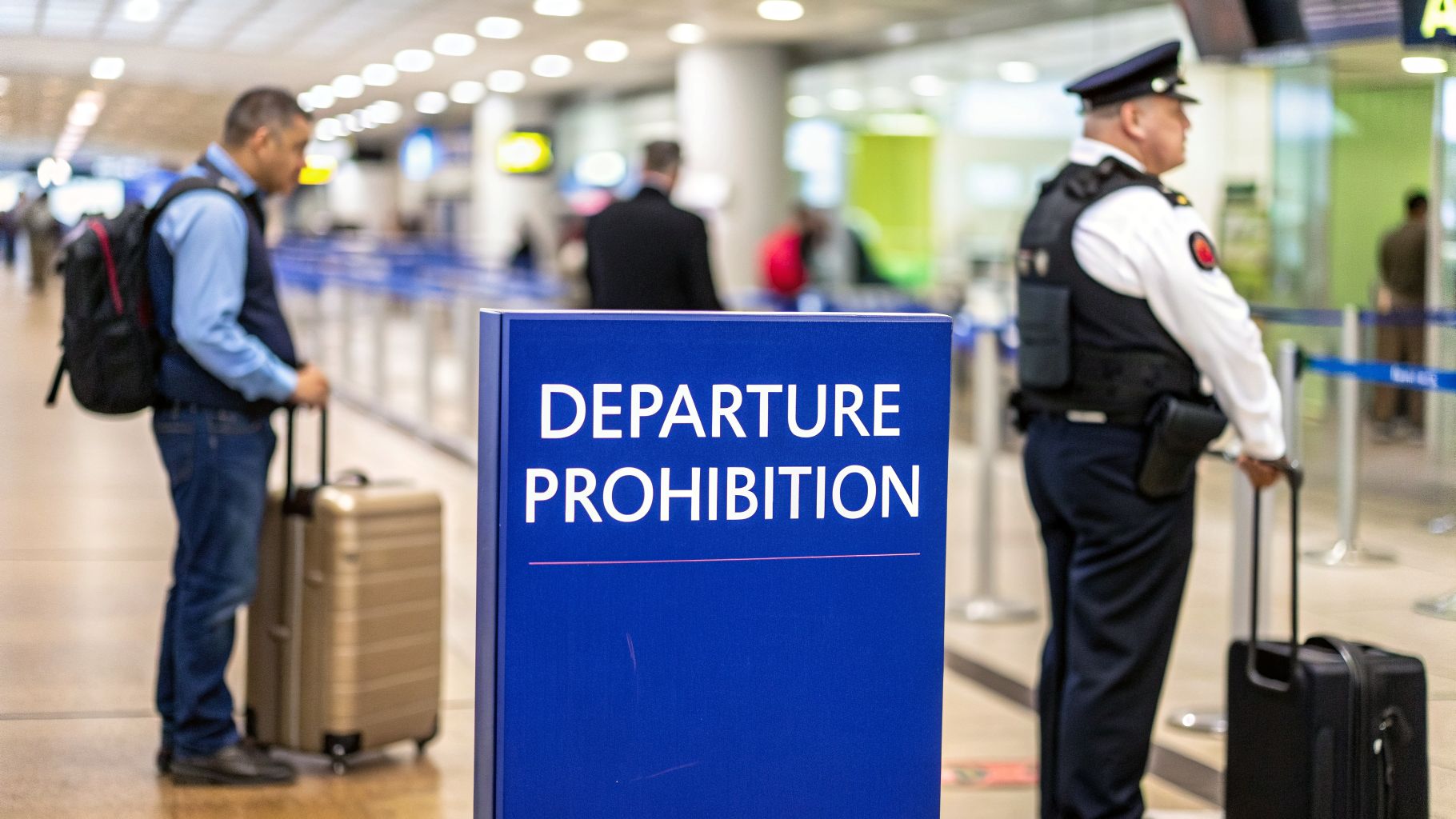
Picture this: your bags are packed, you’re checked in for that long-awaited overseas trip, but when you get to passport control, you’re pulled aside and told you can’t leave the country. This isn’t just a scene from a movie, it’s a real and stressful possibility if you have a serious tax debt, as the ATO can issue a Departure Prohibition Order ATO restriction that prevents you from leaving Australia. The ATO has the power to issue a Departure Prohibition Order (DPO), effectively grounding you in Australia until the debt is dealt with. This guide explains exactly how DPOs work, why they are issued, and what you can do to resolve one and clear yourself for travel.
Can the ATO Stop You at the Airport?
- Yes, the ATO can legally stop you from leaving Australia if you have a significant tax debt.
- This is done using a powerful legal tool called a Departure Prohibition Order (DPO).
- A DPO is issued when you have a tax debt and the ATO believes you are a flight risk.
- If a DPO is active, you will be physically stopped by Australian Border Force at the airport or seaport.
- You can resolve a DPO by paying the debt, entering a formal payment plan, or securing the debt.
- Always seek professional advice and act quickly if you have an outstanding tax debt and plan to travel.
Can the ATO Stop You at the Airport? The Direct Answer
Yes, the Australian Taxation Office (ATO) can legally stop you from leaving Australia at the airport. This is done by issuing a Departure Prohibition Order (DPO). If a DPO is made against you, your details are flagged with the Department of Home Affairs, and Australian Border Force officers will prevent you from departing the country.
This serious enforcement power is granted to the ATO under Part IVA of the Taxation Administration Act 1953. It is used to prevent individuals with tax debts from leaving Australia, especially when the ATO believes that allowing them to depart would jeopardise the recovery of the tax owed.
What is a Departure Prohibition Order (DPO)?
A Departure Prohibition Order ATO is one of the most serious enforcement tools available to the tax office. Itis a formal notice issued by the ATO that makes it illegal for an individual with a tax debt to leave Australia. It is not a punishment but a powerful administrative tool for debt recovery. The core purpose of a DPO is to prevent taxpayers from fleeing the country to avoid their financial obligations.
When a DPO is in place, you are effectively grounded until the tax debt is paid, a suitable payment arrangement is made, or you provide adequate security for the debt.
Who is at Risk?
While anyone with a tax debt could theoretically be subject to a DPO, the ATO typically focuses on cases where the risk of non-payment is high. You are most at risk if you are:
- A company director with outstanding liabilities from a Director Penalty Notice (DPN), such as unpaid PAYG withholding, GST, or superannuation.
- A business owner with a history of poor compliance, such as ignoring ATO notices or failing to lodge returns.
- A high-net-worth individual with a complex or significant tax debt.
- Any individual who has started to move assets offshore while carrying a large tax debt.
The ATO’s decision to issue a DPO is based on a risk assessment. If your actions suggest you might leave Australia permanently without resolving your debt, a DPO becomes highly likely. For a deeper understanding of the ATO’s legal framework, you can read the full guidelines on ato.gov.au, but always remember to check current ATO guidance for the most up-to-date information.
When Does the ATO Issue a Departure Prohibition Order?
A DPO is not issued lightly. It’s usually the culmination of a long period of non-engagement or non-compliance from the taxpayer. The ATO considers both the size of the debt and the individual’s behaviour.
A pattern of avoidance, broken promises on payment plans, or complete radio silence are major red flags for the ATO, suggesting you might be a flight risk.
The ATO has become more aggressive in using DPOs to recover its collectable debt, which now sits in the tens of billions. As of late 2026, the ATO has increased its use of DPOs, signalling a tougher stance on taxpayers who ignore their obligations. Discover more insights about these ATO enforcement trends on salea.com.au.
Key Triggers for a Departure Prohibition Order
The following table outlines the main factors that can lead to the ATO issuing a DPO. It’s crucial to check current ATO guidance for the latest official criteria.
| Trigger | Explanation |
|---|---|
| Large Unpaid Tax Debt | You have a significant outstanding liability (often over $100,000) that has remained unpaid for an extended period. The specific threshold is not public, and the ATO assesses each case individually. |
| Risk of Leaving Australia | The ATO has reasonable grounds to believe you may be planning to leave the country without paying your debt. This can be based on your travel history, asset transfers, or lack of ties to Australia. |
| History of Non-Compliance | You have a clear pattern of ignoring ATO notices, failing to lodge returns, repeatedly defaulting on payment plans, or otherwise failing to engage with the ATO to resolve your debt. |
A DPO is often a predictable outcome based on a history of specific actions (or inactions). If you’re concerned about your situation, understanding other ATO enforcement actions, like whether the ATO can freeze your bank account, can provide further context.
Step-by-Step: How to Remove a Departure Prohibition Order
Discovering you have a Departure Prohibition Order (DPO) is stressful, but it’s not a permanent travel ban. The situation is resolvable, provided you take immediate and proactive steps. Ignoring it is the worst possible course of action.
Here is a step-by-step guide to getting a DPO removed.
- Contact the ATO Immediately: The first and most critical step is to open a line of communication. Either you or your tax professional must contact the ATO to show you are taking the matter seriously and are willing to cooperate.
- Pay the Debt in Full: This is the simplest and quickest way to have the DPO revoked. Once the entire tax liability is paid, the reason for the DPO no longer exists, and it will be cancelled.
- Enter a Formal Payment Arrangement: If paying in full is not an option, you can negotiate a formal payment plan with the ATO. This must be an officially accepted agreement, not just a promise to pay. You can learn more about setting up an effective ATO payment plan in our detailed guide.
- Provide Security for the Debt: In some cases, the ATO may agree to revoke the DPO if you offer sufficient security for the debt, such as a charge or mortgage over a property.
- Formally Apply for DPO Revocation: Once you have paid the debt, entered a plan, or provided security, you must formally apply to the ATO to have the DPO revoked. It is not an automatic process.
- Obtain a Departure Authorisation Certificate (DAC) for Urgent Travel: If you need to travel urgently for a legitimate reason but cannot resolve the debt in time, you can apply for a Departure Authorisation Certificate (DAC). A DAC is a temporary clearance that allows you to leave Australia for a specified period, provided you satisfy the ATO that you will return and the debt is not at risk.
Remember to always check current ATO guidance for the precise forms and procedures required for revocation or DAC applications.
Worked Example: Director Faces a DPO Before an Overseas Trip
Let’s consider a realistic scenario:
- The Situation: Sarah is a director of a small construction company. Due to cash flow issues, her company has an outstanding tax debt of $250,000, consisting of unpaid GST and PAYG withholding from employee wages. The ATO has sent multiple notices, which Sarah has ignored while trying to manage the business.
- The Trigger: Sarah books a family holiday to Fiji. Unbeknownst to her, the ATO’s risk assessment systems flag her as a potential flight risk due to the large debt, her position as a director (making her personally liable via a Director Penalty Notice), and her lack of engagement. The ATO issues a Departure Prohibition Order.
- The Incident: At Sydney Airport, Sarah and her family are stopped at passport control. A Border Force officer informs her that she cannot leave the country due to a DPO. Her holiday is cancelled on the spot, causing immense stress and financial loss.
- The Resolution: Sarah immediately contacts a tax accountant. They engage with the ATO on her behalf and negotiate a formal payment plan for the $250,000 debt. As part of the agreement, Sarah uses a property as security for a portion of the debt. The ATO accepts the arrangement and, upon formal application, revokes the DPO. Sarah is now free to travel, but only after a costly and stressful lesson.
Checklist: Avoid Being Stopped at the Airport
Prevention is always better than cure. Use this simple checklist before planning any international travel to ensure your tax affairs don’t ground you.
- Check for Outstanding ATO Debt: Are all your personal and business tax liabilities paid and up to date?
- Review All ATO Notices: Have you received any letters, emails, or SMS messages from the ATO that you have not responded to?
- Confirm No DPO is Issued: If you have any doubt, contact the ATO (or have your tax agent do so) to confirm your status before booking travel.
- Contact ATO Urgently if You Have a Debt: If you know you have an outstanding debt, engage with the ATO immediately to discuss your options.
- Arrange Payment or a Formal Plan: Ensure any debt is either paid in full or covered by a formal, ATO-accepted payment arrangement that you are complying with.
- Get Clearance in Writing Before Travel: If you have resolved a debt issue, get written confirmation from the ATO that you are cleared to travel before you book any non-refundable flights or accommodation.
Following this checklist can save you from a disastrous and expensive experience at the airport. For those finalising their affairs before leaving Australia, you can explore our tax clearance services in our dedicated guide.
Common Mistakes That Lead to a DPO (and How to Fix Them)
Understanding common pitfalls is the key to avoiding them. Here are the most frequent mistakes that put taxpayers on the ATO’s DPO radar.
| Mistake | The Fix |
|---|---|
| Ignoring ATO letters and phone calls. | Respond early and honestly. Silence is interpreted as avoidance. Engaging with the ATO shows you are taking responsibility, which significantly lowers your risk profile. |
| Assuming a “small” debt is safe. | Understand that risk depends on behaviour. The ATO is more concerned with a pattern of non-compliance than a specific dollar amount. Even a smaller debt can lead to a DPO if you consistently ignore it. |
| Booking travel without getting clearance. | Confirm your status first. Before spending money on non-refundable flights or hotels, confirm with the ATO that you are clear to travel. A simple phone call can prevent thousands of dollars in losses. |
| Delaying negotiation until it’s too late. | Act immediately. The moment you know there’s a problem, start the negotiation process. The ATO is far more willing to work with taxpayers who are proactive, not those who are forced to act at the airport departure gate. |
ATO Enforcement Powers: DPO vs. Other Actions
A DPO is one of the most severe actions the ATO can take, but it’s part of a broader spectrum of enforcement powers. Understanding where it fits in can help you appreciate its seriousness.
| Action | Severity | Description |
|---|---|---|
| Reminder Notice | Low | An initial letter or SMS from the ATO reminding you of an overdue payment or lodgment. |
| Garnishee Notice | Medium | A legal notice sent to your bank or employer, requiring them to send money from your account or wages directly to the ATO to pay your debt. |
| Departure Prohibition Order (DPO) | Severe | A legal order that prevents you from leaving Australia until a tax debt is resolved. This is a last resort for high-risk cases. |
Frequently Asked Questions
Can the ATO stop me at the airport?
Yes, absolutely. If the ATO has issued a Departure Prohibition Order (DPO) against you for an unpaid tax debt, Australian Border Force officers have the legal authority to stop you from boarding an international flight or ship.
How much tax debt triggers a DPO?
There is no specific dollar threshold. DPOs are generally used for significant tax debts, often over $100,000, but the ATO’s decision also heavily depends on your compliance history and whether they consider you a flight risk.
Can I travel overseas if I have an ATO payment plan?
Yes, you can usually travel if you have a formal payment arrangement in place with the ATO and you are complying with its terms. A compliant payment plan demonstrates to the ATO that you are addressing the debt, reducing the need for a DPO.
How long does a DPO last?
A DPO remains in effect indefinitely until it is formally revoked by the ATO. It does not expire. Revocation only occurs after you have paid the debt, entered an approved payment arrangement, or successfully appealed the order.
Can I appeal a DPO?
Yes, you have the right to appeal a DPO. You can object to the ATO’s decision through an internal review or by applying to the Administrative Appeals Tribunal (AAT) or the Federal Court. This is a complex legal process, and you should seek professional advice.
What is a Departure Authorisation Certificate (DAC)?
A Departure Authorisation Certificate (DAC) is a temporary clearance that allows you to leave Australia for a specific period, even if a DPO is in place. You must apply for a DAC and satisfy the ATO that your travel is for a legitimate reason and that the tax debt is not at risk.
Take Control of Your Tax Situation and Travel Plans
The threat of being stopped by Border Force is a serious and growing reality for Australians with significant tax debt. A Departure Prohibition Order (DPO) is not a bluff; it is a powerful legal instrument the ATO is increasingly using to secure government revenue.
However, a DPO is a consequence of inaction. It is what happens when a tax problem is ignored. By facing the issue head-on, communicating with the ATO, and seeking professional guidance, you can find a clear path to resolution. It is entirely possible to manage your debt, protect your freedom to travel, and regain control of your financial future.
Don’t wait until your passport is scanned at the airport to deal with a tax problem. For expert, confidential guidance on managing tax debts and navigating the ATO, book a consultation with Nanak Accountants & Associates today. Call us on 1300 NANAK TAX (626 258) or get in touch online.
