
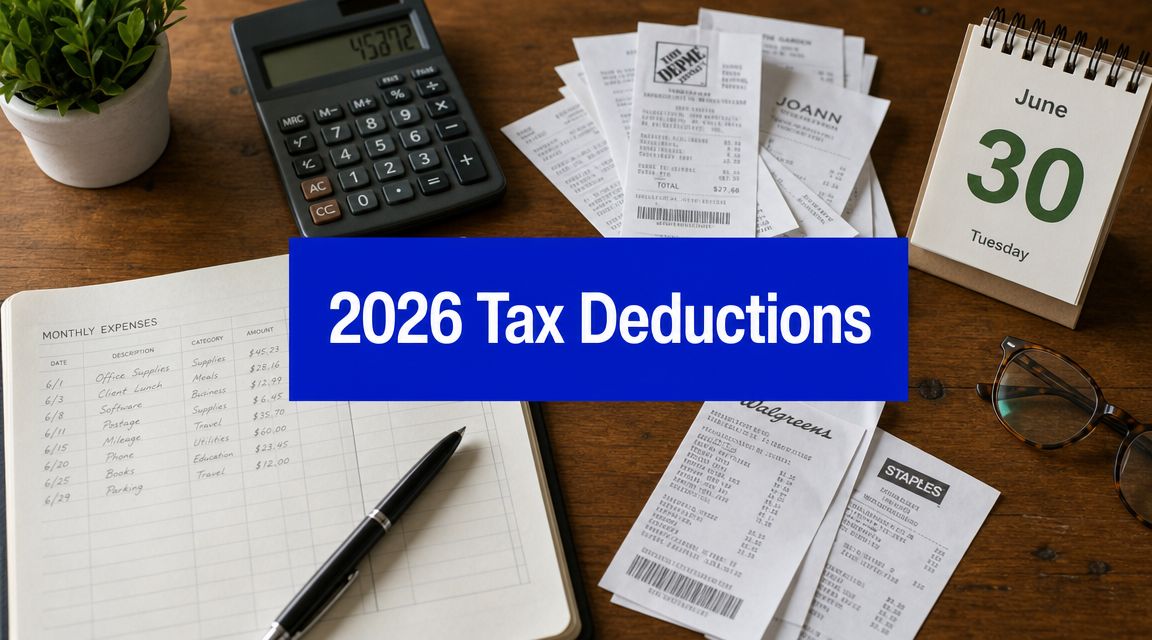
EOFY usually starts the same way. You open a folder of receipts, look at your bank statements, and wonder which expenses are claimable and which ones will create trouble later.
That’s where most tax problems begin. Not because people are dishonest, but because they assume common expenses must be deductible if they “feel work-related”. In Australia, that’s not enough. If you’re searching for practical guidance on EOFY tax deductions Australia rules for the 2026 tax year, the safest approach is to work from the ATO’s logic, not from hearsay.
Understanding How EOFY Tax Deductions Work in Australia
A tax deduction reduces your taxable income. It doesn’t mean the ATO pays you back the full cost of what you spent. That’s why buying something just to “get a deduction” rarely makes sense unless you already needed it for work or business.
The starting point is simple. The expense must be directly connected to earning assessable income. The ATO also requires that you spent the money yourself, weren’t reimbursed, and kept records such as receipts or logs. That rule sits at the centre of almost every deduction dispute, and it’s set out in the ATO’s guidance on deductions you can claim.
The three rules that decide most claims
If a client asks me, “Can I claim this?”, I usually test it against three questions:
- Did you pay for it yourself? If your employer reimbursed you, it’s generally not your deduction.
- Did it help you earn income in your current work or business? Personal benefit alone won’t carry the claim.
- Can you prove it? Receipts, invoices, diary notes, logbooks, and digital records matter.
Practical rule: If you can’t show the work connection and you can’t show the evidence, the claim is weak no matter how common it sounds.
For taxpayers looking at tax deductions 2026 Australia rules, the safest habit is to review the expense before 30 June, not after. That gives you time to organise paperwork, separate mixed-use costs, and avoid last-minute guessing.
14 EOFY Tax Deductions You Can Claim for 2026
Some deductions are straightforward. Others are only partly deductible because they contain both work and private use. That’s where many returns go wrong.
Quick Guide to Common Tax Deductions
| Deduction | Claimable? | Notes |
|---|---|---|
| Work from home expenses | Yes | Must keep records |
| Car expenses | Yes | Work-related only |
| Everyday clothing | No | Unless occupation-specific |
| Self-education | Yes | Must relate to income |
| Fines and penalties | No | ATO disallows claims |
| Tools and equipment | Yes | Subject to ATO rules |
Work from home expenses
If you work from home, you may be able to claim eligible running costs and some work-related equipment. The key issue is evidence. You need records that support the hours worked and the expenses claimed.
This area gets overclaimed because people treat general home living costs as automatically deductible. They aren’t. Only the work-related portion is relevant. Check current ATO guidance.
Car and travel expenses
Car expense deductions in Australia are one of the most misunderstood claims. Travel for work can be deductible, but ordinary travel between home and your regular workplace is usually private.
You need to separate valid work trips from personal driving. If your car use is mixed, your records need to show the business portion clearly. Check current ATO guidance.
Mobile phone and internet
If you use your phone or internet for work, you may claim the work-related share. That means apportionment matters. A full claim is rarely appropriate unless the service is used only for income-producing purposes.
This is a classic mixed-use expense. The stronger your usage records, the easier it is to support the claim. Check current ATO guidance.
Self-education courses
Self-education can be deductible where it maintains or improves skills for your current income-earning activities. The connection to your present role matters more than the course title.
If the study is really about moving into a new field, the claim becomes much harder to support. Check current ATO guidance.
Union fees
Union fees are commonly deductible where they relate to your employment. They’re usually simple claims if you’ve paid them personally and kept the annual statement or receipt.
This is one of the easier EOFY deductions for individuals, but it still needs documentation. Check current ATO guidance.
Tools and equipment
Tools used for your job can be deductible if they’re connected to your work. Tradies, technicians, healthcare workers, and other hands-on roles often have valid claims here.
The main issue is private use. If the item is also used privately, the claim should reflect only the work portion. Check current ATO guidance.
Home office equipment
A laptop, desk, monitor, keyboard, office chair, or printer may be claimable where there is a genuine work connection. Employees and sole traders often assume that because the item sits at home, it falls under a “home office” category automatically. That isn’t the actual test. The question is whether it was bought and used for earning income.
For mixed-use equipment, apportionment is critical. A laptop used for client work and streaming at night isn’t fully deductible on that fact pattern alone. Check current ATO guidance.
Accounting fees
Fees paid for tax return preparation, tax advice, bookkeeping support, and related accounting services are often deductible where they relate to your tax affairs or business operations. For many clients, this is one of the most overlooked claims because the invoice is sitting in an email folder instead of a receipt app.
This category matters for both employees and business owners. It also includes many of the costs associated with getting the return right the first time. Check current ATO guidance.
Good tax work doesn’t just identify deductions. It also removes weak claims before they become expensive.
Donations
Donations can be deductible if they meet the ATO requirements. The practical issue is that not every payment called a “donation” qualifies, and not every organisation will support a valid deduction.
Keep the receipt and confirm the payment is eligible before claiming. Check current ATO guidance.
Uniforms and protective clothing
This area catches people out every year. Protective clothing and occupation-specific items can be claimable. Ordinary clothing is generally private, even if you only wear it to work.
That means high-vis gear, protective boots, or specialist workwear may be different from black pants, suits, and everyday shoes. Check current ATO guidance.
Rental property expenses
Rental property deductions can include eligible expenses connected to earning rental income. What matters is the link to the property’s income-producing use and the quality of your records.
Owners should keep invoices, loan statements, agent summaries, and repair records organised from the start of the year. This is one of the most document-heavy parts of tax return deductions Australia work. Check current ATO guidance.
Sole trader expenses
For sole traders, deductible expenses often include ordinary running costs used to generate business income. The rule is still the same as it is for employees. The expense must connect to earning assessable income, and private use must be excluded.
That includes common operating expenses such as software, office consumables, phone use, professional services, and business-related travel where properly substantiated. Check current ATO guidance.
Instant asset write-off
Many business owners ask about the instant asset write-off 2026 before buying equipment near year-end. The tax outcome depends on the specific rules, eligibility, timing, business structure, and whether the asset is used in the business.
Because these settings can change and the treatment is technical, this isn’t an area for assumptions. Get the facts before purchase, not after. Check current ATO guidance.
Depreciation deductions
Not every asset is claimed all at once. Some items are instead deducted over time through depreciation, depending on the rules that apply to the asset and the taxpayer.
This commonly affects business equipment, office assets, and property-related items. Depreciation can still be valuable, but the records need to identify what was purchased, when it was first used, and how it was used. Check current ATO guidance.
Common Tax Deduction Mistakes and What You Cannot Claim
The biggest EOFY errors usually come from confidence, not complexity. Someone assumes an expense must be deductible because it helped them do their job more comfortably or because other people claim it.
Mistakes and fixes
- Claiming personal expenses
Fix it by claiming only costs with a real income connection. Private living costs stay private, even if work benefits from them in some indirect way. - No receipts or weak evidence
Fix it by storing digital copies of invoices, statements, and logs as you go. Reconstructing a year of spending in July is where many bad claims start. - Overclaiming car expenses
Fix it by keeping proper travel records and separating work trips from private travel. The daily commute is a common problem area. - Guessing the work-use percentage
Fix it by using records that support your apportionment. Phone, internet, laptop, and home office claims all need a basis.
Expenses the ATO commonly disallows
Some claims are regularly rejected because they fail the basic deduction test:
- Everyday clothing such as suits, black pants, standard shoes, or office wear
- Fines and penalties
- Private travel, including ordinary home-to-work commuting
- Personal expenses with no direct income link
- Gym memberships and general fitness costs
- Personal grooming such as haircuts and cosmetics
If an expense is mainly private, calling it “work-related” on a tax return won’t change its character.
For anyone asking what can I claim on tax, the safest answer is this: claim what you can prove, not what sounds familiar. That approach also helps avoid common ATO tax deductions red flags such as rounded estimates, duplicated expenses, and unsupported mixed-use claims.
Your Essential Guide to Audit-Proof Record-Keeping
A Brisbane marketing consultant is a good example of how this works in real life. They work partly from home, use a laptop for client campaigns, rely on a mobile phone for calls and approvals, and pay accounting fees each year to prepare their return. None of those claims are automatic.
The difference is documentation. They keep digital receipts, save invoices in labelled folders, separate business-related costs from private spending, and retain evidence for work use. That record trail makes the claims easier to prepare and easier to defend.
Worked example
The consultant keeps:
- Home office records showing when they worked from home
- Laptop purchase evidence with clear work purpose
- Phone records that support business use
- Accounting invoices tied to tax return preparation
- Digital storage so documents aren’t lost at EOFY
Because the records are organised, the return is built from evidence rather than memory. That’s how you reduce review risk.
If you want a practical way to streamline document handling, it helps to discover how receipt scanning apps work. For businesses and sole traders that need ongoing support, structured bookkeeping also makes a difference, especially when records are maintained throughout the year rather than rebuilt at tax time through bookkeeping support.
EOFY record-keeping checklist
- Keep receipts and invoices for every claim you intend to make
- Separate personal and business expenses across bank accounts or categories
- Track work-related travel with a diary, app, or logbook
- Review bank statements before lodging your return
- Download ATO records and compare them with your own documents
- Confirm eligibility before claiming any mixed-use or unusual item
- Use accounting software or digital folders to stay organised
- Lodge before deadlines and don’t leave substantiation until the last week
Records don’t just support deductions. They often decide whether the deduction survives scrutiny.
Key Deductions for Small Businesses and Sole Traders
A common June mistake is assuming an expense is deductible solely because the money left your account before year end. For small businesses and sole traders, the year of claim often depends on when the expense is incurred, when an asset is first used or installed ready for use, or when a contribution is received by the fund.
That distinction matters most at EOFY. I regularly see business owners buy software subscriptions, replace equipment, or make super contributions in the final week of June, then assume the deduction automatically falls into that financial year. Sometimes it does. Sometimes it does not. The difference usually comes down to timing and paperwork.
Where business owners usually get value
The strongest deduction areas are usually the ordinary costs of running the business. That includes software, phone and internet, merchant fees, insurance, bookkeeping, accounting, and other professional services tied to earning business income.
Equipment can also be deductible, but the treatment depends on the asset, its cost, and whether it is being claimed outright or through depreciation. A laptop bought for business use is straightforward if the invoice, payment record, and business purpose are clear. Mixed-use items need apportionment.
Super contributions are another area worth checking carefully. For a deduction to apply in a given financial year, the complying fund must receive the contribution by the 30 June deadline for that year. Sending payment in late June is not enough if the fund processes it in July. The ATO explains the timing issue in its guidance on when to pay super contributions.
Practical EOFY points for sole traders
If you are planning year-end deductions, leave enough time for processing. Bank transfer screenshots help, but they do not replace fund confirmation, supplier invoices, or records showing when an asset was installed ready for use.
Sole traders should also review how the business is set up administratively. Clean records, separate business spending, secure file storage, and limited access to accounting systems make tax time easier and reduce problems if the ATO asks questions later. Cyber risk belongs in that review too, especially if you store client records digitally. The EOFY cyber security checklist for small businesses is a practical place to start.
If you operate on your own account and want help with setup, deductions, and ongoing compliance, practical guidance for sole trader tax and bookkeeping support can help keep the business side clean before lodgment.
Frequently Asked Questions about 2026 Tax Deductions
What can I claim on tax in 2026?
You can generally claim expenses that are directly connected to earning your income, that you paid for yourself, and that you can substantiate. Mixed-use items need to be apportioned properly.
Can I claim work from home expenses?
Yes, if your work from home arrangement and records support the claim. The method and evidence matter, so check current ATO guidance before lodging.
Are gym memberships tax deductible?
Usually no. Gym costs are commonly treated as private expenses, even where general fitness helps you perform your work.
Can I claim my laptop?
You may be able to if the laptop is used for work or business. If the use is mixed, only the work-related portion should be claimed.
What deductions trigger ATO audits?
Unsupported claims are the main issue. Overclaimed car expenses, weak work-from-home records, guessed percentages, and personal items described as work-related all attract attention.
Can sole traders claim more deductions?
Sole traders often have access to a broader range of business-related expenses than employees, but only where the expense relates to earning business income. Private spending still isn’t deductible.
Are accountant fees deductible?
They often are where they relate to tax return preparation, tax advice, or business accounting support. Keep the invoice and payment evidence.
What records do I need to keep?
Keep receipts, invoices, statements, diary notes, and any logs that support the claim. For mixed-use expenses, keep records that explain how you worked out the business or work portion.
Can I claim regular work clothes?
Usually no. Standard clothing remains private unless it falls into a recognised deductible category such as protective or occupation-specific clothing.
Maximise Your Refund with Expert Help
Tax deductions are valuable, but weak claims can cost more than they save. An EOFY win is a return that is both complete and defensible.
If you want help reviewing deductions, separating private from work-related spending, and planning ahead before lodgment, professional tax planning support can make the process far cleaner. Structured year-end advice is available through tax planning services.
Need help maximising EOFY deductions and staying ATO compliant? Contact Nanak Accountants and Associates on 1300 NANAK TAX (626 258) for support with individual returns, sole trader claims, rental property deductions, bookkeeping, and EOFY tax planning.
