
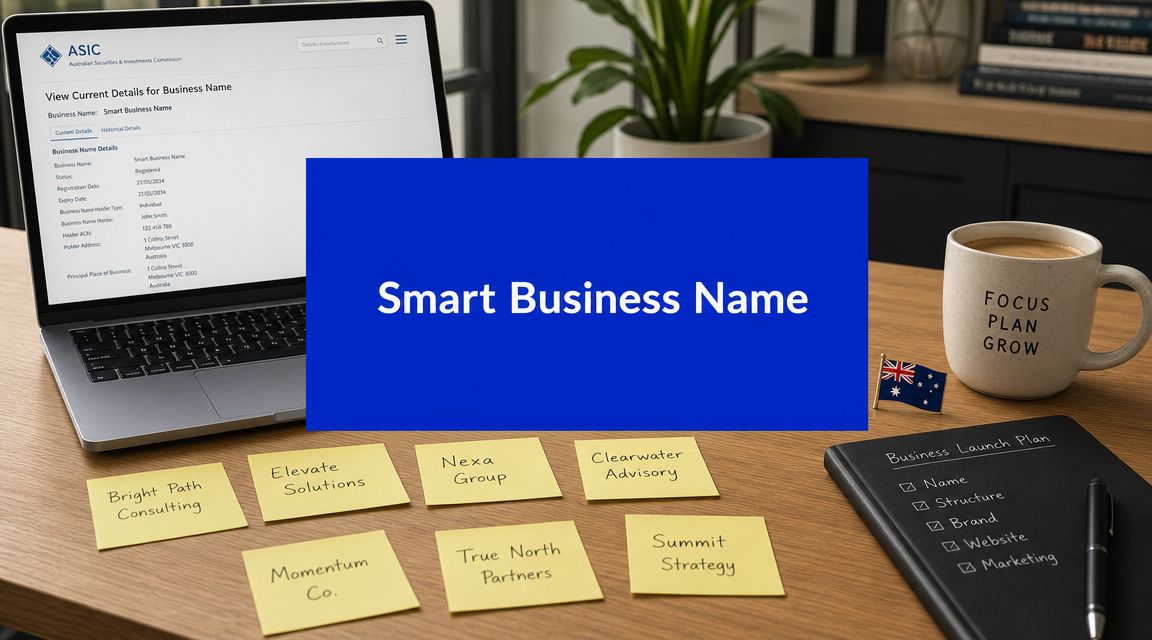
Choosing a name often feels like the fun part of starting a business. Then the practical questions hit. Is it available, does it need ASIC registration, can you use it with your ABN, and what happens if someone else already has the trade mark?
How to Choose a Business Name in Australia (Examples and Pitfalls to Avoid) comes down to more than creativity. In Australia, naming is a branding decision, a compliance decision, and a risk decision. Get it right and the name supports marketing, trust, and growth. Get it wrong and you can end up with registration issues, branding conflicts, domain problems, or an expensive rebrand.
This guide takes the accountant’s view. Clear process first, excitement second. That usually saves money.
How to Choose a Business Name in Australia (Examples and Pitfalls to Avoid)
If you’re sitting with a notebook full of ideas, that’s normal. Most owners start with what sounds good, then realise the ultimate test is whether the name works legally, commercially, and online.
A practical Australian approach is to treat naming as a risk-managed selection process. You want a name that customers can say, spell, and remember. You also want a name that fits your structure, matches your ABN setup, can be registered properly, and doesn’t create obvious problems with trade marks or digital branding.
A legally available name can still be a bad business name. It might be too generic, too narrow, hard to pronounce, or awkward once you try to build a website and brand around it.
The safest path is simple. Choose carefully, check precisely, and register only after the right searches.
Key Naming Rules You Cannot Ignore
Business names and company names aren’t the same thing. A trading name, legal entity name, and trade mark each do different jobs.
ASIC registration doesn’t give you ownership rights in the brand. It records the business name for trading purposes.
Trade mark and domain checks matter. A name that looks available on one register can still cause trouble elsewhere.
Simple beats clever. Easy spelling and broad relevance usually age better than gimmicky names.
Narrow names create future costs. A suburb-based or service-specific name can force a rebrand later.
ABN setup matters early. Your business name registration is tied to the ABN holder.
What Is a Business Name in Australia
A business name is the name you trade under. In Australia, it’s registered with ASIC and tied to the ABN holder. It does not create a separate legal entity by itself.
That’s the point many new owners miss. If you trade under your own personal name, business.gov.au says you may not need to register a separate business name. If you trade under anything different, you usually need to register that trading name.
What a business name does
A business name lets the public see who is behind the business. It creates a formal trading identity on the register.
What it doesn’t do is equally important. It doesn’t give you automatic brand ownership. It doesn’t replace a company registration. It doesn’t replace a trade mark.
Why this matters early
A lot of setup mistakes happen because owners assume the first registration covers everything. It doesn’t. If you separate the ideas early, the rest of the process becomes much cleaner.
Why Choosing the Right Business Name Matters
A name affects more than your logo. It shapes how people find you, remember you, and judge whether you look credible.
Branding and trust
A clear name sounds organised. A messy or confusing name often makes the business look less established, even when the work is excellent.
Names also create expectations. If the name sounds too cheap, too broad, or too gimmicky, it can attract the wrong clients or weaken trust before you’ve had a chance to speak to them.
Search and growth
Online discovery matters. If people can’t spell your name, they’ll struggle to find your site or refer you to others. If the name is too generic, it becomes harder to stand out in search results and branding.
Compliance and rework
Poor naming creates admin pain. You might need to change domains, redesign signage, update invoicing details, and correct records across platforms. That’s why careful naming at the start is usually cheaper than fixing a rushed choice later.
Business Name vs Company Name vs Trademark
Many founders assume a registration gives them ownership rights. It doesn’t. Business.gov.au makes it clear that a business name is different from a trade mark, and that you don’t need to register a business name if you trade under your own name. It also highlights the need to check ASIC, IP Australia, domains, and social handles separately before launch through its guidance on choosing a business name.
| Feature | Business Name | Company Name | Trademark |
|---|---|---|---|
| Purpose | Trading identity | Legal entity name | Brand protection |
| Registered with | ASIC | ASIC | IP Australia |
| Legal ownership protection | Limited | Limited | Stronger rights |
| Public register | Yes | Yes | Yes |
Check current ASIC and IP Australia guidance.
The practical difference
A business name is what customers see when you trade. A company name is the legal name of the entity, such as a Pty Ltd company. If you’re setting up a company structure, this guide to registering a company is the relevant starting point.
A trade mark sits in a different category. It’s the protection tool for the brand itself. That’s why business owners shouldn’t stop at ASIC availability and assume they’re safe.
How to Choose a Great Business Name
Good names usually do three jobs at once. They’re distinctive, they leave room for growth, and they fit the rules.
A sound naming brief should prioritise distinctiveness, scalability, and regulatory fit. A common Australian pitfall is choosing a descriptive or geographically narrow name such as “Ballarat Discount Tyres”, which can limit future growth. Exact spelling, spacing, and punctuation also matter to ASIC’s systems, as explained in this guidance on choosing the perfect business name.
What tends to work
Names work better when they are:
- Easy to say so customers can repeat them without hesitation
- Easy to spell so they can find you online
- Relevant without being restrictive so the name hints at the business without boxing you in
- Clean in presentation so the website, invoices, and signage all look consistent
What usually fails
These patterns cause problems fast:
- Overly descriptive names that sound like everyone else
- Suburb-locked names when you plan to expand
- Clever spellings that customers won’t guess correctly
- Misleading names that suggest services, status, or affiliation you do not have
Practical rule: if the name only works for your first service, first location, or first year in business, it probably isn’t the right name.
How to Check and Register Your Business Name
The most reliable workflow in Australia is a three-layer clearance process. Choose your structure and get an ABN if needed, check the exact name on ASIC’s register, then run a separate trade mark search before launch. ASIC also states that registering a business name only records the trading name and doesn’t guarantee exclusive brand rights in its guidance on registering a business name.
1. Brainstorm name ideas
Start with a shortlist, not one favourite. Include a mix of brandable options and clear service-linked options. Say each one aloud and test whether someone could spell it after hearing it once.
2. Search ASIC availability
Check the exact version you want to use. Small differences in punctuation or spacing can matter, so don’t assume a close variation will pass.
3. Check domain name availability
Before you get attached, see whether a matching or sensible domain is available. For a practical overview of domain choices in Australia, this guide on how to choose an Australian domain is useful.
4. Search IP Australia trade marks
This step is where many owners cut corners. Don’t. A business name search and a trade mark search are different checks.
5. Confirm ABN eligibility
Your registration links back to the ABN holder, so structure comes first. If you haven’t sorted that yet, start with ABN registration.
6. Register the business name
ASIC says business names can be registered through the Business Registration Service or ASIC’s online system. Enter the exact name carefully. If your market-facing brand differs from the legal entity name, register that variation properly.
7. Secure branding and digital assets
Once registered, secure the domain, key social handles, and your brand files promptly. If you want help with the admin side, Nanak Accountants & Associates is one option for business setup support including registration assistance.
The application itself isn’t usually the hard part. The hard part is getting the details right early enough that settlement isn’t put under pressure.
Business Name Examples Good vs Bad
A name doesn’t need to be flashy. It needs to be usable.
- Too generic
Bad: Sydney Cleaning Services
Better: Harbour Shine Cleaning
The second is easier to brand and remember. - Too narrow
Bad: Richmond Only Plumbing
Better: Richmond Flow Plumbing
The first blocks growth. The second keeps a local signal without boxing the business in. - Hard to spell
Bad: Kwyk Kutz Studio
Better: Quick Cut Studio
Clever spelling usually creates friction. - Too broad and vague
Bad: Aussie Solutions Group
Better: Summit Bookkeeping Co
Customers should have some idea what you do.
If you want a plain-English walkthrough of the process itself, this article on understanding legal business name registration gives a general overview, but always confirm the current Australian rules through official registers before lodging anything.
Worked Example Melbourne Landscaping Business
A sole trader in Melbourne wants a name for a new landscaping business. The first shortlist includes Melbourne Gardens, Southside Lawn Help, and Evergreen Outdoor Spaces.
Why one name was rejected
Melbourne Gardens sounds clear, but it’s too generic. It doesn’t stand out, and it gives the owner very little brand personality to work with. It also leans heavily into one broad phrase that many similar operators might want.
Southside Lawn Help has a different problem. It’s too narrow. If the owner later adds paving, irrigation, planting design, or maintenance outside the south side, the name starts working against the business.
Why the final name worked better
Evergreen Outdoor Spaces is the stronger choice. It’s easier to brand, broad enough to support landscaping beyond lawns, and still relevant to what the business does. It also leaves room for future services such as garden design, decking, or outdoor improvements.
From a local SEO point of view, the business can use Melbourne in page titles, service pages, and Google Business content without locking the actual business name to a single suburb or generic phrase. That’s usually a healthier long-term position.
Common Business Name Mistakes to Avoid
ASIC’s rules prohibit names that imply false government affiliation, use certain restricted expressions, or are likely to offend. Business.gov.au also advises testing names for negative meanings in other cultures and avoiding names that are too narrow, generic, or hard to pronounce. The core lesson from ASIC’s rules for acceptable company names is simple. Legal availability isn’t the same as commercial quality.
- Mistake: Choosing a name without checking trade marks.
Quick Fix: Search IP Australia before registering the business name. - Mistake: Using hard-to-spell words or novelty spelling.
Quick Fix: Pick the version customers will type correctly the first time. - Mistake: Copying a competitor’s style too closely.
Quick Fix: Choose a name that is clearly distinct in sound and presentation. - Mistake: Forgetting domain and social handle checks.
Quick Fix: Check digital branding at the same time as the ASIC search. - Mistake: Choosing a generic name that says everything and nothing.
Quick Fix: Use a name with some character and some relevance. - Mistake: Confusing company registration with business name registration.
Quick Fix: Match the trading name, legal entity, and registrations properly.
Your Business Name Checklist
Use this before you commit to any name:
- ASIC availability checked
- Domain secured
- Trade mark search completed
- ABN ready
- Social handles checked
- Name easy to spell
- Branding scalable
Add one final check of your own. Ask whether the name still makes sense if the business grows into new services, new suburbs, or a company structure later.
Australia-Specific Compliance Considerations
Australian naming compliance starts with the structure. If you need a separate trading name, you’ll usually need an ABN and a properly linked business name registration. If you’re still deciding whether to operate as a sole trader, company, or trust, structured advice on business structuring can prevent mismatches later.
Points owners often miss
- ASIC business name rules: A name can be rejected if it’s identical or nearly identical to an existing one, or if it breaches naming restrictions.
- ABN requirements: The business name is tied to the ABN holder, not to a separate stand-alone identity.
- IP Australia checks: A business name registration is not a substitute for trade mark protection.
- auDA domain eligibility: Your domain choice should line up with your business details and eligibility requirements.
- Restricted or misleading words: Avoid names that imply government, royal, or institutional links that don’t exist.
- Record-keeping obligations: Keep your registration details, entity records, and branding consistent across documents.
Check current ASIC, IP Australia and auDA guidance.
Frequently Asked Questions
How do I choose a business name in Australia?
Start with a shortlist that is easy to say, easy to spell, and broad enough to grow with the business. Then check ASIC availability, domain options, and trade marks before registering anything.
Is a business name the same as a company?
No. A business name is a trading identity. A company is a legal entity with its own registered name.
Do I need to trademark my business name?
Not every business does, but relying only on business name registration can leave a gap in brand protection. If the name is important to your long-term brand, a trade mark check should be part of the decision.
Can two businesses have the same name?
ASIC can reject names that are identical or nearly identical. Similarity issues can also arise outside ASIC when branding and trade marks are involved.
How do I check ASIC business name availability?
Search the proposed name exactly as you intend to use it. Don’t rely on rough matches or assumptions about minor formatting differences.
Can I change my business name later?
Yes, but changing a name later often means extra admin, branding changes, and possible disruption. It’s usually better to choose carefully at the start.
Do I need an ABN first?
In many cases, yes. The business name is tied to the ABN holder, so your structure and ABN setup should be sorted early.
What names are restricted in Australia?
Names can be refused if they are misleading, offensive, or imply a government, royal, or institutional connection that doesn’t exist. Certain expressions are restricted.
Should my business name include my location?
Sometimes. A location can help with local relevance, but it can also limit expansion if you outgrow that area. Use it only if it fits your long-term plan.
Can accountants help register business names?
Yes. Accountants often help with structure selection, ABN setup, and registration admin so the trading name aligns with the entity and tax records.
If you want help choosing the right structure, checking naming risks, and handling the registration process properly, book a consult with Nanak Accountants and Associates. Book a consult with Nanak Accountants & Associates, 1300 NANAK TAX (626 258).
This article provides general information only for Australia. It doesn’t consider your objectives, financial situation or needs. ASIC business name rules, trademark requirements and registration obligations can change, check current ASIC, IP Australia and auDA guidance and seek professional advice before acting.
