
You’ve registered an ABN, opened a business bank account and started trading. Then a government form asks for your ANZSIC code, and the options seem to describe industries rather than the service you provide. The confusion becomes greater when a tax return asks for a five-digit ATO Business Industry Code.
These codes are related, but they aren’t the same thing. Choosing the right classification means looking at your real business activity, keeping your ABR details current and checking whether the form requires a four-digit ANZSIC class or an ATO code.
What Is an ANZSIC Code and Why It Matters
ANZSIC stands for Australian and New Zealand Standard Industrial Classification. It’s the shared framework used by the Australian Bureau of Statistics and Statistics New Zealand to group businesses according to their industry and main business activity. The ABS explains that ANZSIC classifies activity descriptions into a four-digit class code. You can review the official ABS ANZSIC classification when you need to confirm a classification.
A business encounters an ANZSIC code during ABN registration, when updating business details and when completing some government reporting. The classification supports a common statistical framework across Australia and New Zealand, so government agencies can organise industry information consistently.
Why accuracy matters
Your ANZSIC business code should describe what the business does. It isn’t a label for your profession, business name or preferred marketing category. Accurate classification can support government records, statistical reporting, benchmarking and programs where industry information is relevant.
It also helps to separate ANZSIC from other registration identifiers. An ANZSIC code classifies an activity, while an ABN identifies a business entity or enterprise. If you’re comparing industry classifications with transport-related registration terminology, the explanation of what is an MC number provides useful context about why different government identifiers serve different purposes.
The ABS says ANZSIC 2006 was first published in February 2006, with revision 2.0 released on 26 June 2013. It remains the current Australian and New Zealand standard cited by the ABS.
Understanding the ANZSIC Code Structure
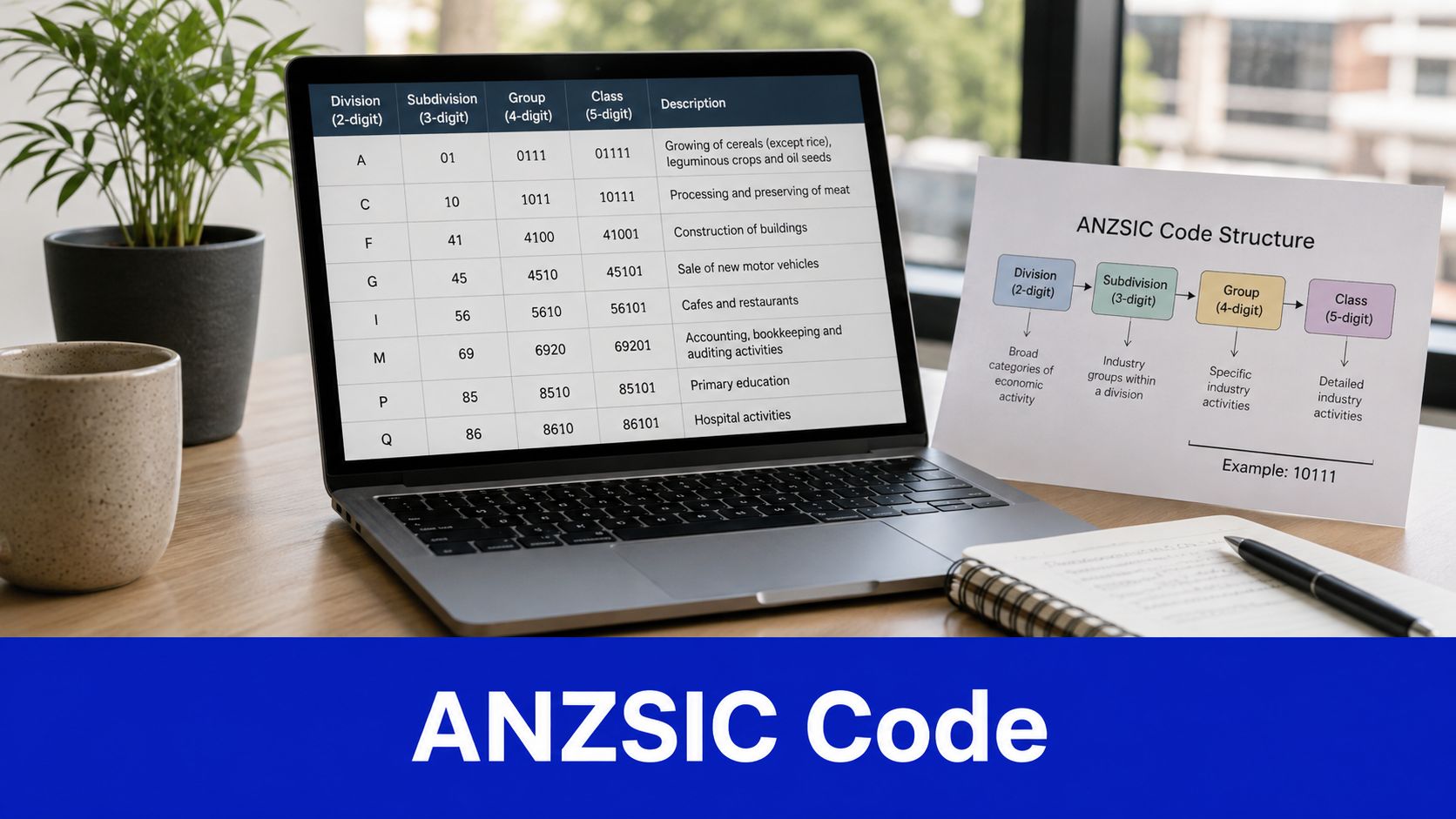
ANZSIC works as a hierarchy. It begins with a broad industry division and narrows through subdivision, group and class. The class level is generally four digits, and that level provides the detailed description most businesses need when identifying their activity.
The structure looks like this:
| Level | Format | Example | Description |
|---|---|---|---|
| Division | Letter | A | Broad industry division |
| Subdivision | Two digits | 01 | More specific industry area |
| Group | Three digits | 011 | Related activities within the subdivision |
| Class | Four digits | 0111 | Detailed industry activity |
The letters and codes are read as a progression from broad to specific. For example, a business may sit within a broad division covering agriculture, forestry and fishing, then move into a more focused subdivision, group and class based on the activity it performs. The precise class must be checked in the ABS material rather than inferred from a similar-sounding label.
Practical rule: classify the activity performed by the business, not the description that sounds most familiar.
ANZSIC 2006 contains 19 divisions, 86 subdivisions, 214 groups and 506 classes, as described in the ANZSIC reference material available through the ANZSIC code classification overview. That scale allows official reporting and analysis to distinguish broad sectors from detailed business activities.
A business shouldn’t select a class merely because it contains a familiar word such as “services”, “retail” or “construction”. Read the class description, included activities and exclusions. That process reduces the risk of selecting a code that misrepresents the main business activity.
How to Find Your ANZSIC Code Step by Step
A reliable ANZSIC code lookup starts with the business activity, not the form field. Use the following process for an ANZSIC code search.
- Identify your main business activity. Decide what the business mainly does now, rather than what it originally intended to do.
- Describe the work in plain language. Write a short description of the products supplied or services performed. “Provides bookkeeping services to small businesses” is more useful than “consultant”.
- Search the official ABS classification. Use the ABS ANZSIC material and search for the activity, product or service that best describes the work.
- Review possible industry classes. Compare more than one result if the activity could fit across several industries.
- Read the class description and included activities. The detailed wording often separates similar activities that appear interchangeable at first.
- Check exclusions where relevant. An exclusion can direct you to another class, so don’t stop at the first familiar result.
- Select the classification that best reflects the activity. As a practical accounting rule, the description should align with the activity generating the most gross income, rather than a generic label.
- Check whether an ATO Business Industry Code is required. A tax return or schedule may ask for a five-digit BIC instead of the four-digit ANZSIC class.
- Seek guidance if activities cross several industries. Classification can be less obvious where a business provides distinct professional, retail, care or construction services.
Many regulatory systems use the detailed four-digit level. For example, National Pollutant Inventory reporting facilities are assigned an ANZSIC code at that level to describe their activity, as shown in the official ANZSIC code list for NPI reporting.
If you’re setting up a company as well as choosing an industry classification, keep the tasks separate. The company registration service may assist with establishment, but the ANZSIC decision still needs to reflect the activity the business carries on.
ANZSIC Code vs ATO Business Industry Code
The most common mistake is treating a four-digit ANZSIC class and a five-digit ATO code as interchangeable. They’re connected, but they serve different reporting purposes.
| Feature | ANZSIC Code | ATO Business Industry Code |
|---|---|---|
| Administered or used by | ABS and Statistics New Zealand classification | Australian Taxation Office reporting structure |
| Purpose | Classifies an industry and business activity | Describes the main business activity on relevant tax returns and schedules |
| Digits | Class level generally uses four digits | Uses five digits |
| Relationship | ANZSIC 2006 class code | Derived from the corresponding ANZSIC class |
| Where to search | ABS ANZSIC classification | ATO Business Industry Code tool |
The first four digits of an ATO BIC match the corresponding four-digit ANZSIC 2006 class code. The fifth digit distinguishes the ATO’s reporting code structure, which is why the two codes shouldn’t be copied across without checking the relevant form.
Which code belongs on the form
Use the code requested by the agency or document. An ABN record may require ANZSIC and business activity information, while an income tax return may require an ATO Business Industry Code, also called a BIC code in Australia.
The ATO tool is designed to help taxpayers select the reporting code for their main activity. Don’t assume that entering the ANZSIC class into a tax return is sufficient because the first four digits appear to match.
ANZSIC Codes for Different Business Types
A café owner who also caters for private functions has two genuine business activities. If café sales generate the main share of gross income, the café activity would generally be considered the main business activity, while catering may be recorded as an additional activity where appropriate. The owner should still check the descriptions and classifications rather than selecting codes based on casual terminology.
The ABR allows an ABN holder to record one main business activity plus up to four additional business activities, each with its associated ANZSIC code. This is useful for businesses that have expanded, diversified or introduced a separate revenue stream.
| Business situation | Classification approach |
|---|---|
| Café with occasional catering | Identify the activity generating the most gross income, then consider catering as an additional activity |
| Contractor installing electrical systems | Focus on the actual installation service and industry context, not only “contractor” |
| Consultant providing specialised advice | Review the substance of the advice and service supplied |
| Support worker providing personal assistance | Match the classification to the actual support service |
| Business with several unrelated services | Identify the main activity and record relevant additional activities |
A job title doesn’t determine the correct classification. Two people may both call themselves contractors, yet one may perform construction work and another may provide information technology services. The service supplied, the customer context and the principal activity matter more than the title on a business card.
Sole traders should keep their description aligned with current operations. Guidance for sole traders and their accounting obligations can be useful where the business has moved from a side activity into a more substantial operation.
NDIS and support workers
NDIS-related businesses don’t all use one universal ANZSIC code. The appropriate classification may depend on whether the business provides personal support, community services, allied health, accommodation or another activity. Review the actual service delivered and avoid selecting a code solely because the business works with NDIS participants.
How to Update Your ANZSIC Code on the ABR
Update the ABR record when the business’s main revenue activity changes. A pivot from product sales to consulting, or from a side activity to a different service, may mean the classification no longer reflects the business.
The ABR generally uses a four-digit ANZSIC class, while an ATO tax return may request a five-digit Business Industry Code. Check which classification the form requires before changing your records. If you are also registering or updating your ABN, coordinate the process with this ABN registration guide.
Follow the current ABR instructions for updating business details:
- Access the Australian Business Register. Log in using the method available to the ABN holder.
- Choose the update option. Review the existing business information before making changes.
- Review the recorded activities. Check the main activity and any additional activities already listed.
- Update the relevant activity. Set the main activity to the operation currently driving the business.
- Check the description and classification. For an additional activity, enter the required short description and category. The ANZSIC code and description are generated before submission.
- Submit and retain evidence. Save confirmation of the change with the business records.
Accurate details support government records, reporting, benchmarking and tax return industry coding. They do not automatically determine GST registration, deductions or licensing.
If the classification is unclear, obtain advice before submitting. A review can also identify changes needed in accounting records or tax return settings.
Common ANZSIC Code Mistakes and Your Next Steps
Use this Mistake → Quick fix approach before submitting an ABN update or tax information.
- Confusing ANZSIC with an ABN → An ABN identifies the business. An ANZSIC code describes its industry activity.
- Confusing a four-digit ANZSIC class with a five-digit ATO BIC → Check the form and use the ATO tool when the tax return requests a business industry code.
- Selecting a code from a job title → Describe the service or product supplied.
- Choosing the closest-sounding description → Read the class description, included activities and exclusions.
- Failing to update the ABR after a change → Review the classification when the main revenue stream changes.
- Assuming one code covers every activity → Record relevant additional activities where the ABR permits them.
- Guessing a code → Use the official ABS classification and ATO guidance instead.
ANZSIC code checklist
- Main business activity identified: Confirm the activity generating the most gross income.
- Actual services and products reviewed: Use operational facts, not a job title.
- ABS classification searched: Complete an ANZSIC code search.
- Class description checked: Read the detailed wording.
- Exclusions reviewed: Confirm that another class doesn’t apply.
- Main activity selected correctly: Keep it aligned with current operations.
- Additional activities considered: Record relevant secondary activities.
- ABR details checked: Ensure the public record remains accurate.
- ATO BIC checked separately: Use the five-digit code where required.
- Professional advice obtained: Ask for help if activities overlap.
Frequently asked questions
What is an ANZSIC code?
It’s an industry classification used to describe a business’s main activity. The ANZSIC class level generally uses four digits.
What does ANZSIC stand for?
It stands for Australian and New Zealand Standard Industrial Classification.
How do I find my ANZSIC code?
Describe what the business does, search the ABS classification and compare the relevant class descriptions, included activities and exclusions.
Where can I search ANZSIC codes?
Start with the official ABS ANZSIC classification rather than relying on an unverified commercial lookup.
Is an ANZSIC code the same as an ABN?
No. An ABN identifies a business, while an ANZSIC code classifies its industry activity.
Is an ANZSIC code the same as an ATO business industry code?
No. An ATO Business Industry Code is a five-digit reporting code derived from ANZSIC and used on relevant tax returns and schedules.
Are ANZSIC codes four or five digits?
ANZSIC class codes are four digits. The ATO Business Industry Code uses five digits.
Can my business have more than one ANZSIC code?
Yes. The ABR allows a main business activity plus up to four additional business activities.
How do I change my ANZSIC code?
Log in to the ABR, update ANZSIC and business details, review the generated classification and submit the change.
What ANZSIC code should a sole trader use?
Use the class that best describes the sole trader’s actual main business activity. If the work spans several industries, review additional activities and obtain professional guidance where needed.
Final check: Don’t submit a guessed classification simply to complete a form. Confirm whether you need an ANZSIC class or an ATO BIC, then keep the ABR record consistent with the business you operate today.
For help selecting an ANZSIC code, updating ABR details or checking the correct ATO Business Industry Code, book a consultation with Nanak Accountants & Associates. Visit Nanak Accountants and Associates for practical accounting and compliance support for your business activities.
This article provides general information only and isn’t a substitute for professional accounting, tax or legal advice. Classification requirements can depend on your circumstances and the form or agency involved, so check current ABS, ATO and ABR guidance or obtain advice before acting.