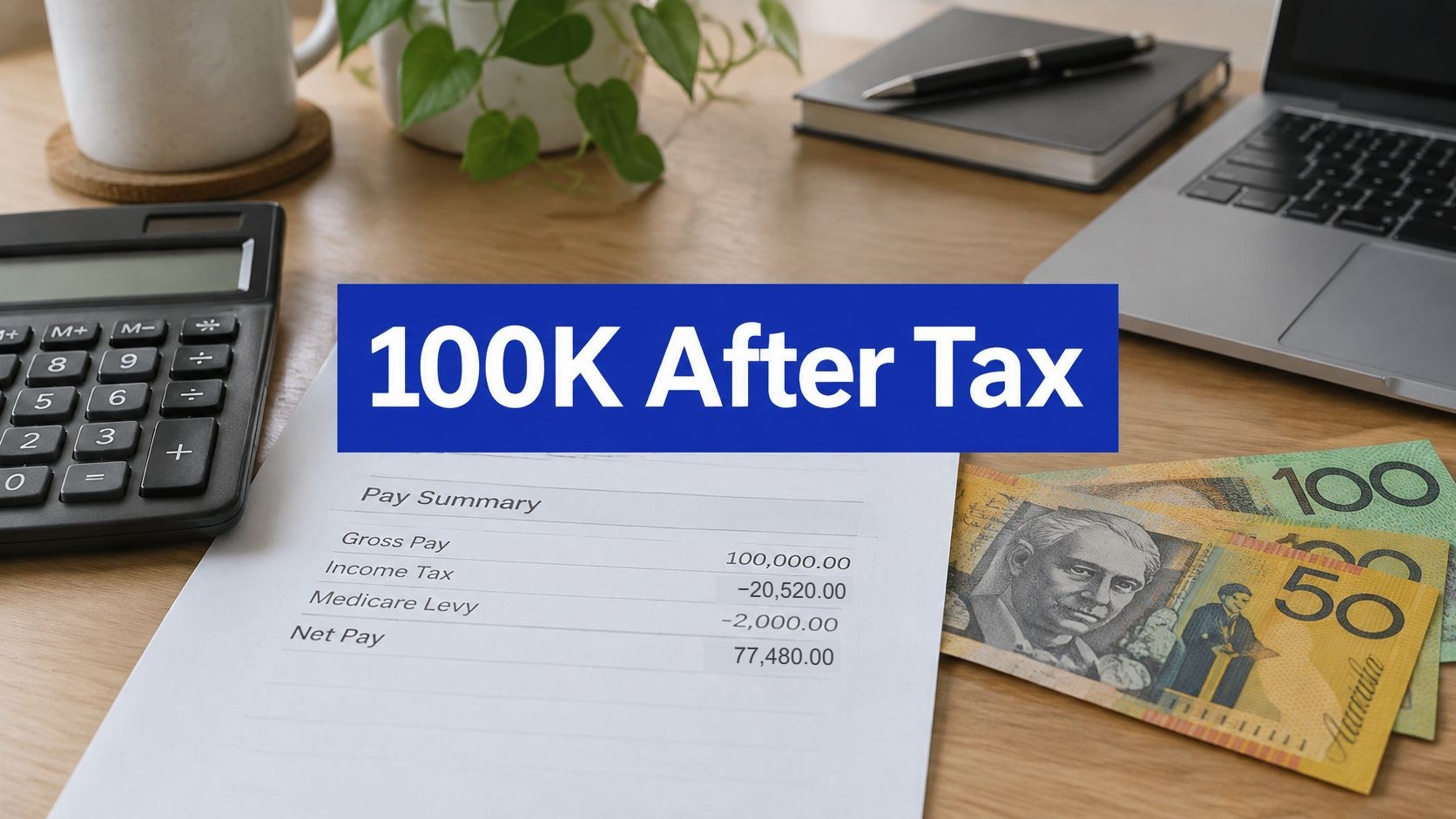
On a $100,000 salary, 100k after tax in Australia is $77,480 a year for 2026-27. That works out to $6,456.67 a month, $2,980 a fortnight or $1,490 a week for a resident taxpayer with no other income, deductions, offsets, HELP debt or salary sacrifice.
The $22,520 difference is $20,520 of income tax plus the 2% Medicare levy of $2,000. Super is not part of it, because your employer pays super guarantee on top of your salary unless your contract says the $100,000 includes super.
This guide shows the working bracket by bracket, then covers what can change the result: a package that includes super, the Medicare levy surcharge, HELP repayments and salary sacrifice. To run your own numbers, use our income tax calculator.
Key takeaways
- A resident on a $100,000 salary takes home $77,480 a year in 2026-27.
- Income tax is $20,520 and the Medicare levy is $2,000.
- From 1 July 2026 the rate on income from $18,201 to $45,000 fell from 16% to 15%, which saves $268 a year at this salary compared with 2025-26.
- A $100,000 package that includes 12% super leaves $70,194.29 in the hand.
- Without private hospital cover, the Medicare levy surcharge starts above $105,000 for singles in 2026-27, so it does not apply at $100,000 unless other MLS income takes you over.
How much is 100k after tax per week, fortnight and month?
Here are the 2026-27 figures for a $100,000 cash salary at Australian resident rates.
| Pay cycle | Gross pay | Tax and Medicare levy | Take-home pay |
|---|---|---|---|
| Yearly | $100,000.00 | $22,520.00 | $77,480.00 |
| Monthly | $8,333.33 | $1,876.67 | $6,456.67 |
| Fortnightly | $3,846.15 | $866.15 | $2,980.00 |
| Weekly | $1,923.08 | $433.08 | $1,490.00 |
Your payslip may be a few dollars different, because withholding is worked out one pay period at a time. The final figure is settled when you lodge your tax return, and if too much was withheld the difference comes back as a refund. Our tax refund calculator gives an estimate.
How is tax on a $100,000 salary worked out?
Australia taxes income in bands. Each rate applies only to the part of your income inside that band. These are the ATO resident tax rates for 2026-27:
| Taxable income | Rate | Tax on this band at $100,000 |
|---|---|---|
| $0 – $18,200 | Nil | $0 |
| $18,201 – $45,000 | 15% | $4,020 |
| $45,001 – $135,000 | 30% | $16,500 |
| $135,001 – $190,000 | 37% | $0 (not reached) |
| $190,001 and over | 45% | $0 (not reached) |
| Total income tax | $20,520 |
The working: the first $18,200 is tax free. The next $26,800 is taxed at 15%, which is $4,020. The $55,000 between $45,000 and $100,000 is taxed at 30%, which is $16,500. Add them and income tax is $20,520.
Where does the Medicare levy fit?
The Medicare levy is 2% of your taxable income and is added on top of income tax. At $100,000 that is $2,000, bringing the total to $22,520.
Tip: check the income year
In 2025-26 the second band was taxed at 16%, so tax on $100,000 was $20,788 and take-home pay was $77,212. If you are comparing an old payslip with a new one, the 1 July 2026 rate cut explains a $268 a year difference. See our guide to ATO tax rates for 2025-26.
Does a $100,000 salary include super?
It depends on the wording of your offer. “$100,000 plus super” means $100,000 of cash salary with super paid on top. “$100,000 including super” means the super comes out of the $100,000.
The super guarantee rate is 12% for 2026-27. From 1 July 2026, under Payday Super, employers calculate it on qualifying earnings and pay it each payday. The maximum contribution base is now an annual amount of $270,830, so it has no effect at $100,000.
| $100,000 plus super | $100,000 including super | |
|---|---|---|
| Cash salary | $100,000.00 | $89,285.71 |
| Employer super (12%) | $12,000.00 | $10,714.29 |
| Income tax | $20,520.00 | $17,305.71 |
| Medicare levy | $2,000.00 | $1,785.71 |
| Take-home pay | $77,480.00 | $70,194.29 |
The including-super package works backwards: $100,000 divided by 1.12 is $89,285.71 of salary, with $10,714.29 going to super. Tax on $89,285.71 is $4,020 plus 30% of $44,285.71 ($13,285.71), which is $17,305.71. The levy is $1,785.71. Take-home pay is $7,285.71 a year lower than on a $100,000 salary plus super.
Watch out
Not every package is split this way. Some contracts set super as a fixed dollar amount, or bundle in items such as a car or other salary packaging. Read the contract and ask payroll for the cash salary figure before you compare offers.
What else can change your take-home pay?
Medicare levy surcharge
If you do not hold an appropriate level of private patient hospital cover, the Medicare levy surcharge (MLS) can apply on top of the 2% levy. The 2026-27 MLS thresholds are:
| Tier | Singles | Families | Surcharge |
|---|---|---|---|
| Base tier | $105,000 or less | $210,000 or less | 0% |
| Tier 1 | $105,001 – $123,000 | $210,001 – $246,000 | 1% |
| Tier 2 | $123,001 – $164,000 | $246,001 – $328,000 | 1.25% |
| Tier 3 | $164,001 or more | $328,001 or more | 1.5% |
A single person with $100,000 of taxable income sits in the base tier. Income for MLS purposes is more than taxable income, though. It adds reportable fringe benefits, net investment losses and reportable super contributions, which include salary sacrificed super. The family threshold rises by $1,500 for each MLS dependent child after the first.
HELP repayments
If you have a HELP or other study loan, the 2026-27 repayment rates apply to repayment income above $69,528. Between $69,529 and $129,717 you repay 15c for each $1 over $69,528. With repayment income of $100,000 that is $4,570.80 a year, which brings take-home pay down to $72,909.20. Our guide to HELP repayment thresholds has more examples.
Bonuses and work deductions
A bonus is added to your taxable income, so at this salary each extra dollar is taxed at 30% plus the 2% levy, as long as your total stays under $135,000. See how bonuses are taxed. Going the other way, each $1,000 of eligible work-related deductions saves $320 of tax and levy at $100,000.
Worked example: does salary sacrifice increase take-home pay?
The facts
Priya earns a $100,000 salary plus super in 2026-27. She is a resident, has no HELP debt and holds private hospital cover. She is weighing up salary sacrificing $5,000 a year into super.
Option 1: no salary sacrifice
- Taxable income: $100,000
- Income tax: $4,020 + ($55,000 x 30%) = $20,520
- Medicare levy: $100,000 x 2% = $2,000
- Take-home pay: $100,000 – $20,520 – $2,000 = $77,480
- Employer super: $100,000 x 12% = $12,000
Option 2: salary sacrifice $5,000
- Taxable income: $100,000 – $5,000 = $95,000
- Income tax: $4,020 + ($50,000 x 30%) = $19,020
- Medicare levy: $95,000 x 2% = $1,900
- Take-home pay: $95,000 – $19,020 – $1,900 = $74,080
- Extra super after 15% contributions tax: $5,000 – $750 = $4,250
What it means
Take-home pay falls by $3,400 ($77,480 – $74,080) and super rises by $4,250. The $850 gap is the tax saving: as salary, the $5,000 would have been taxed at 32% (30% plus the levy), which is $1,600, compared with $750 at 15% in the fund.
Salary sacrifice does not reduce the super guarantee her employer has to pay, so the $12,000 stays. Her total concessional contributions are $17,000 ($12,000 + $5,000), well under the 2026-27 concessional contributions cap of $32,500. The trade-off is access: super is preserved until she meets a condition of release. The ATO guide to salary sacrificing super explains how the arrangement works, and our salary packaging team can help set it up.
How do $90,000 and $110,000 salaries compare?
| Salary | Income tax | Medicare levy | Take-home pay |
|---|---|---|---|
| $90,000 | $17,520 | $1,800 | $70,680 |
| $100,000 | $20,520 | $2,000 | $77,480 |
| $110,000 | $23,520 | $2,200 | $84,280 |
Between $45,001 and $135,000, each extra $10,000 of salary adds $6,800 to take-home pay, because 32c in every dollar goes to tax and the levy. At $110,000 a single person without private hospital cover would also pay the 1% MLS, or $1,100, which brings take-home pay to $83,180. For more on average and marginal rates, read what your true tax rate is.
What mistakes skew a $100k pay calculation?
- Using last year’s rates. 2025-26 used 16% for the second band, which gives $268 more tax at $100,000.
- Treating a package as a salary. Check whether super is included before you compare offers.
- Forgetting the MLS or HELP. Both can apply on top of the 2% Medicare levy.
- Using resident rates for everyone. Foreign residents and working holiday makers have their own rate tables.
To compare pay cycles quickly, try our Australian pay calculator.
Common questions about 100k after tax
How much is 100k after tax in Australia?
For 2026-27, a resident on a $100,000 salary takes home $77,480 a year after $20,520 income tax and the $2,000 Medicare levy. That is $2,980 a fortnight or $1,490 a week.
What is the tax rate on $100,000 in Australia?
The marginal rate is 30%, plus the 2% Medicare levy. The average rate is lower: $20,520 of income tax is 20.52% of $100,000, or 22.52% including the levy.
Does the Medicare levy surcharge apply at $100,000?
Not for a single person whose income for MLS purposes is $100,000. In 2026-27 the singles base tier covers income up to $105,000. Above that, the surcharge is 1% to 1.5% if you do not have appropriate private hospital cover.
How much HELP do I repay on $100,000?
For 2026-27, repayment income of $100,000 means a compulsory repayment of $4,570.80, which is 15c for each $1 over $69,528.
Is $100,000 including super the same as $100,000 plus super?
No. With super at 12%, a $100,000 package including super is a cash salary of $89,285.71, which leaves $70,194.29 after tax and the Medicare levy, compared with $77,480 on a $100,000 salary plus super.
Talk to a registered tax agent
Weighing up a new salary, a salary sacrifice arrangement or a package that includes super? Speak with a registered tax agent at Nanak Accountants & Associates on 1300 626 258, or book a consultation with our team. We prepare individual tax returns and help employees plan their tax across Australia.
This article is general information only and is not personal financial or tax advice. Information checked against ATO sources on 12 November 2026.