
Seeing “In progress – Balancing account” on your tax return in myGov usually means you are close to the end. The ATO has worked out the result of your return and is now matching it against your accounts with the ATO and other Australian Government agencies before it issues your Notice of Assessment.
For most people the stage lasts a few days and the refund follows soon after. It takes longer when the ATO needs to offset a debt – such as HECS-HELP, Centrelink or Child Support – or when a return is pulled aside for manual checks.
This guide explains what the status means for 2025-26 tax returns, how it fits with the other statuses you will see, what the ATO says about processing times, and what to do if your return seems stuck.
Key takeaways
- Balancing account is a normal stage, not an audit and not a sign of a problem. It sits between “Processing” and “Issued”.
- It does not guarantee a refund. The result can be a refund, a reduced refund or an amount owing.
- The ATO says most online returns are processed within 12 business days; returns that need manual processing can take up to 30 calendar days.
- Government debts are deducted first. HECS-HELP, Centrelink and Child Support balances can reduce your refund and add time.
- Do not lodge again. Check myGov or the ATO app, keep your bank details current, and only contact the ATO once the normal processing window has passed.
Tax return statuses at a glance
| Status in myGov | What it means | Typical time |
|---|---|---|
| In progress – Processing | The ATO has received your return and is running automated checks against employer, bank and other third-party data. | Usually the longest stage; most online returns finish within 12 business days overall |
| In progress – Information pending | The ATO is collecting information to finish processing. It will contact you if it needs anything. | Varies |
| In progress – Under review | A manual review to make sure everything is right before the return is finalised. | Up to 30 calendar days |
| In progress – Balancing account | The ATO is balancing your result against your ATO account and other government agency balances. Funds may be transferred to cover debts. | Often a few days; longer if a debt is being offset |
| Issued – $ amount or Nil | Processing is complete and your Notice of Assessment has issued. A refund is paid to your nominated bank account. | Allow a few business days for the bank to clear funds |
Timeframes are the ATO’s published guidance for standard returns and vary with individual circumstances.
What is an ATO balancing account?
The balancing account is the final calculation stage of your tax return. The Australian Taxation Office (ATO) squares up all your tax credits and debits for the financial year to work out your final position. You will usually see it in your ATO online account straight after “Processing” and just before your refund or bill is issued.
Think of it as a holding zone where the ATO double-checks the figures. It pulls together:
- Your declared income and the tax withheld by your employer.
- Any compulsory repayments for debts like HECS-HELP.
- Your entitlement to tax offsets and credits.
- Debts you may have with other government agencies, such as Centrelink or Child Support.
All of that is reconciled into a single outcome: a refund owed to you, or a tax debt you need to pay.
Why does the ATO balance your account?
Your tax return is not assessed in isolation. Before the ATO finalises it, the figures you lodged are matched against information it already holds from third parties:
- Income statements reported by your employer through Single Touch Payroll, including salary and tax withheld.
- Bank interest and dividends reported by banks and share registries.
- Private health insurance statements, which drive the private health insurance rebate and Medicare levy surcharge.
- Government payments from Services Australia, and any Medicare or Centrelink adjustments.
- Your existing ATO account, including prior-year debts, activity statement balances and HECS-HELP.
Balancing is where any difference between what you lodged and what those sources say gets resolved. It is a routine data-matching step, not an audit. An audit or review is a separate process and the ATO tells you in writing if one starts.
Timing matters here. Employers have until 14 July to finalise income statements, and the ATO warns that if you lodge before your income statement is marked “Tax ready” you may have to amend your return. Returns lodged in the first fortnight of July are the ones most likely to sit longer in processing and balancing while late employer, bank and health fund data arrives.
Where does balancing account fit in your tax return?
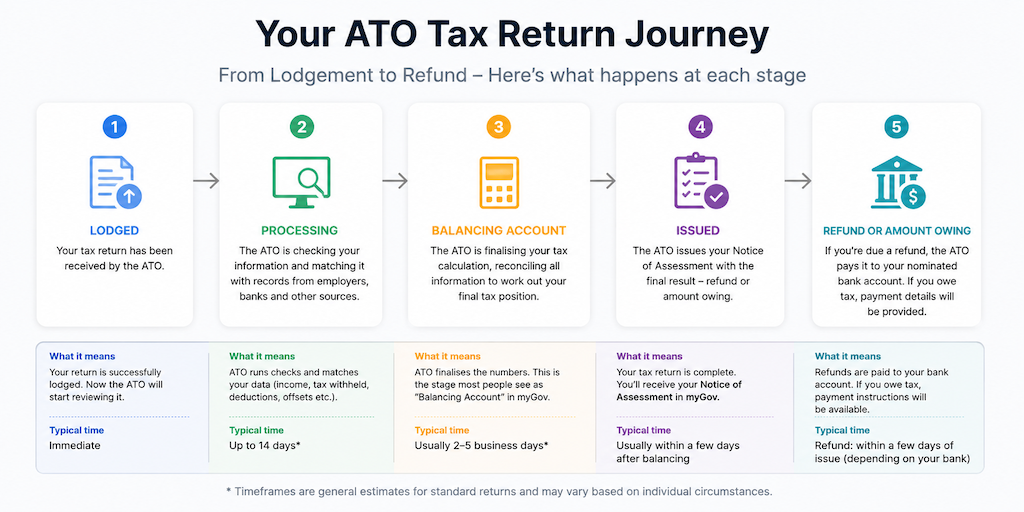
Your tax return moves through five steps before the final result is available:
- Lodged – your return has been submitted and received by the ATO.
- Processing – the ATO works through your return and cross-matches it against the data it already holds. This is normally the longest step.
- Balancing account – the ATO brings the numbers together, reconciles your return with your accounts and considers any balances with other government agencies.
- Issued – your Notice of Assessment is finalised and sent to your myGov inbox.
- Refund or amount owing – a refund is paid to your nominated bank account, or you receive a bill with a due date.
Does balancing account mean I will get a refund?
No. The balancing stage is about determining your final tax position, not confirming that money is coming back to you. The outcome can be:
- A refund – if you have paid more tax than you ultimately owe.
- An amount owing – if your final tax liability is more than the tax already paid.
- A reduced refund – where a debt or other amount is deducted before the balance is paid to you.
That is why the estimate you saw when lodging may not match the amount on your final Notice of Assessment.
What if balancing ends in an amount owing?
If the ATO works out that you owe tax, your Notice of Assessment shows the amount, the due date and any credits or offsets already applied. If you lodge your own return, the ATO’s due date for payment is 21 November, regardless of when in the season you lodged. If you lodge through a registered tax agent, the due date follows your agent’s lodgement program and is often later.
A debt after balancing does not mean something went wrong. It usually means tax withheld during the year was lower than your final liability – common when you had two jobs, a HECS-HELP debt that was not being deducted, or investment income with no tax withheld. If you cannot pay in full by the due date, the ATO offers payment plans online through myGov, and setting one up before the due date avoids general interest charge building up unnoticed.
How long after balancing account will I get my refund?
Once balancing is complete your return still has to be finalised and your Notice of Assessment issued. The sequence is:
- Balancing account completed
- Notice of Assessment issued to your myGov inbox
- Refund payment released by the ATO
- Funds clear into your nominated bank account
The gap between these steps is not identical for everyone. As a practical guide, once the ATO shows a payment date, allow a few business days for your bank to clear the funds. If nothing has arrived about five business days after that date, contact the ATO.
What the ATO actually says about timing
Most returns lodged online are processed within 12 business days. If a return needs manual processing it can take up to 30 calendar days. Paper returns can take up to 50 business days and up to seven weeks just to appear in the ATO’s systems. Balancing account is one part of that overall window, not a separate clock.
Why does balancing sometimes take longer?
Two things stretch the balancing stage beyond a few days:
- Offsets. If you have an existing debt with the ATO or another Australian Government agency – an older tax debt, a Centrelink overpayment, Child Support – your refund is applied to that debt first. Coordinating this between agencies adds time, and the amount left over is what you receive.
- Manual review. Complex claims, unusual deductions or data that does not match what employers and banks have reported can move a return into “Under review”. The ATO allows up to 30 calendar days for these.
HECS-HELP works slightly differently. Your compulsory repayment is calculated as part of the assessment itself, so a refund can come out lower than your estimate even when nothing is “delayed”. Your Notice of Assessment shows exactly how the figure was reached and where any offset money went.
If your myGov status shows “Accounting action in progress” rather than “Balancing account”, it describes the same reconciliation step from the account side – our guide to accounting action in progress covers it in detail, including a worked refund-offset example.
Two common scenarios
Example 1: Employee with a simple return
Sarah is a full-time employee with no government debts. She lodges her return online in July. Her myGov status shows “Processing” for about five days, then “Balancing account” for three or four days, then “Issued”. Her refund lands in her bank account a few business days later. This is the standard experience for most salary earners.
Example 2: Sole trader with GST obligations
David is a sole trader. When his return reaches balancing, the ATO is not only looking at his income tax. It is also reconciling his Business Activity Statement (BAS) lodgements, GST payments and PAYG instalments. If there is an outstanding GST debt, his income tax refund is used to offset it. That cross-checking adds a few extra days, and the refund he receives is the net amount.
How can I check my tax return status?
You can check progress without calling the ATO:
- Sign in to myGov.
- Select the ATO from your linked services.
- Choose Manage tax returns.
- Select the income year you are checking (2025-26 for this year’s return).
- Read the status shown next to the return.
The ATO app shows the same status under Your tax return for 2025-26, and your Notice of Assessment is delivered to your myGov inbox when the return is issued.
What should I do while my return is at balancing account?
For most people the right move is to wait and let the ATO finish. While you wait:
- Check myGov for status changes or messages from the ATO.
- Make sure your bank account and contact details in myGov are current – an old account number is a common reason refunds go missing.
- Check whether the ATO has asked you for information, and respond promptly if it has.
- Do not lodge another copy of the same return because the status has not changed. A duplicate lodgement slows everything down.
Rule of thumb
If you lodged online and it has been more than 12 business days with no Notice of Assessment, or the ATO has asked you for information, it is reasonable to follow up. Inside that window, ATO staff generally cannot tell you anything the status screen does not.
Common mistakes to avoid
- Lodging before your income statement is “Tax ready”. Employers have until 14 July to finalise. Lodge earlier and the ATO may need to re-balance your return against the final figures, or you may need to amend it.
- Calling the ATO too early. Within the standard processing window there is usually no extra information to give you.
- Ignoring myGov messages. myGov is the ATO’s primary channel. Requests for information and your Notice of Assessment arrive there, not by post.
- Spending the estimate. The refund estimate shown at lodgement does not account for HECS-HELP repayments or government debts. Wait for the Notice of Assessment.
- Lodging on paper. Paper returns can take up to 50 business days to process. Lodging online, or through a registered tax agent, is much faster.
FAQ about the ATO balancing account
How long does the ATO balancing account stage take?
There is no fixed number of days for the balancing stage itself. For most people it is short – often a few days. The ATO says most returns lodged online are processed within 12 business days overall, and manually processed returns can take up to 30 calendar days.
Does “balancing account” mean I am getting a refund?
No. It means the ATO is working out your final position. The result can be a refund, a reduced refund (if a debt is offset) or an amount you need to pay. Your Notice of Assessment confirms the outcome.
Why has my return been on balancing account for more than a week?
The most common reason is an offset. If you have a debt with the ATO or another Australian Government agency – such as Centrelink, Child Support or an older tax debt – your refund is applied to that debt first, which adds time. Returns that need manual checks also take longer.
Is “balancing account” a sign the ATO is auditing me?
No. Balancing account is routine data matching that every return goes through. An audit or review is a separate process and the ATO notifies you in writing if one starts. If the ATO needs more information to finish your return, the status changes to “Information pending” or “Under review”.
Does balancing account mean something is wrong?
Not necessarily. It is a normal status that appears while your return is being finalised. If the ATO needs something from you, it will contact you or move your return to “Information pending” or “Under review”.
Can HECS-HELP affect my refund at the balancing stage?
Yes. Compulsory HECS-HELP repayments are worked out as part of your assessment, so a refund that looked higher in your estimate can be lower once the repayment is included. Other government debts can also be deducted from your refund.
Can a tax agent speed up the balancing process?
A tax agent cannot speed up the ATO’s automated calculation. Where they help is lodging an accurate, complete return that is less likely to be pulled for manual review, and using dedicated agent channels to get answers from the ATO if a return is genuinely stuck.
Talk to a registered tax agent
A tax agent cannot make the ATO’s systems run faster, but an accurate, complete return is far less likely to be pulled for manual review in the first place, and if a return is genuinely stuck a registered agent can use dedicated ATO channels to find out why.
If your refund is delayed or the outcome is not what you expected, contact Nanak Accountants on 1300 626 258. Book your consultation today and we will review your return and your ATO account with you.
This article is general information only and is not personal financial or tax advice. Processing times and status descriptions checked against ATO sources on 6 October 2026.
