
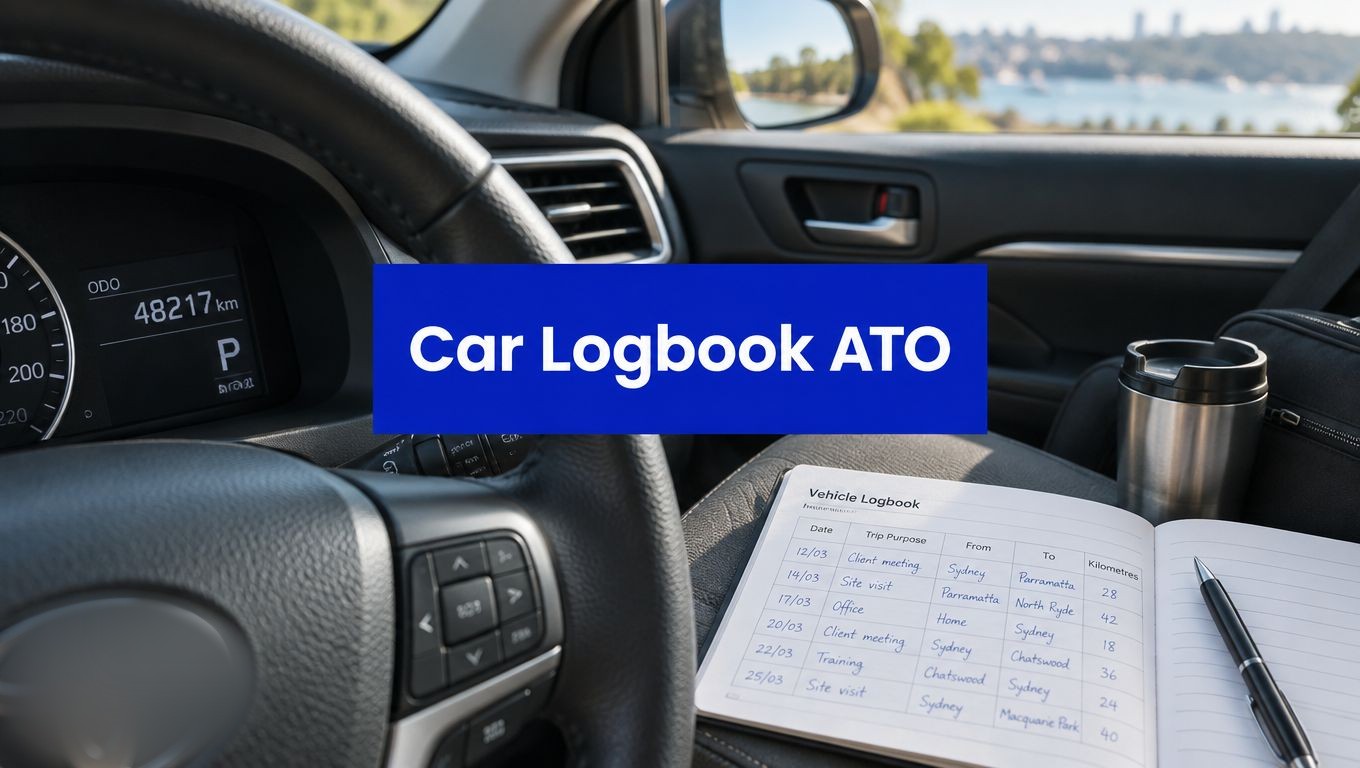
Under the car logbook ATO rules, you record your work trips over 12 continuous weeks. That gives you a work-use percentage, which you apply to your actual car costs. One logbook can be used for up to 5 years.
The alternative is the cents per km method: 88c per km for 2025-26 and 91c per km for 2026-27, capped at 5,000 work km per car.
If you drive a lot for work, a logbook usually gives the bigger deduction. Here is what the ATO needs, and a worked example under both rates.
Key takeaways
- Keep a logbook for at least 12 continuous weeks that reflect your normal travel.
- Record the destination, reason, start and end odometer readings and kilometres of every work trip.
- A logbook is valid for 5 years, unless your job, home or work travel changes.
- Cents per km is 88c for 2025-26 and 91c for 2026-27, capped at 5,000 km per car.
- You must own or lease the car. Novated lease cars, companies and trusts can’t use either method.
What are the car logbook ATO rules at a glance?
| Rule | What the ATO requires |
|---|---|
| Logbook period | At least 12 continuous weeks, broadly representative of your travel |
| How long it lasts | 5 years, unless your circumstances change |
| Each work trip | Destination and reason, start and end odometer, kilometres travelled |
| The logbook period | Start and end odometer readings and total kilometres |
| Each later year | Odometer readings at the start and end of the year, work km and work-use % |
| Format | Paper, or the myDeductions tool in the ATO app |
| Record keeping | 5 years after the end of the last income year you rely on the logbook |
| Alternative | Cents per km: 88c (2025-26), 91c (2026-27), max 5,000 km |
What is the ATO logbook method?
The logbook method lets you claim the work-related share of your actual car expenses. If 65% of the kilometres in your logbook were for work, you claim 65% of your car costs.
Car expenses the ATO accepts include:
- Fuel and oil, or electricity for an EV
- Repairs, servicing, tyres and cleaning
- Registration and insurance
- Interest on a car loan, or lease payments
- Decline in value (depreciation), subject to the car limit
The purchase price, loan principal repayments, and parking and tolls are not car expenses. See the ATO’s logbook method page for the full rules.
Who can use the logbook method?
You can use it if all of these apply:
- The vehicle is a car: it carries less than one tonne and fewer than 9 passengers, including the driver.
- You own or lease the car, or have it under a hire-purchase agreement.
- You paid the expenses yourself and weren’t reimbursed.
- The trips were for work, not private travel.
Motorcycles and vehicles that carry one tonne or more, such as some utes and vans, are not cars. They are claimed on actual costs as a travel expense. See the ATO’s guide to vehicles that aren’t cars.
Watch out: novated leases
If you drive a car under a novated lease or salary sacrifice arrangement, you don’t own or lease it yourself. You can’t claim its running costs with either method, although you may be able to claim work parking and tolls. Source: ATO, expenses for a car you own or lease.
What must a car logbook record?
A logbook can be on paper or kept in the free myDeductions tool in the ATO app. Either way, it needs these details.
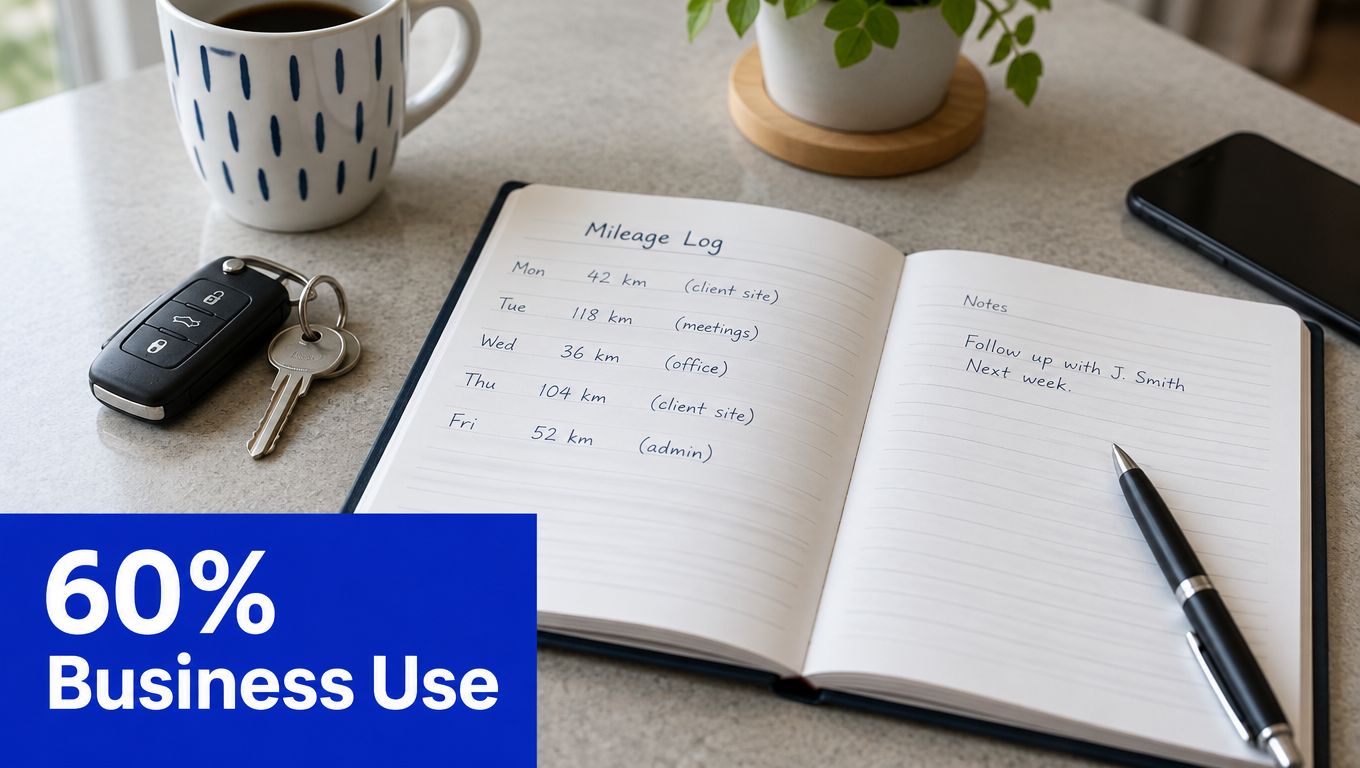
For the logbook period
- The date the logbook period starts and ends
- Odometer readings at the start and end of the period
- Total kilometres travelled during the period
- Your work-use percentage for the period
For every work trip
- The start and end date of the trip
- Odometer readings at the start and end of the trip
- Kilometres travelled
- The destination and reason, for example “Client site, Tarneit – switchboard upgrade”
Tip for sole traders
The ATO’s business logbook rules also ask for the car’s make, model, engine capacity and registration number. Two or more trips in a row on the same day can be recorded as one journey.
Write up each trip at the end of the journey or as soon as possible afterwards. A logbook filled in months later is hard to rely on in an ATO review.
How do you keep an ATO logbook?
- Pick a typical 12 weeks. Avoid leave, a one-off project or weeks when the car is off the road.
- Record the starting odometer and the date on day one.
- Log every work trip with the date, odometer readings, kilometres, destination and reason.
- Record the closing odometer and date at the end of week 12.
- Work out your work-use percentage. Divide work km by total km for the period and multiply by 100.
- Keep your receipts. Fuel can be receipts or a reasonable estimate from odometer readings. Other costs need written evidence.
- Take odometer readings each year. For the next 4 years, record the start and end readings for each income year.
Using the logbook method for 2 or more cars? Keep a logbook for each car, covering the same 12 weeks.
Logbook or cents per km: which gives a bigger claim?
| Logbook method | Cents per km method | |
|---|---|---|
| What you claim | Work-use % of actual car costs | A set rate per work km |
| Rate | Not applicable | 88c (2025-26), 91c (2026-27) |
| Kilometre cap | None | 5,000 work km per car, per year |
| Maximum claim | No set maximum | $4,400 (2025-26), $4,550 (2026-27) |
| Receipts needed | Yes, for all car expenses | No, but you must show how you worked out work km |
| Depreciation | Claimed as decline in value | Included in the rate |
| Best for | High work km or high running costs | Low work km and minimal paperwork |
The cents per km rate covers all car costs, including fuel, registration, insurance, repairs and depreciation, so you can’t add any of them on top. You can use a different method for each car, and switch methods from one income year to the next.
The 91c rate is set by the Cents per Kilometre Deduction Rate for Car Expenses Determination 2026, which starts on 1 July 2026. The ATO’s work-related car expenses calculator can run both methods for you.
Worked example: how much can Raj claim?
The facts
- Raj is an employed electrician in Melbourne’s west. He drives his own car between several job sites each day, so his trips are work travel.
- His 12-week logbook shows 6,000 km in total, of which 3,900 km were work trips. Work use: 3,900 ÷ 6,000 × 100 = 65%.
- He drives about 26,000 km a year, so his work km (around 16,900) are well over the 5,000 km cents per km cap.
- His car had an opening value of $17,200 on 1 July 2025. He uses the diminishing value method and the ATO’s 8-year effective life for cars.
Old rate: 2025-26 (88c per km)
| Car expense | 2025-26 |
|---|---|
| Fuel | $4,200 |
| Registration | $900 |
| Insurance | $1,300 |
| Servicing and tyres | $800 |
| Loan interest | $1,500 |
| Decline in value ($17,200 × 200% ÷ 8) | $4,300 |
| Total | $13,000 |
- Logbook method: $13,000 × 65% = $8,450
- Cents per km: 5,000 km × 88c = $4,400
New rate: 2026-27 (91c per km)
Raj keeps using the same logbook. Assume his running costs stay the same. His car’s value has dropped to $12,900, so decline in value falls to $3,225 ($12,900 × 200% ÷ 8) and his total costs are $11,925.
- Logbook method: $11,925 × 65% = $7,751
- Cents per km: 5,000 km × 91c = $4,550
The result
The logbook gives Raj $4,050 more in 2025-26 and about $3,201 more in 2026-27. The higher 91c rate narrows the gap, but it doesn’t close it for someone who drives this much for work.
Which trips can you claim?
For employees, the ATO allows trips made while doing your job, such as:
- Travelling between workplaces, or between clients
- Going from your regular workplace to a client or an alternative place of work
- Delivering items or collecting supplies
- Travelling between 2 separate jobs, as long as neither is your home
Trips between home and your regular workplace are private. They stay private even if you live far away, work shifts or overtime, or do some work at home. The exceptions are narrow:
- You carry bulky tools or equipment that are essential for work and there is no secure storage at the workplace
- You do itinerant work, regularly working at several sites in a day with no fixed workplace
- Your home is a base of employment, meaning you start your duties at home and must finish them at work
The ATO sets these out in trips you can and can’t claim. For other claims, see our guides to work-related tax deductions and what you can claim on tax.
What logbook mistakes does the ATO pick up?
- A logbook shorter than 12 weeks, or with gaps in it
- Using an old logbook after a new job, a move or a change in travel
- Claiming home-to-work trips as work travel
- No yearly odometer readings in the years after the logbook
- Adding fuel or rego on top of a cents per km claim
- Missing receipts for registration, insurance, servicing and interest
If you use cents per km, you don’t need receipts, but you still need records of how you worked out your work km. Our guide to claiming without receipts explains where that line sits.
How long do you keep logbook records?
Keep your logbook and odometer records for 5 years after the end of the last income year you rely on them. So a logbook used for 2025-26 to 2029-30 is kept until 30 June 2035.
The usual deadline to lodge your 2025-26 return yourself is 31 October 2026. If you use a registered tax agent, contact them before 31 October to join their lodgment program. See our tax return deadline guide for key dates.
Sole traders
Sole traders and some partnerships can use the logbook or cents per km method for a car. Our sole trader tax deductions guide covers the other expenses you can claim, and you can estimate your result with our tax refund calculator. If you are in business with a partner, our partnership tax return guide covers how the business profit is shared.
FAQ about the ATO car logbook
How long does an ATO car logbook need to be kept?
Your logbook must cover at least 12 continuous weeks that are representative of your travel. Once done, it is valid for 5 years, as long as you record odometer readings at the start and end of each later year and your circumstances don’t change.
What is the ATO cents per km rate for 2025-26 and 2026-27?
The rate is 88c per km for 2025-26 and 91c per km for 2026-27. You can claim up to 5,000 work kilometres per car, so the maximum is $4,400 for 2025-26 and $4,550 for 2026-27.
Can I use the ATO app as my car logbook?
Yes. The ATO accepts an electronic logbook kept with the myDeductions tool in the ATO app, or a paper logbook. It must still record every detail the ATO requires.
Can I claim car expenses on a novated lease?
Not the running costs. Under a novated lease or salary sacrifice arrangement you don’t own or lease the car yourself, so you can’t use the logbook or cents per km method. You may still be able to claim work-related parking and tolls.
Can a company or trust use the logbook method?
No. The logbook and cents per km methods are for individuals, sole traders and some partnerships. Companies and trusts claim actual car costs, and fringe benefits tax may apply if the car is used privately.
Talk to a registered tax agent
Not sure which method gives you the bigger deduction? Speak with a registered tax agent at Nanak Accountants & Associates on 1300 626 258, or book a consultation with our team. We prepare individual tax returns and sole trader accounts across Australia.
This article is general information only and is not personal financial or tax advice. Information checked against ATO and Federal Register of Legislation sources on 1 October 2026.