
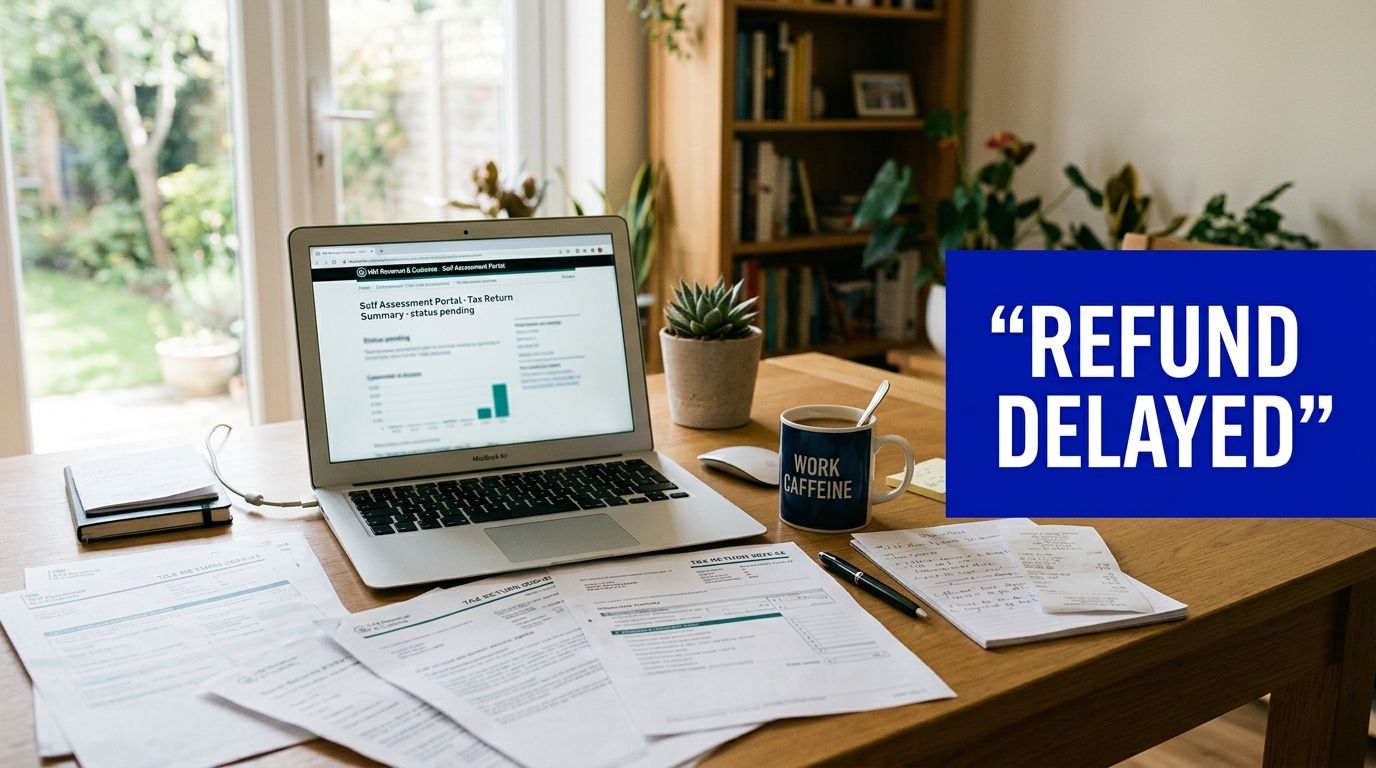
You lodge your return, the refund estimate looks right, and a few days later there is still nothing in your account. That usually points to timing or processing, not a rejection. In practice, the first job is to work out whether your return is still within the normal ATO window or has moved into a slower review path.
For many online individual returns, the ATO says processing is usually completed within 2 weeks. Paper returns and amended returns often take longer. Returns can also take longer when the ATO needs to verify information, match late third-party data, or complete manual checks before issuing a notice of assessment and payment.
Why Is My ATO Refund Delayed?
An ATO refund delayed issue can start at several points in the process. The return may still be in standard processing. It may have been pulled for manual review. The ATO may also be waiting on information already reported by an employer, bank, insurer, or government agency.
A delay by itself does not mean an audit.
The practical approach is to diagnose the stage first, then act. Start with the ATO’s official refund progress tool at status of your tax return. Then check messages, bank details, and any requests for more information before making changes. That sequence saves time and avoids creating a second problem by lodging again or amending too early.
Practical rule: Do not relodge or amend a return just because payment is slower than expected. Confirm the status first and read every ATO message linked to that income year.
Key Takeaways
- Standard online processing is often within 2 weeks: That is the usual benchmark, not a guarantee.
- Some returns leave the automated queue: Manual review, data matching, and identity checks can extend the timeframe.
- Early July lodgements can be slower: Employer payroll data may not be finalised yet.
- Refund issue and refund payment are not always the same thing: A return can be assessed, then held up by offsets or bank detail problems.
- Use a checklist before escalating: Check status, inbox messages, notice of assessment, and account details first.
- Get professional help if the delay goes past the normal window and no clear reason appears: A tax agent can review the lodged position and contact the ATO if needed.
How Long Does an ATO Refund Normally Take?
The usual timeframe depends on what you lodged and how much ATO checking is required.
- Online returns: Often processed within 2 weeks.
- Paper returns: Usually slower because they require more manual handling.
- Amendments: Commonly take longer than original returns because the ATO has to reopen the assessed position.
- Returns needing extra review: These can extend beyond the standard window if the ATO is checking income, deductions, offsets, identity, or banking details.
- Returns where the ATO asks for more information: Processing can pause until the requested material is received and reviewed.
One of the most common timing problems is lodging too early in July. The ATO advises taxpayers to wait until late July, and employers generally have until 14 July to finalise payroll information through Single Touch Payroll. The ATO has also previously noted that a significant number of early lodgers face delays because returns may need amendment or extra checking once final data is reported.
If the return is still inside the normal timeframe, the best step is usually to monitor the status and keep records ready. If it has moved past that window, the next step is not to guess. It is to run a proper check of the status, messages, and payment details, then decide whether the issue is something you can fix yourself or whether a tax agent should step in.
Common Reasons an ATO Refund Is Delayed
You lodge on time, the refund looks straightforward, and then nothing lands in your bank account. In practice, delays usually happen because the ATO cannot finalise the return through its standard automated checks, or because the refund is held up after assessment.
The good news is that many delays are fixable once you identify the exact cause. The key is to diagnose the issue in order, starting with the lodged return itself, then the data that supports it, and then the payment outcome.
Reasons for ATO Refund Delays
| Reason | What it may mean | What to do |
|---|---|---|
| Employer income not finalised | Your income statement was not fully finalised when you lodged | Check whether payroll information was marked tax ready before lodgement |
| Bank interest or dividend mismatches | Income reported by the bank, share registry, or investment platform does not match the return | Compare your records and pre-fill data against the lodged figures |
| Private health insurance mismatches | The policy details in the return do not match what the insurer reported | Check membership details, rebate tier, policy number, and coverage dates |
| Large or unusual deductions | The claim sits outside your normal pattern or needs closer review | Keep receipts, diaries, and work-related support ready in case the ATO asks |
| Identity-security checks | The ATO needs to confirm identity, account access, or bank details | Read ATO messages carefully and complete any verification request promptly |
| Several overdue returns lodged together | Multiple years may need to be balanced before a refund is released | Review each year separately and make sure all lodgement obligations are up to date |
| An amendment already processing | A pending change can slow the original refund outcome | Wait for the amendment status to update before lodging another correction |
| Incorrect bank details | The payment may be held, rejected, or sent to an old account | Check the nominated Australian bank account on the return and ATO record |
| Existing ATO or government debts | The refund may be reduced or applied against an eligible debt | Review account transactions and the Notice of Assessment |
| Insolvency or debt arrangements | Refunds may be handled under the terms of an existing arrangement | Confirm with the administrator or relevant contact how refunds are treated |
| Missing information from an employer or another organisation | The ATO may still be waiting for third-party reporting | Allow time for the data to update, or provide documents if requested |
| Manual ATO processing | The return has moved out of automatic processing and into staff review | Wait through the stated review period, then follow up if it runs past that time |
Some delay triggers show up repeatedly in agent work. The ones I see most often are private health insurance details that do not match pre-fill data, omitted interest or dividend income, duplicate lodgements, and bank account details that were correct last year but have since changed. None of those issues automatically mean an audit. They do mean the return may need a person at the ATO to look at it.
A useful way to troubleshoot is to match the problem to the likely fix:
- Lodged before third-party data was finalised: Compare the lodged return against final income statements, bank interest, dividend summaries, and health insurance data.
- Pre-fill looked right but the return was edited manually: Check every adjusted figure against source documents.
- Refund issued but no money received: Review bank details, account transactions, and any offset shown on the assessment.
- More than one return or amendment lodged close together: Confirm which lodgement is active before making another change.
- ATO message requests information: Respond with the exact documents requested, not a broad dump of unrelated records.
If the issue is not obvious, individual tax return support from a registered tax agent can help identify whether the problem is a data mismatch, a payment hold, or a return that has moved into manual review.
A delayed refund often starts with a small mismatch. One incorrect field can stop an otherwise straightforward return from flowing through automatically.
What Do ATO Tax Return Statuses Mean?
The wording in myGov can give you a strong clue about what is happening, even before you call anyone.
- In progress: Processing. The return is still moving through standard processing.
- In progress: Balancing account. The ATO is checking the wider account position, including credits, debts, or other transactions.
- In progress: Information pending. The ATO is waiting on information from you or from another organisation.
- In progress: Under review. The return needs closer examination than ordinary processing or balancing.
- Issued. The assessment has been finalised and the result should appear in your Notice of Assessment and account transactions.
- Cancelled transaction. A payment or transaction has been stopped, reversed, or replaced and needs checking.
Those labels matter because they point you toward the next step. For example, “information pending” usually calls for document checking, while “issued” shifts the focus to offsets, bank details, or payment timing.
How to Check Your Refund Status and What to Look For
You log in expecting to see a refund date, and instead the return is still sitting in progress. At that point, the goal is not to guess. The goal is to identify exactly where the return has stopped and whether you need to act or wait out normal processing.
If you use a registered agent for your individual tax return support, they can review what appears in the lodged record and tell you whether the delay looks routine, document-related, or serious enough to escalate. They cannot override ATO controls, but they can usually narrow the problem much faster than trial and error.
How to Check Your ATO Refund Status
Start with myGov or the ATO app and check the lodged return itself, not just the home screen summary. Small details matter here. The wrong financial year, an unread message, or an outdated bank account can send you in the wrong direction.
- Sign in securely: Go directly to myGov or the ATO app. Do not use links from unexpected texts or emails.
- Open the ATO service: Confirm you are inside the tax section linked to your account.
- Go to lodged returns: Open the area that shows submitted returns and assessments.
- Select the correct financial year: Many delays are misread because the wrong year is open.
- Read the exact status wording: A return marked processing needs a different response from one marked information pending or issued.
- Check for messages or requests: Review your myGov inbox and any ATO correspondence for identity checks, document requests, or notices.
- Review the payment details on the lodged return: Make sure the bank account recorded there is still open and correct.
- Check the timing against normal processing: If the return is still within the usual ATO timeframe, calling too early rarely changes the outcome.
- Look for signs the matter needs escalation: Long delays, repeated requests, or a status that does not change for an extended period usually justify a follow-up.
A practical rule is to check the status and the messages together. A status on its own can be misleading. For example, a return may still show as in progress while a separate message already tells you the ATO is waiting for identity documents or clarification about income, deductions, or account details.
ATO Refund Delay Checklist
Use this checklist before you call the ATO or ask a tax agent to step in:
- Confirm you are viewing the correct financial year
- Read the exact return status, not just the summary screen
- Check for any estimated issue date
- Open all ATO and myGov messages
- Confirm the bank account on the lodged return
- Check whether income statements were finalised before lodgement
- Review whether you lodged an amendment after the original return
- Have payslips, deduction records, and bank details ready
- Note how long the return has been sitting in the same status
- Escalate if the delay is beyond normal processing or the status is unclear
Common mistake and fix pairs are worth keeping in mind. Wrong year selected. Open the lodged return list and confirm the year first. Status says issued but no money received. Check the Notice of Assessment and payment details before assuming the refund is lost. No clear reason for the hold. Gather your records and get the lodged return reviewed properly rather than submitting duplicate enquiries.
Never provide your TFN or bank details through a link in an unexpected text or email. Go directly to myGov or the ATO app.
Understanding Refund Offsets and Missing Payments
A common stress point is seeing Issued in ATO systems and still having no money in the bank. In practice, that usually points to a payment issue or a refund offset, not a return that has disappeared.
What If the Refund Was Issued but Not Received?
Start with the Notice of Assessment. It shows the final outcome, the refund amount after any adjustments, and the payment destination recorded on the lodged return. Then compare that with your bank account activity. We explain each line in our guide to reading your notice of assessment.
Several practical issues can explain the gap:
- Incorrect or closed bank account: The ATO may have sent the payment to the account listed on the return, even if you no longer use it.
- Bank rejected the deposit: If account details do not match or the account cannot accept the payment, the funds can be returned.
- Tax agent trust account listed on lodgement: Some refunds are directed to the account nominated in the return, which may be a tax agent’s trust account where that arrangement applies.
- Offset applied before payment: The refund may have been reduced to pay an eligible government debt.
- Ordinary bank timing: A payment can be marked issued before it appears in your account history.
For business owners and sole traders, refund confusion can sit alongside wider account obligations such as BAS and GST reporting requirements, especially where cash flow is already tight.
How Refund Offsets Work
The refund estimate shown at lodgement is only an estimate. The amount can change once the ATO issues the assessment and applies any credits, corrections, or offsets.
A simple example:
$3,800 tax return credit
$1,250 offset to an eligible debt
$2,550 paid as a refund
If the amount received is lower than expected, check whether the Notice of Assessment or ATO account transcript refers to an offset. The ATO can apply refunds against certain debts, including amounts linked to government agencies such as Services Australia and Child Support. If that has happened, there is usually a record of it.
Missing Payment Checklist
If the refund says issued but nothing has arrived, work through this in order:
- Confirm the final refund amount on the Notice of Assessment
- Check whether an offset or adjustment reduced the payment
- Verify the BSB and account number on the lodged return
- Review your bank statement for the days after the issue date
- Ask your tax agent whether a trust account was nominated
- Check for any ATO message showing the payment was returned or redirected
Do not lodge the return again. That creates a new problem and rarely fixes the original one.
Serious Financial Hardship
If the delay is creating genuine hardship, ask the ATO or your registered tax agent whether your circumstances meet the criteria for priority processing. Approval depends on evidence, and standard frustration on its own is usually not enough.
Where the pressure is tied to unpaid customer debts rather than the refund itself, improving cash collection can help steady the position. This guide on getting your invoices paid faster is useful for that side of the problem.
Common Mistakes to Avoid and When to Seek Help
A lot of delay gets worse because taxpayers react too quickly. The better approach is to check the status, understand what it means, and only then decide whether to wait, respond, or escalate.
Common Mistakes and Quick Fixes
- Assuming every delay means an audit: A delay can be routine processing, balancing, or verification.
Fix: Read the exact status before jumping to conclusions. - Treating an estimated refund as guaranteed: The estimate is only a guide until the Notice of Assessment is issued.
Fix: Wait for the issued assessment before relying on the amount. - Lodging the same return again: Duplicate lodgements can create extra review and confusion.
Fix: Don’t relodge unless you’ve confirmed the original status and been advised to act. - Amending before the original return is finalised: Early amendments can complicate the processing path.
Fix: Check whether the original return is still in progress. - Ignoring an ATO request: Missing a message can stop the return for longer.
Fix: Respond promptly and keep copies of what you send. - Calling too early: If the return is still within the published timeframe, a phone call often won’t change anything.
Fix: Wait until the official timeframe has passed unless the ATO asked for action. - Expecting an accountant to guarantee faster processing: A tax agent can review and follow up, but can’t override ATO systems.
Fix: Use an agent for diagnosis, accuracy, and escalation support rather than promises of speed.
For small business owners trying to reduce admin friction more broadly, practical systems for getting your invoices paid faster can help cash flow while tax matters are still moving through normal channels.
When to Contact the ATO or a Tax Agent
Seek help if any of these apply:
- Published timeframe has passed
- ATO requests documents
- Status shows information pending or under review
- Refund was issued but not received
- Refund was unexpectedly offset
- Notice of Assessment differs from the estimate
- Incorrect income or deductions appear
- Duplicate returns or amendments exist
- Serious financial hardship may apply
For disputes, follow-up, or account clarification, a registered agent or adviser can help interpret records and contact the ATO. One option is Nanak’s ATO dispute resolution service. The role is to review, explain, and follow up. It isn’t to override ATO controls.
Conclusion and Frequently Asked Questions
Most cases of tax refund delayed Australia issues come back to ordinary processing, balancing, verification, bank details, or debt offsets. The practical path is to check the exact status, read your messages, confirm the bank account, and compare the elapsed time with current ATO guidance before taking further action.
If you’re improving back-office workflows more generally, tools and services that optimize tax processes can reduce preventable admin errors. They still don’t replace checking the live ATO status of a lodged return.
