
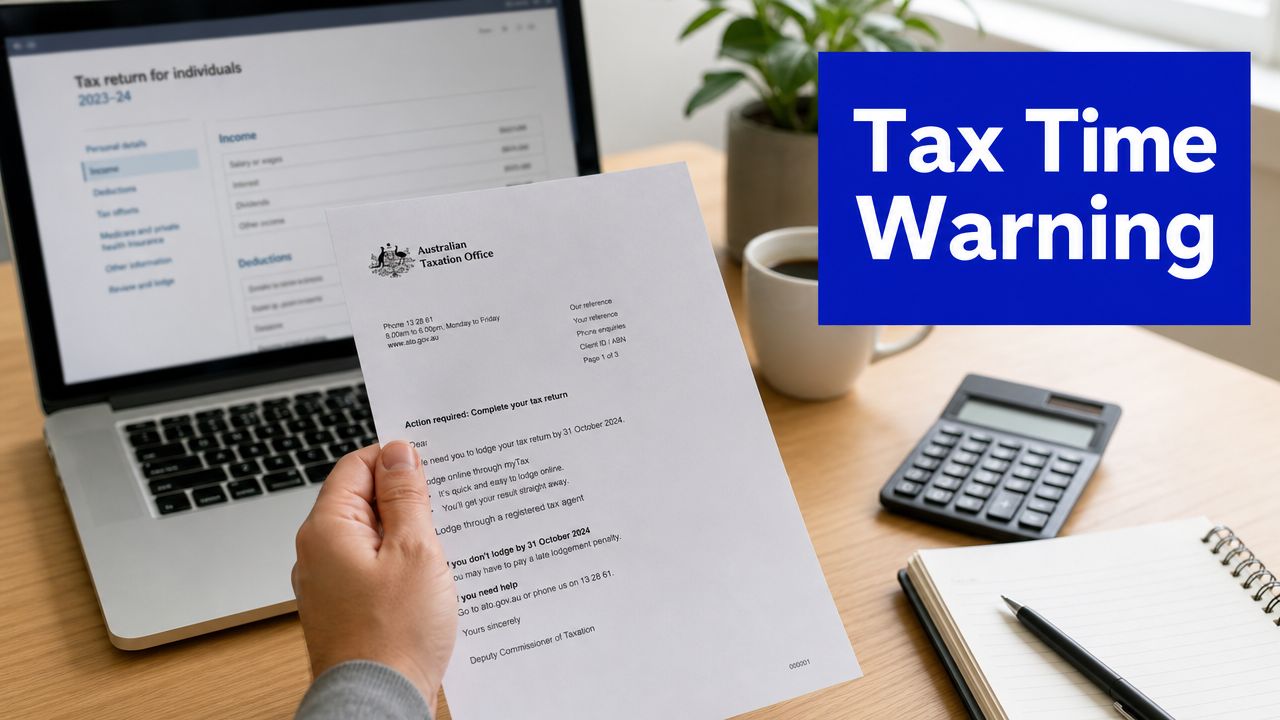
An ATO tax time warning letter is usually a data-matching reminder to review your income and deductions before lodging, not an audit or penalty notice. In the 2024 tax year, the ATO adjusted more than 595,000 individual tax returns because of missing income, overstated deductions and incorrect tax credits, which is why these letters matter before you press submit.
If you’ve opened an ATO letter and felt your stomach drop, that’s normal. The important part is what you do next. In most cases, the letter is a prompt to slow down, check what the ATO may already know, and lodge accurately the first time.
What Is an ATO Tax Time Warning Letter
An ATO tax time warning letter is a notice the ATO may send before tax time when its data-matching systems identify income, deductions or other tax items you should review before lodging. It doesn’t automatically mean you’ve done anything wrong, and it doesn’t always mean you’re being audited.
Many people read these letters as a pre-audit threat. That reaction is understandable, but it often isn’t accurate. Reporting around the ATO’s recent approach has highlighted that these letters are commonly a proactive data-matching notification under the broadened Sharing Economy Reporting Regime, rather than a criminal or enforcement notice (Yahoo Finance’s coverage of ATO warning letters).
What the letter is really telling you
In plain English, the ATO is saying: check your return carefully before lodging because there may be income or deductions that need closer attention.
That matters most for taxpayers whose income doesn’t flow neatly from one salary statement. Employees with multiple jobs, property investors, crypto traders, Uber drivers, Airbnb hosts, online sellers and small business owners often have items that must be reviewed manually.
Practical rule: Treat the letter as a reminder to verify, not a finding of guilt.
Why these letters arrive before you lodge
The ATO uses pre-lodgment letters to stop avoidable mistakes. That is a better outcome for taxpayers than lodging incorrectly and then dealing with amendments, delays, interest charges or penalties later.
Common examples include:
- Side hustle income: Earnings from rideshare, delivery apps, online marketplaces or short-stay platforms may not appear in the same way as wages.
- Investment income: Bank interest, dividends, share sales and some crypto activity can create tax items people forget.
- Higher deductions: A claim may be legitimate, but if it looks unusually large, the ATO may want you to double-check it before lodging.
A warning letter versus a formal compliance action
These letters sit at the lighter end of the ATO’s compliance process. They are often a chance to self-correct while the issue is still manageable.
A useful way to think about it is this:
| ATO contact type | What it usually means |
|---|---|
| Warning letter | Review your records before lodging or respond to a specific concern |
| Review | The ATO wants more detail or documents about an item |
| Audit | A more formal examination of your tax affairs |
If you receive an ATO warning letter before tax time, don’t assume the worst. Assume the ATO wants your return to match the information it expects to receive.
Why the ATO Knows About Your Income Sources
The phrase many clients use is simple: “ATO knows my income.” In a lot of cases, that instinct is partly right. The ATO doesn’t rely only on what you type into your tax return. It compares what you report with data received from other parties.
RemoveUploadDownloadRegenerateAsk AI
In the 2024 tax year, the ATO adjusted more than 595,000 individual tax returns due to missing income, overstated deductions and incorrect tax credits through its data matching program, and it warned taxpayers against early lodgment in July (ATO media release on tax return adjustments and early lodgment).
Where the ATO gets information
The ATO may receive or compare information from sources such as:
- Employers through Single Touch Payroll: Salary, wages and some payroll reporting.
- Banks and financial institutions: Interest and account-related data.
- Share registries: Dividends and investment records.
- Cryptocurrency exchanges: Information relevant to crypto activity.
- Property and rental records: Rental income and related data points.
- Gig economy platforms: Rideshare, delivery and short-term accommodation income.
- Online marketplaces: Marketplace data has expanded under the sharing economy reporting rules.
This is why an ATO data matching letter can arrive even when a taxpayer thought a small amount was too minor to matter.
What income the ATO is watching
The broad categories are straightforward, but taxpayers often miss the items that sit underneath them.
- Salary and wages
- Bank interest
- Dividends
- Share trading
- Crypto transactions
- Rental income
- Airbnb or short-stay income
- Uber, delivery and other gig income
- Side hustle or online marketplace income
A common problem is assuming that if a platform reports data, that income will automatically appear correctly in your return. That isn’t always how it works in practice. Some items still need to be checked and manually reported properly.
Real-world examples
A taxpayer with two jobs may rely on one income statement and forget the second employer’s finalised figures.
A property investor may declare rent received but miss another rental-related amount that affects the return.
A crypto investor may think tax only applies when money is withdrawn to a bank account, then receive an ATO crypto income letter because taxable events can arise earlier than expected.
The practical takeaway is simple. If money came in, or an asset was sold, exchanged or earned through a platform, assume it needs to be reviewed.
Common Tax Return Mistakes That Trigger a Warning
Most ATO warning letters come back to a small number of recurring mistakes. In practice, the top three are usually missing income, deductions that look high for the taxpayer’s occupation or profile, and lodging too early before the ATO pre-fill tax return data is complete.
As of the 2024–25 financial year, over 10 million Australians reported about $31 billion in work-related expenditure claims, and the ATO is using letters to pre-verify claims for specific occupations or high-deduction groups (ABC reporting on work-related deduction claims and ATO letters).
Mistake one is leaving income out
This is the most common trigger behind an ATO warning letter tax return issue.
Examples include:
- Investment income omitted: Bank interest, dividends or share-related amounts are easy to overlook.
- Side income forgotten: Uber, delivery, Airbnb and marketplace income often sits outside the taxpayer’s normal payroll routine.
- Crypto activity missed: Many taxpayers track purchases but not disposals, swaps or other reportable events.
- Rental income not fully reconciled: A property investor may remember the rent but miss related statements or records.
Mistake two is overclaiming deductions
The ATO’s focus on deductions has sharpened. That doesn’t mean you shouldn’t claim what you’re entitled to. It means every claim should have a clear income-producing connection and records to support it.
Claims that often attract attention include:
- Work-from-home expenses
- Car and travel claims
- Tools, uniforms and equipment
- Rental property deductions
- Home office internet and phone costs
- Items that are partly private
If you need a plain-English refresher on what can and can’t be claimed, a practical tax deductions guide for Australians can help you review common categories before lodging.
Checklist mindset: If you can’t explain the work connection clearly and produce records, don’t assume the claim will stand.
Mistake three is lodging too early
Early July lodgments cause problems every year. People want the refund processed quickly, but speed often creates amendments later.
Common missing items in an early lodgment include finalised wages, bank interest, private health, government payment details and investment information. That’s why tie-out work matters. Even though it is written for preparers, these essential tie-out tips for tax preparers are a useful way to think about reconciling what you’ve entered against source documents.
Advice that doesn’t hold up
Another trigger is relying on AI summaries, social posts or finfluencer content without checking whether the advice applies to your facts. Generic online advice often ignores the details that matter, such as mixed private and work use, ownership structure, record keeping, or whether a gain has been realised for tax purposes.
A short rule works well here:
| Source of advice | Safe to rely on by itself |
|---|---|
| Social media post | Usually no |
| AI-generated answer | Not by itself |
| ATO letter and your records | Yes, if reviewed carefully |
| Registered tax agent advice | Yes, when based on your facts |
Your Step-by-Step Response to an ATO Letter
The first rule is simple. Don’t ignore the letter. Early action gives you more options and usually keeps the issue smaller.
RemoveUploadDownloadRegenerateAsk AI
Step one is read the letter closely
Start with the basics. What issue is the ATO raising, what period does it relate to, what deadline applies, and is it asking you to review before lodging or to respond to something already lodged?
Look for whether the issue relates to:
- Income
- Work-related deductions
- Rental property
- Crypto
- Business income
- BAS or GST
- Another compliance item
If you misunderstand the issue at the start, every step after that gets harder.
Step two is compare the ATO issue with your records
Before replying, compare the letter with what you have.
Check:
- MyGov and ATO pre-fill information
- Your draft or lodged tax return
- Bank records
- Payslips or income statements
- Investment records
- Rental statements
- Platform summaries for gig or marketplace income
This is the point where many taxpayers realise the problem is a mismatch, not deliberate non-compliance. Sometimes the return is wrong. Sometimes the records are incomplete. Sometimes the issue is timing.
Step three is gather the right documents
Build one organised file rather than searching for documents one by one.
Useful records often include:
- The ATO warning letter
- The lodged tax return or BAS
- ATO pre-fill report
- Income statements and payslips
- Bank statements
- Invoices and receipts
- Rental property statements
- Dividend and share trading statements
- Crypto transaction reports
- Loan statements and interest summaries
- Car logbooks
- Home office calculation records
- Business profit and loss reports
- BAS and GST working papers
- Any previous ATO correspondence
A strong response file is usually boring. That’s a good sign. The clearer the records, the easier it is to resolve the issue.
Step four is work out whether this is a warning, review or audit
People often ask whether the letter means an audit. Not always.
Here is the practical difference:
| ATO process | What it usually looks like | What you should do |
|---|---|---|
| Early warning | Reminder to check income or deductions before lodging | Review and correct before submitting |
| Data-matching alert | The ATO has third-party data that may not match your figures | Reconcile the difference with documents |
| Review | Request for explanation or evidence | Respond by the deadline with records |
| Formal audit | Broader examination of tax affairs | Get professional help immediately |
An ATO rental income warning, ATO side hustle income letter or ATO work-related deductions warning often starts at the warning or alert stage, not the audit stage.
Step five is get advice before lodging if you’re unsure
If the issue isn’t obvious, speak with a registered tax agent before lodging or replying. That is especially important if crypto, property, GST, multiple income streams or prior-year amendments are involved.
For taxpayers dealing with a more serious dispute or needing representation, ATO dispute resolution support is one pathway to get the matter handled properly.
Step six is respond early if more time is needed
If you need more time to gather records, contact the ATO before the deadline rather than letting the date pass. Silence is rarely interpreted kindly.
A common example is the taxpayer who lodged early and forgot a small amount of investment income. When the mismatch is identified quickly, the return can often be amended before the matter grows into a wider compliance review. What works is prompt correction with records. What doesn’t work is hoping the issue will disappear.
Expert Insights and Frequently Asked Questions
A lot of tax anxiety comes from uncertainty, not the letter itself. Calm, methodical action usually produces a better result than a rushed response.
Puneet Singh, CEO of Nanak Accountants & Associates, puts it well:
“Many taxpayers panic when they receive an ATO letter, but the smartest response is not panic, it is preparation. Review your income, check your records, and make sure your tax return matches the information the ATO is likely to receive through data matching.”
The ATO also recommends waiting until late July to begin tax tasks so pre-fill information for wages, bank interest, government payments and private health insurance details is available in its system (SBS reporting on the ATO’s advice to wait for pre-fill information).
Frequently asked questions
Why did I receive an ATO letter before tax time
Usually because the ATO’s data matching systems have identified income, deductions or reporting areas you should review before lodging. It doesn’t automatically mean you’ve done anything wrong.
Does the ATO already know my income
The ATO may already hold or receive information from employers, banks, investment records, property-related data and some platforms. That is why many taxpayers say, “the ATO knows my income”. The safer assumption is that the ATO may know enough to identify gaps.
Should I be worried about an ATO warning letter
You should take it seriously, but panic isn’t useful. A warning letter is often an opportunity to fix a mismatch early.
Most problems are easier to resolve before lodgment than after an amended assessment or formal review starts.
Can I ignore an ATO tax letter
No. Ignoring it removes your chance to correct the issue early and may lead to adjustments, interest charges, penalties or a more formal review.
What happens if I leave income out of my tax return
The return may be amended. Depending on the circumstances, interest charges or penalties can follow. Missing income is one of the clearest triggers for ATO attention, especially for side hustles, investments, rental income and crypto.
Should I wait before lodging my tax return
In many cases, yes. If pre-fill data isn’t complete, lodging too early can create missing income, incorrect claims and refund delays. Waiting until the available information is more complete is often the better trade-off.
Can a tax agent help with an ATO letter
Yes. A registered tax agent can interpret the letter, compare it with your records, identify gaps, prepare a response, and amend a return if needed. That is particularly helpful where the issue involves rental property, crypto, side income, GST or unusually high deductions.
Examples that commonly trigger letters
These are all practical situations that can lead to an ATO tax return warning:
- An employee with multiple jobs: One income source is reported, another is missed.
- A property investor: Rental figures or deductions don’t line up with the records.
- A crypto seller or trader: A disposal event wasn’t properly accounted for.
- An Uber driver with GST obligations: Income is reported inconsistently across tax and activity statement records.
- An online seller: Marketplace income wasn’t included because it felt informal.
- A taxpayer with large deductions: Claims are higher than expected for the occupation or benchmark profile.
Lodge Accurately and Avoid Future Warnings
The best way to handle an ATO letter tax time warning is to treat it as a useful pause point. Review every income source, check your deductions carefully, and don’t rush to lodge before your records and pre-fill information are ready.
The ATO’s current focus areas for the 2026 tax season include omitted income, work-related deductions and expenses, with common triggers including under-reported income, large or unusual deductions, and figures that don’t match industry benchmarks. That makes record keeping, reconciliation and accurate reporting more important than ever.
A simple prevention routine works well:
- Keep records as you go: Save statements, invoices and platform summaries throughout the year.
- Protect your tax documents: If you’re sharing records digitally, practical document privacy tips from File Studio can help you keep sensitive files secure.
- Review before lodging: Reconcile your return against bank, investment, property and business records.
- Plan ahead: If your affairs are more complex, tax planning support for individuals and businesses can help reduce surprises at year end.
ATO letters are not there to create panic. They are a reminder to lodge accurately, declare all income and keep proper records.
If you have received an ATO letter or are unsure whether your income and deductions are reported correctly, speak with a registered tax agent before lodging your tax return. If you need help reviewing records, responding to the ATO or correcting a return, Nanak Accountants and Associates provides tax and accounting support for individuals, investors, side-hustle earners and businesses across Australia.
