
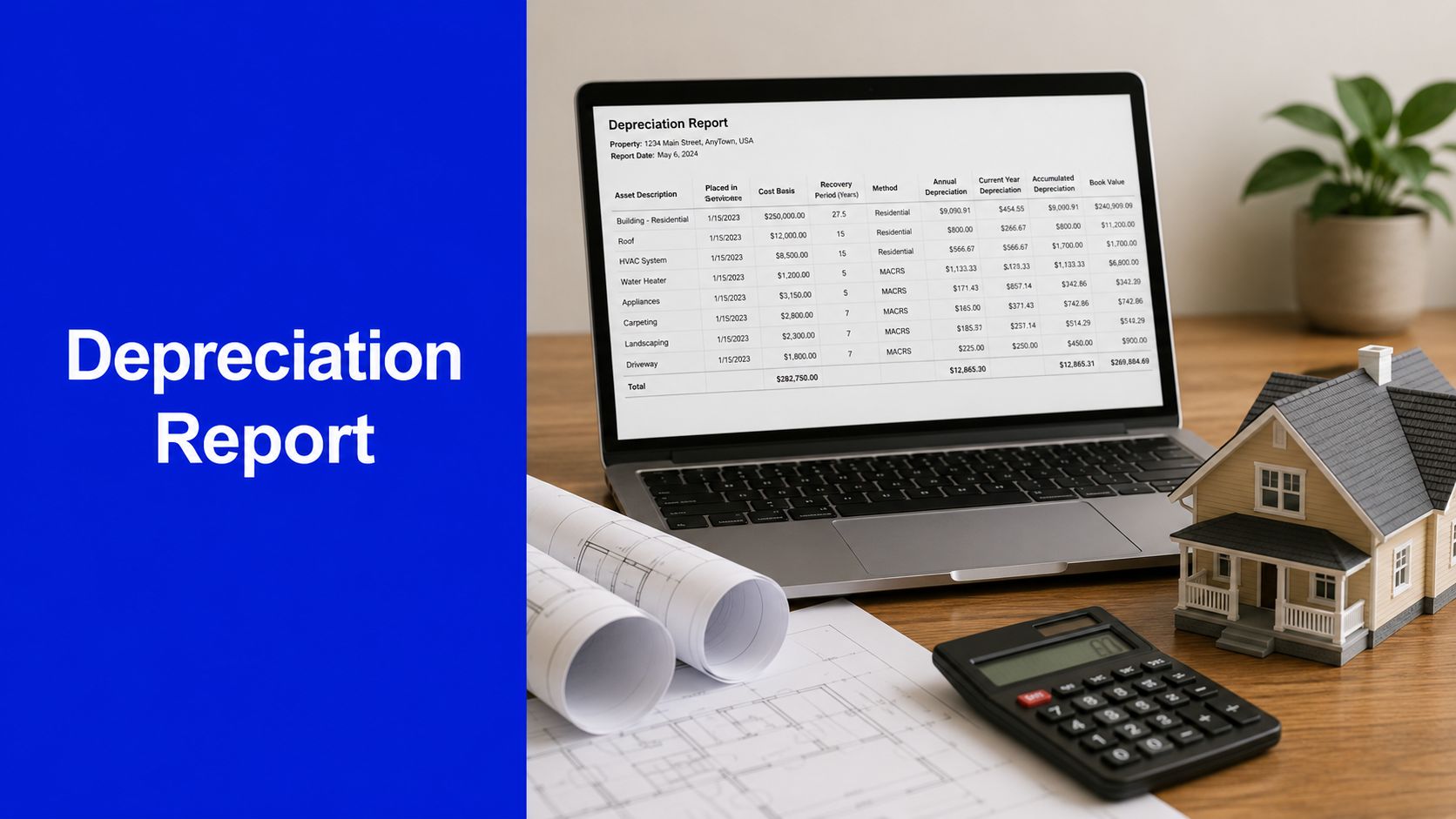
A depreciation report for a rental property is a tax schedule that estimates deductions for eligible building costs and depreciating assets over time. In Australia, it helps property investors claim capital works and decline in value deductions correctly. Claims must follow ATO rules and be supported by proper records.
Maximising your rental property’s tax performance isn’t just about claiming interest and rates. It’s about finding every legal deduction to boost your cash flow. A depreciation report for a rental property is often the biggest deduction many investors miss. This guide explains how it works, what you can claim, and why it’s a non-negotiable for serious Australian property investors.
Key Takeaways
- A depreciation report for a rental property (also called a depreciation schedule) is a document that lists the tax deductions you can claim for the wear and tear of your property’s building and assets.
- It’s prepared by a specialist quantity surveyor and is essential for maximising your tax savings.
- Depreciation is a non-cash deduction, meaning you claim a tax benefit without spending money in that financial year.
- Claims are split into Division 43 (capital works) for the building structure and Division 40 (plant and equipment) for depreciating assets like ovens and carpets.
- The report provides figures for up to 40 years, and its cost is 100% tax-deductible.
- Even older properties and renovated homes can yield significant depreciation deductions.
What Is a Depreciation Report for Rental Property?
A depreciation report for a rental property, often called a tax depreciation schedule, is a detailed report prepared by a qualified quantity surveyor. It identifies the value of your property’s structure and the individual assets within it, then calculates the tax deductions you can claim as they age and lose value.
Think of it as the official roadmap for claiming deductions on the natural wear and tear of your investment property. This isn’t about the cash you spend on immediate repairs or maintenance. Instead, it’s about the gradual loss in value of your building’s structure (capital works) and the fittings inside it (depreciating assets).
The Australian Taxation Office (ATO) lets you claim this loss as a non-cash deduction. This means you can reduce your taxable rental income each year without having to spend any money. Without a depreciation report, you are almost certainly missing out on significant tax savings and overpaying the ATO.
How Rental Property Depreciation Works in Australia
Depreciation is one of the most powerful tools in a property investor’s tax toolkit. It’s a non-cash deduction, which means you claim it as an expense without spending money in that financial year. The ATO recognises that your property and its assets like carpets, ovens, and air conditioners gradually wear out. A property depreciation schedule Australia allows you to claim that loss of value as a tax deduction.
This process reduces your taxable income from the property, which in turn lowers your overall tax bill. Your tax accountant uses the figures from a rental property depreciation report to make these claims on your annual tax return.
The Two Calculation Methods
A quantity surveyor will calculate your depreciation claim using one of two ATO-approved methods. The choice can impact your cash flow, especially in the early years.
- Prime Cost (Straight-Line): This method spreads the deduction evenly over an asset’s effective life. It provides a consistent, predictable claim each year.
- Diminishing Value: This method front-loads your deductions, allowing you to claim a larger portion of the asset’s value in the first few years. This can significantly boost your cash flow when you might need it most.
The ATO has specific rules for how these methods apply. For example, assets with a value of $300 or more must be depreciated over their effective life. Assets under $300 can often be claimed in full immediately. For detailed rules, check the ATO’s guidance on depreciating assets in rental properties.
Division 40 vs Division 43: What Is the Difference?
A comprehensive depreciation report splits your claims into two key categories: Division 40 and Division 43. Understanding the difference is crucial for any investor wanting to maximise their rental property tax deductions.
Division 43: The Building’s Structure (Capital Works)
Division 43 covers the “bones” of your property – the fixed, structural parts that can’t be easily removed. These deductions, known as the capital works deduction, apply to the construction cost of the building, not the land it sits on.
For residential properties built after 15 September 1987, you can typically claim a deduction of 2.5% per year on the original construction cost, for up to 40 years.
Items that fall under Division 43 usually include:
- Foundations, walls, and roof
- Permanent fixtures like built-in wardrobes and kitchen benchtops
- Structural renovations, such as adding a pergola or an extension
Division 40: The Fittings and Fixtures (Plant and Equipment)
Division 40 covers the assets inside your property that can be easily removed or have a mechanical function. These are your depreciating assets rental property items, or ‘plant and equipment’. They generally wear out much faster than the building, so they depreciate at a higher rate.
The decline in value for these items is calculated based on each asset’s individual effective life, a standard set by the ATO. Common Division 40 items include:
- Carpets and vinyl flooring
- Blinds and curtains
- Ovens, cooktops, and dishwashers
- Air conditioning units and hot water systems
It’s important to remember that since 2017, rules limit claims on second-hand plant and equipment in residential properties. However, any new assets you purchase and install are still fully claimable. For more detail, check the ATO’s guidance on capital works deductions.
RemoveUploadDownloadRegenerateAsk AI
What Can Be Included in a Rental Property Depreciation Report?
A good quantity surveyor will identify dozens, if not hundreds, of depreciable items in your property. Both structural elements and individual assets contribute to your total claim. Below is a table showing common items and how they are typically treated for tax purposes.
| Item | Possible Tax Treatment | Notes |
|---|---|---|
| Building structure | Division 43 (Capital Works) | Claimed at 2.5% per year on original construction cost for eligible properties. |
| Kitchen renovation | Division 43 (Structure) & Division 40 (Assets) | Cabinets are capital works; new appliances are depreciating assets. |
| Bathroom renovation | Division 43 (Structure) & Division 40 (Assets) | Tiling is capital works; a new vanity or fan is a depreciating asset. |
| Carpets | Division 40 (Depreciating Asset) | Claimed based on their effective life. |
| Blinds | Division 40 (Depreciating Asset) | Claimed based on their effective life. |
| Appliances | Division 40 (Depreciating Asset) | Ovens, dishwashers, etc. New assets are claimable. Second-hand rules apply. |
| Air conditioner | Division 40 (Depreciating Asset) | Claimed based on its effective life. |
| Hot water system | Division 40 (Depreciating Asset) | Claimed based on its effective life. |
| Furniture | Division 40 (Depreciating Asset) | For furnished properties. Second-hand rules apply. |
| Landscaping | Division 43 (Structural Improvement) | In-ground pools, retaining walls, and sealed driveways may be claimable as capital works. |
| Repairs after tenant damage | Immediate Deduction | Generally claimable in the year the expense is incurred, not depreciation. See our rental property deductions guide. |
| Initial repairs after purchase | Capital Expense | Repairs to fix defects present at purchase are usually capital and may form part of the cost base. See ATO guidance on capital expenses. |
Who Can Prepare a Depreciation Report?
The ATO has strict rules about who can estimate construction costs for depreciation purposes. While your accountant uses the report to prepare your tax return, they are not qualified to create it.
A depreciation report for a rental property must be prepared by a qualified quantity surveyor. These professionals are recognised by the ATO as having the necessary skills in construction, building, and asset valuation. A quantity surveyor depreciation report is the only way to satisfy ATO requirements, especially when original construction costs are unknown. Hiring a registered quantity surveyor ensures your report is compliant and maximises your claims.
Step-by-Step: How to Get a Depreciation Report for Your Rental Property
Getting a depreciation report for a rental property is a straightforward process, and the fee is an investment that usually pays for itself in the first year’s tax return.
The Four-Step Process to Claim Your Deductions
- Find and Engage a Quantity Surveyor: Your first step is to hire a qualified professional. Ensure they are a registered tax agent and members of the Australian Institute of Quantity Surveyors (AIQS).
- Arrange a Site Inspection: The quantity surveyor will visit your rental property to conduct a detailed inspection. They’ll document everything from the building’s structure (Division 43) to the fittings and fixtures like carpets, ovens, and blinds (Division 40).
- Receive Your Depreciation Schedule: After the inspection, you’ll receive a comprehensive report. This document details all available deductions for up to 40 years, giving your accountant the exact figures they need for your investment property depreciation claims.
- Provide the Report to Your Accountant: At tax time, give the depreciation schedule to your tax agent. They will use the figures to claim the maximum deductions on your rental property tax return Australia.
A depreciation report typically costs between $385 and $770 in 2026. The entire fee is 100% tax-deductible in the same year you pay for it.
Worked Example: How Depreciation Can Affect a Rental Property Tax Return
Let’s walk through a simple example to see how a depreciation report impacts an investor’s tax position.
Imagine your investment property earns $32,000 in rent for the year. Your cash expenses: interest, council rates, insurance, and agent fees, total $24,000.
- Net rental result before depreciation: $32,000 (Income) – $24,000 (Expenses) = $8,000 profit
Now, let’s bring in the depreciation report for your rental property. Your quantity surveyor has calculated the following deductions:
- Capital works deduction (Division 43): $4,000
- Depreciating asset deduction (Division 40): $1,200
- Total depreciation claim: $5,200
We now subtract these non-cash deductions from your profit:
- Net rental result after depreciation: $8,000 (Profit) – $5,200 (Depreciation) = $2,800 profit
Depreciation has reduced your taxable rental income from $8,000 to just $2,800. This doesn’t automatically create a refund, but it does lower the tax you pay on that income, depending on your marginal tax rate.
New Property vs Old Property: Does Depreciation Still Apply?
It’s a common myth that older properties offer no depreciation benefits. While rules have changed, there are often still significant deductions available, making a depreciation report for a rental property valuable for most buildings.
Capital Works on Older Buildings
The 2017 legislation changes targeted claims for second-hand plant and equipment (Division 40 assets). Importantly, the rules for the building’s structure (Division 43) were left untouched.
You can still claim capital works deductions for the original construction costs on any residential property where construction commenced after 15 September 1987. If your property qualifies, a quantity surveyor can estimate those original building costs, unlocking annual deductions at 2.5% for up to 40 years from the construction completion date.
New Assets You Install Are Always Claimable
Any new assets you purchase and install in the property are entirely claimable. If you put in a new air conditioner, replace carpets, or upgrade the oven, you can claim depreciation on those items. The 2017 rules only apply to the used assets that were already there when you bought the place.
The Bottom Line: Whether your property is brand new or decades old, it’s almost certain there are depreciation deductions available. A professionally prepared depreciation schedule is the only way to legally find and claim them.
Renovations, Repairs and Improvements: What Investors Must Know
Navigating the tax treatment of money spent on your property can be tricky. The ATO treats repairs, improvements, and renovations differently.
- Repairs: Work done to fix wear and tear or damage that occurred while the property was rented out (e.g., fixing a broken window) is generally claimable as an immediate deduction in the year you pay for it.
- Initial Repairs: Repairs to fix defects that existed when you purchased the property are considered capital expenses and are not immediately deductible. They are added to the property’s cost base.
- Improvements and Renovations: Work that improves the property beyond its original state (e.g., a new kitchen or extension) is a capital work. These costs are added to your Division 43 capital works claim and depreciated at 2.5% per year. A quantity surveyor can update your depreciation schedule to include these new costs.
Depreciation Report for Property Investors and CGT
Claiming depreciation boosts your cash flow each year, but it’s vital to understand its long-term effect on Capital Gains Tax (CGT).
Every dollar of capital works (Division 43) depreciation you claim reduces your property’s cost base. The cost base is, simply put, the property’s purchase price plus acquisition costs, used to calculate your capital gain when you sell.
When your cost base goes down, your taxable capital gain goes up. For example, claiming $50,000 in capital works deductions over ten years will increase your assessable capital gain by $50,000 when you sell.
This is not a bad thing; it’s smart property tax planning. You are receiving an immediate, year-on-year tax benefit in exchange for a future tax event. With the 50% CGT discount for assets held over 12 months, the trade-off is often highly favourable. The key is to keep meticulous records and get professional advice. To get a deeper understanding, explore our Capital Gains Tax services.
Common Mistakes With Rental Property Depreciation
- Not getting a report: The biggest mistake is assuming it’s not worth it. Most properties have thousands in unclaimed deductions.
- DIY estimates: Trying to estimate construction costs yourself is not compliant with ATO rules and will likely be rejected.
- Forgetting renovations: Failing to update your schedule after a renovation means you miss out on new deductions.
- Claiming second-hand assets incorrectly: Misunderstanding the 2017 rules for previously used plant and equipment can lead to compliance issues.
- Poor record-keeping: Not keeping receipts for new assets or a copy of your report can make an ATO rental property depreciation audit difficult. You must keep records for five years after lodging your return. The ATO provides guidance on rental property records.
Depreciation Report Checklist
Use this checklist to ensure you’re ready to maximise your depreciation claims.
- Property Eligibility Check: Was the property built after 15 September 1987?
- Find a Quantity Surveyor: Have I found a registered quantity surveyor?
- Book an Inspection: Have I scheduled a site visit?
- Gather Documents: Do I have the contract of sale, settlement statement, and a list of any assets I’ve purchased?
- Receive the Schedule: Have I received the final, multi-year depreciation report?
- Provide to Accountant: Have I given a copy of the report to my tax accountant?
- Update for Renovations: Have I contacted my quantity surveyor to update the schedule after completing any improvements?
- Keep Records: Have I stored the report and all related invoices securely for tax purposes?
When Should You Speak to a Property Tax Accountant?
While a quantity surveyor prepares your depreciation report, a specialist property tax accountant is crucial for integrating it into your overall tax strategy. You should speak to an accountant:
- Before you buy: For property tax planning advice on ownership structures and CGT implications.
- When you get your report: To understand how the deductions will impact your specific tax situation.
- At tax time: To prepare and lodge your rental property tax return Australia correctly.
- When you renovate: To ensure you are correctly classifying expenses as repairs or capital improvements.
- When you plan to sell: For advice on minimising your Capital Gains Tax liability.
FAQs
What is a depreciation report for a rental property?
A depreciation report for a rental property is a document prepared by a quantity surveyor that outlines the tax deductions available for the wear and tear of a building’s structure (capital works) and its fittings/fixtures (plant and equipment). It’s essential for maximising tax returns for property investors.
Is a depreciation report the same as a depreciation schedule?
Yes, the terms are used interchangeably. Whether called a depreciation report, depreciation schedule, or quantity surveyor’s report, they all refer to the same document used for claiming tax deductions on an investment property.
Do I need a quantity surveyor for rental property depreciation?
Yes. The ATO requires that construction costs be estimated by a qualified professional. A quantity surveyor is recognised by the ATO as having the expertise to do this. An accountant cannot prepare the report, but they use it to lodge your tax return.
Can I claim depreciation on an old rental property?
Yes. While rules since 2017 limit claims on second-hand assets, you can still claim capital works deductions on the building structure if it was built after 15 September 1987. You can also claim depreciation on any new assets you purchase and install in the property.
What is Division 40 depreciation?
Division 40 depreciation covers the decline in value of ‘plant and equipment’ assets in your rental property. These are items that can be easily removed, such as carpets, blinds, ovens, air conditioners, and hot water systems.
What is Division 43 capital works?
Division 43 capital works refers to deductions for the construction cost of the building’s structure. This includes foundations, walls, roofs, and permanent fixtures. For eligible residential properties, this is typically claimed at a rate of 2.5% per year for up to 40 years.
Can I claim depreciation on second-hand assets?
For residential properties purchased after 9 May 2017, you generally cannot claim depreciation on previously used or second-hand plant and equipment assets (Division 40) that came with the property. However, capital works (Division 43) deductions are unaffected.
Can renovations be included in a depreciation report?
Absolutely. Costs from renovations and improvements that are capital in nature (like a new kitchen or extension) can be added to your depreciation schedule. It is wise to have your quantity surveyor update your report after completing any significant work.
Does depreciation affect capital gains tax?
Yes. Capital works deductions you claim reduce the cost base of your property. This increases your capital gain when you sell. However, the annual cash flow benefits and the 50% CGT discount usually make claiming depreciation a highly effective tax strategy.
How long should I keep rental depreciation records?
You must keep your depreciation report and all supporting documents for five years from the date you lodge the tax return where you made your final claim. It’s best practice to keep the report for the entire time you own the property.
Can I claim depreciation if the property was partly private use?
Yes, but you must apportion your claim. You can only claim deductions for the period the property was genuinely rented or available for rent. Your tax accountant can help you calculate the correct apportionment.
When should I speak to a property tax accountant?
You should speak to a property tax accountant when you are planning to buy, after receiving your depreciation report, each year at tax time, and when you are planning to sell. They ensure your claims are compliant and part of a smart overall tax strategy. We offer expert individual tax return services for investors.
Conclusion
A depreciation report for a rental property is not just an optional extra; it is a fundamental tool for any serious Australian property investor. It unlocks thousands of dollars in non-cash tax deductions, directly improving your annual cash flow and the return on your investment. From new apartments to older houses, almost every property has depreciation potential waiting to be claimed.
By engaging a qualified quantity surveyor and working with a specialist property accounting services team, you can ensure you are compliant with ATO rental property depreciation rules while maximising every legal deduction available.
Ready to unlock the full potential of your investment property?
Book a consult with Nanak Accountants & Associates – 1300 NANAK TAX (626 258).
