
Your notice of assessment is the statement the ATO sends after it processes your tax return. It shows the tax worked out on your taxable income, the credits for tax you have already paid, and whether you get a refund or owe money.
Most people check the bottom line and move on. That can be a costly habit, because the notice also sets your payment due date and starts the clock on how long you, or the ATO, can change the assessment.
Below we explain how to read each line, when a tax bill is due, how long you have to fix an error, and what to do if you think the ATO has got it wrong.
Key takeaways
- The ATO aims to process returns lodged through myTax or a registered tax agent within 12 business days, and paper returns within 50 business days.
- If your myGov account is linked to the ATO, your notice goes to your myGov Inbox. If not, it is posted to you.
- If you lodge your own 2025-26 return on time, any tax bill is due on the later of 21 November 2026 or 21 days after you receive your notice.
- Most individuals have 2 years to amend an assessment, starting the day after the notice is sent. Sole traders have 4 years for 2024-25 and later years.
- If you made the mistake, amend your return. If you think the ATO is wrong, lodge an objection.
Notice of assessment at a glance
| Item | What applies |
|---|---|
| What it is | The ATO statement that explains how your tax assessment was calculated |
| How you get it | myGov Inbox if myGov is linked to the ATO, otherwise by post |
| Processing target | 12 business days for myTax and tax agent lodgments, 50 business days for paper |
| Tax bill due (2025-26, you lodge yourself on time) | The later of 21 November 2026 or 21 days after you receive the notice |
| Time to amend (individuals) | Generally 2 years from the day after the notice is sent |
| Time to amend (sole traders, 2024-25 onwards) | 4 years |
| Time to object | 2 years for most individuals and small businesses, 4 years for other taxpayers |
| How long to keep it | 5 years from the date you lodge your return |
What is a notice of assessment?
A notice of assessment (NOA) is the statement the ATO issues after it processes your income tax return or a refund of franking credits application. According to the ATO, it explains how your tax assessment is calculated. It shows:
- the tax on your taxable income
- credits for tax you paid during the year, such as tax withheld from your wages
- the amount you need to pay, or your refund
- any excess private health reduction or refund, if it applies to you.
Most people also receive a tax receipt with their notice, showing how their tax was allocated across key areas of government spending.
If your ATO account balance is different from the assessment result, the ATO also sends a statement of account, and your payment advice and due date appear on that statement instead. This can happen if a refund was used to pay another debt, a penalty or general interest charge applies, or you lodged returns for several years on the same day.
How long does it take to get your notice of assessment?
The ATO aims to process returns within these timeframes:
- lodged online through myTax: within 12 business days
- lodged through a registered tax agent: within 12 business days
- lodged on paper: within 50 business days (10 weeks). Paper returns can take up to 7 weeks just to show in ATO systems.
These are targets, not guarantees. If yours is taking longer, read our guide on why a myGov tax return can stay in processing.
How do you read the key lines on your notice?
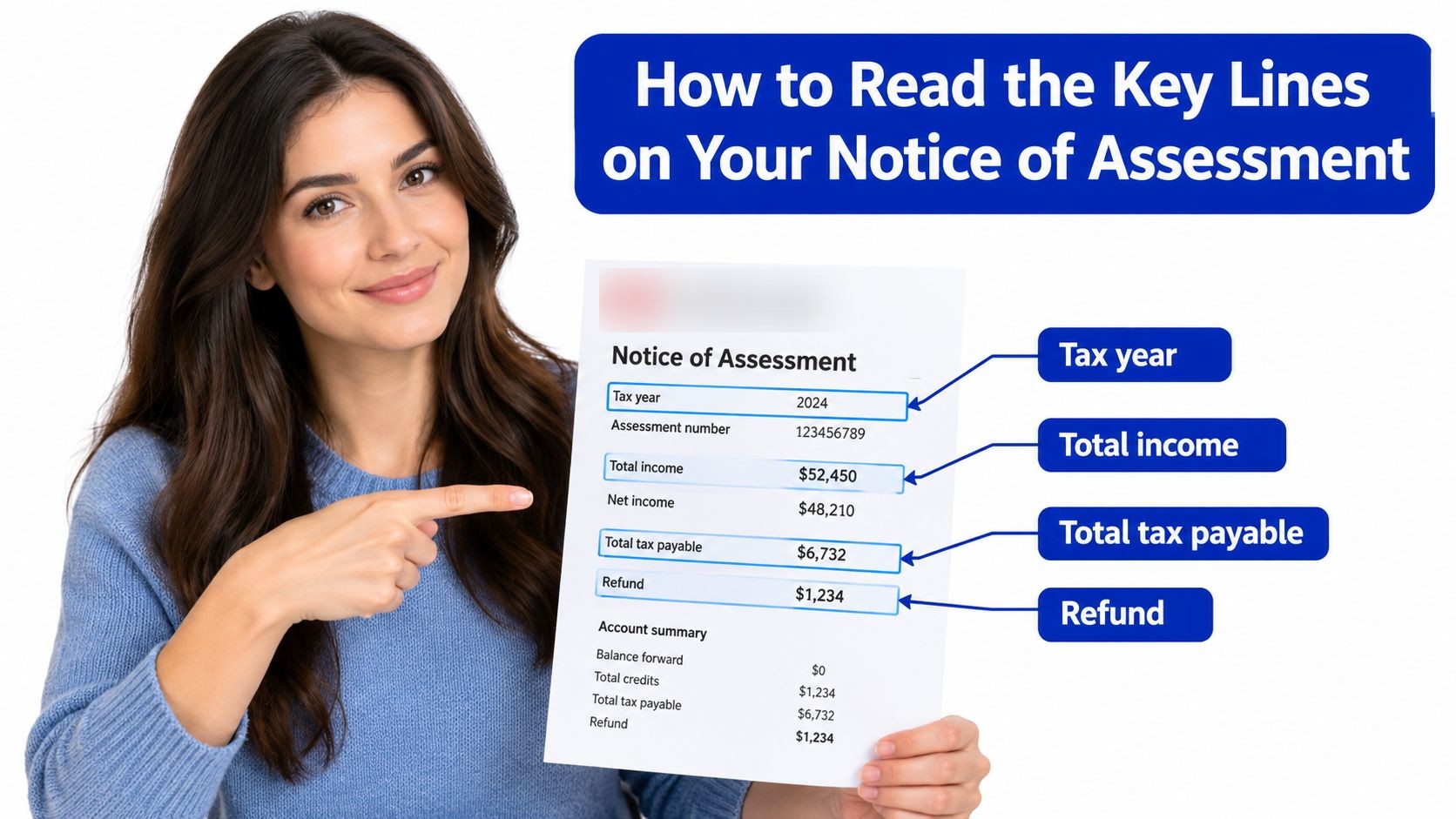
The notice reconciles the tax you owe for the year against what you have already paid. Check each line against the return you lodged:
- Taxable income: your assessable income minus allowable deductions. This should match your return.
- Tax on taxable income: worked out using the resident tax rates for that year.
- Medicare levy: generally 2% of your taxable income, with a reduction for some low-income earners.
- Study loan repayment: a compulsory HELP or other study loan repayment, if your income is high enough to trigger one.
- Tax offsets: amounts that reduce the tax you pay, such as the low income tax offset.
- Credits: tax withheld by your employers and any PAYG instalments you paid.
- Result: your refund, or the amount you need to pay.
Tip
Check the taxable income figure first. If it doesn’t match the return you lodged, the ATO has changed something. A difference between your return and the pre-fill or data-matching information the ATO holds is a common reason for an unexpected result.
When is a tax bill on your notice of assessment due?
Your due date is printed on your notice, or on your statement of account if one was sent. For a 2025-26 return you lodge yourself, the ATO says:
- if you lodge on time, any tax bill is due on the later of 21 November 2026 or 21 days after you receive your notice of assessment
- if you lodge late, any tax bill is due on 21 November 2026, which is 21 days after the return was due.
If a registered tax agent lodges for you, later dates can apply under the agent lodgment program. For returns due 15 May 2027, payment is due on 21 March 2027, 21 April 2027 or 5 June 2027, depending on when the return is lodged. Our tax due dates guide covers the main dates.
If the ATO sends an amended assessment after data matching, the due date for payment is 21 days after the ATO notifies you of the amounts.
If you can’t pay in full by the due date, act early. You may be eligible for a payment plan. See our guide to ATO tax debt relief options.
Watch out
Lodging an objection generally doesn’t change your due date. The ATO usually won’t take recovery action until the objection is finalised, but the debt is still there, so plan how you will pay it while you wait.
Why might you get a tax bill you didn’t expect?
The ATO lists several common reasons, including:
- not enough tax was withheld, for example because you claimed the tax-free threshold from more than one payer (see our article on the two jobs tax-free threshold mistake)
- a capital gains tax event, such as selling real estate, shares or crypto assets
- investment income such as dividends or rent
- business, partnership or trust income, or not paying enough through PAYG instalments as a sole trader
- changes to your Medicare levy, Medicare levy surcharge or private health insurance rebate
- a higher study loan repayment because your income went up
- your return differs from pre-fill data or the ATO’s data matching.
Worked example: one tax-free threshold claim vs two
The facts
Priya is an Australian resident for the whole 2025-26 income year. She earns $50,000 from her main job and $30,000 from a weekend job, so her taxable income is $80,000. She has no deductions, holds private hospital cover, has no study loan and no other income. She lodges her own return through myTax on 20 September 2026 and receives her notice of assessment on 2 October 2026.
Her assessed tax is the same in both scenarios below, because it depends on her taxable income, not on how much her employers withheld:
- Tax on the first $45,000: $4,288 (16% of the $26,800 above $18,200)
- Tax on $45,001 to $80,000: 30% x $35,000 = $10,500
- Tax on taxable income: $4,288 + $10,500 = $14,788
- Medicare levy: 2% x $80,000 = $1,600
- Low income tax offset: nil, because her taxable income is above $66,667
- Total assessed: $14,788 + $1,600 = $16,388
Scenario 1: tax-free threshold claimed with the main job only
Assume her two employers withheld a combined $16,700 during the year.
- Tax withheld: $16,700
- Less total assessed: $16,388
- Result: $16,700 – $16,388 = $312 refund
Scenario 2: tax-free threshold claimed with both jobs
Here each employer treated its job as her only job, so less tax was withheld. Assume the combined withholding was $13,900.
- Tax withheld: $13,900
- Less total assessed: $16,388
- Result: $16,388 – $13,900 = $2,488 to pay
Priya lodged on time. 21 days after 2 October 2026 is 23 October 2026, which is earlier than 21 November 2026, so her $2,488 is due by 21 November 2026.
The withholding figures are assumptions for illustration. Your own withholding depends on the tax tables your employers use. You can estimate your result with our tax refund calculator.
What should you do if your notice of assessment is wrong?
Start by comparing the notice with the return you lodged. The right fix depends on who made the mistake.
You made the mistake: amend your return
If you left out income, claimed a deduction you weren’t entitled to or missed one you were, lodge an amendment rather than a second return. Individuals generally have 2 years to amend, starting the day after the notice of assessment is sent. For example, if myGov tells you on 3 November 2026 that your notice is available, the period runs from 4 November 2026 to 4 November 2028.
Sole traders have 4 years to amend for the 2024-25 income year and later years. For 2023-24 and earlier, it is generally 2 years. Our sole trader accounting team can check your return before the window closes.
You think the ATO is wrong: lodge an objection
If you think the ATO has interpreted the law incorrectly or hasn’t taken relevant information into account, you can lodge an objection in writing. There is no fee. For an income tax assessment, the time limit is 2 years for most individuals, small businesses and medium businesses, and 4 years for other taxpayers. For an amended assessment, it is the later of 60 days from when you were given it or the time limit for the original assessment.
An objection may also be the only option if you are outside the amendment time limit.
You can’t work out what changed
Call the ATO on 13 28 65 with your notice and a copy of your return, or ask your registered tax agent to check it. Agents can see most of the correspondence the ATO sends you.
Good to know
The ATO can also increase or decrease your assessment during its review period. This is normally 2 years, but in certain circumstances it can be 4 years.
Where can you find a copy of your notice of assessment?
If your myGov account is linked to the ATO, check your myGov Inbox first. If you can’t find a current or earlier notice there:
- Sign in to myGov and select ATO from your linked services.
- Select My profile.
- Select Communication, then History from the drop-down menu.
You can save or print the notice as a PDF. Do this before you unlink the ATO from myGov, because you can’t access those messages afterwards. To receive ATO mail by post instead, call 13 28 61. If you haven’t linked your account yet, see our guide on how to link myGov to the ATO.
How long should you keep your notice of assessment?
Keep your notice with your return and supporting records for 5 years from the date you lodge. Keep them longer if:
- you claim decline in value on an asset: 5 years from your last claim
- you own a CGT asset: 5 years after it is certain no CGT event can happen
- you are in a dispute with the ATO: the later of 5 years from lodgment or 5 years from when the dispute is resolved.
Frequently asked questions about the notice of assessment
How do I get my notice of assessment?
If your myGov account is linked to the ATO, it goes to your myGov Inbox and you get an email or SMS saying you have mail. If it isn’t there, sign in to myGov, select ATO, then My profile, Communication and History. If you lodged on paper and aren’t linked to myGov, it is posted to you.
How long after lodging will I get my notice of assessment?
The ATO aims to process returns lodged through myTax or a registered tax agent within 12 business days, and paper returns within 50 business days. These are targets, so some returns take longer.
Why is my refund smaller than the amount on my notice?
The ATO can use a refund to pay other debts, including tax debts and some debts with other government agencies. When this happens, the ATO sends a statement of account showing how your balance was worked out.
Can I amend my tax return after I get my notice of assessment?
Yes. Individuals generally have 2 years from the day after the notice is sent. Sole traders have 4 years for the 2024-25 income year and later years.
Do I have to pay my tax bill while my objection is being decided?
Generally yes. An objection usually doesn’t change your due date, although the ATO usually won’t take recovery action until the objection is finalised. If you can’t pay in full, contact the ATO about a payment plan.
Talk to a registered tax agent
If your notice of assessment shows a bill you didn’t expect, or a figure you don’t recognise, a registered tax agent can compare it with your return and work out whether to amend, object or set up a payment plan. Call Nanak Accountants & Associates on 1300 626 258 or book a consultation with our team. We can help through our individual tax return service and our ATO dispute resolution service.
This article is general information only and is not personal financial or tax advice. Information checked against ATO sources on 8 October 2026.
