
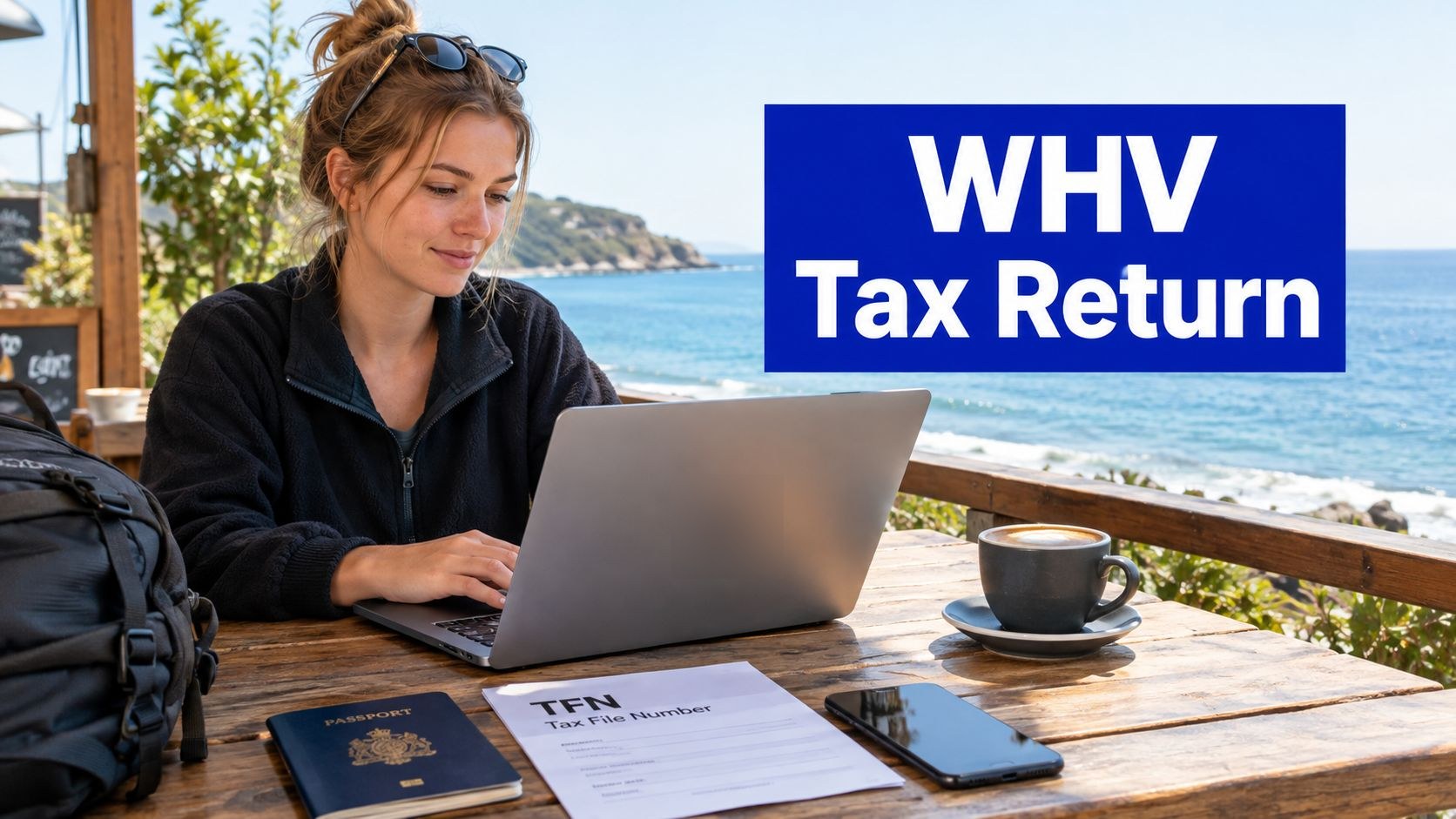
A WHV tax return is the Australian income tax return you lodge if you worked here on a working holiday visa (subclass 417 or 462). Working holiday makers pay 15% on the first $45,000 of taxable income, and lodging a return is how you get back any tax that was over-withheld and claim your work-related deductions.
You don’t always have to lodge. If all your income was salary or wages earned as a working holiday maker and your taxable income was under $45,001, the ATO says no return is required. But many backpackers still lodge, because a second job with an employer who wasn’t registered, or deductions for work gear, can mean a refund is sitting there.
This guide covers the rates for 2025-26 and 2026-27, when you need to lodge, how to lodge before you leave Australia, and what happens to your super. There’s a worked example with the maths shown.
Key takeaways
- Working holiday makers are people on a 417 or 462 visa. They pay 15% on the first $45,000, then 30%, 37% and 45%, with no tax-free threshold.
- An employer who isn’t registered as a WHM employer must withhold 30% from the first dollar, so you can end up overpaying.
- You must lodge if you want to claim deductions. If you lodge yourself, the 2025-26 return is due by 31 October 2026.
- Leaving Australia for good? You may be able to lodge early on a paper return.
- Super paid out to you after you leave (DASP) is taxed at 65% for working holiday makers.
WHV tax return at a glance
| Item | 2025-26 and 2026-27 position |
|---|---|
| Who it applies to | Holders of a 417 (Working Holiday) or 462 (Work and Holiday) visa |
| Tax on the first $45,000 | 15% from the first dollar (no tax-free threshold) |
| $45,001 to $135,000 | $6,750 plus 30c for each $1 over $45,000 |
| $135,001 to $190,000 | $33,750 plus 37c for each $1 over $135,000 |
| $190,001 and over | $54,100 plus 45c for each $1 over $190,000 |
| Withholding by an unregistered employer | 30% on each dollar up to $135,000 |
| Do you have to lodge? | Not if all income was WHM salary or wages and taxable income was under $45,001, but you must lodge to claim deductions |
| Self-lodgment due date for 2025-26 | 31 October 2026 |
| Medicare levy | Full exemption for a full year as a foreign resident |
| Tax on DASP (super paid out after you leave) | 65% on the taxable component |
Who counts as a working holiday maker for tax?
The ATO treats you as a working holiday maker if you hold a subclass 417 Working Holiday visa or a subclass 462 Work and Holiday visa. Your visa type is what matters, not how long you stay or what work you do.
When you start a job, give your employer a tax file number (TFN) declaration and tell them your visa subclass. Without a TFN, your employer has to withhold tax at the top rate of 45%.
What tax rate do working holiday makers pay?
The working holiday maker tax rates are the same for 2024-25, 2025-26 and 2026-27. They are set in Schedule 7 of the Income Tax Rates Act 1986:
- $0 to $45,000: 15c for each $1
- $45,001 to $135,000: $6,750 plus 30c for each $1 over $45,000
- $135,001 to $190,000: $33,750 plus 37c for each $1 over $135,000
- $190,001 and over: $54,100 plus 45c for each $1 over $190,000
There is no $18,200 tax-free threshold. Tax starts from the first dollar you earn. For example, on $52,000 of taxable income the tax is $45,000 x 15% = $6,750, plus ($52,000 – $45,000) x 30% = $2,100, for a total of $8,850. The ATO’s Schedule 15 withholding table for payments from 1 July 2026 uses the same bands.
Watch out: check your employer is registered
Employers must register with the ATO as an employer of working holiday makers to withhold at 15%. If they aren’t registered, they must withhold 30% from each dollar up to $135,000. If your payslips show 30% coming out of a small wage, that’s usually why, and lodging a return is how you get the extra back.
Are you a foreign resident or an Australian resident?
Most working holiday makers are foreign residents for tax purposes. The ATO’s long-standing view is that people here mainly for a holiday, who work to fund their travel, are visitors. You can read its factors on residency if you’re on a working holiday.
For most people, residency doesn’t change the rate. The exception is an Australian resident working holiday maker from a country whose tax treaty has a non-discrimination article (NDA). After the High Court’s Addy decision on 3 November 2021, these people are taxed like an Australian national. The NDA countries are:
- Chile, Finland, Germany, Japan, Norway, Turkey and the United Kingdom
- Israel, for 2020-21 and later income years
If you’re a resident from one of these countries, your employer still withholds 15%, but your assessment uses the lower of resident rates and WHM rates. You’ll need to lodge a return showing your residency, your WHM income and your nationality. Our guide to double tax agreements explains how treaties work more generally.
Do you need to lodge a WHV tax return?
You don’t need to lodge if all your income was salary or wages earned as a working holiday maker and your taxable income was less than $45,001. You do need to lodge if any of these apply:
- Your taxable income was $45,001 or more.
- You want to claim deductions, such as protective gear or tools you paid for. See our list of work-related tax deductions.
- You had income other than salary or wages earned as a working holiday maker.
- You were, or became, an Australian resident from an NDA country during the year (the ATO says you may want to lodge).
Your income statement in myGov shows what each employer paid you, the tax withheld and the super paid. If you’re unsure what it shows, our guide to PAYG payment summaries and income statements walks through it.
When is a WHV tax return due?
The Australian income year runs from 1 July to 30 June. If you lodge your own return, you have from 1 July to 31 October, so the 2025-26 return is due by 31 October 2026. If you plan to use a registered tax agent, you need to be on their client list before 31 October. Our tax return deadline guide has more detail.
Can you lodge before you leave Australia?
Yes, if you’re leaving permanently and won’t earn Australian-sourced income after you go (other than interest, dividends or royalties), you may be able to lodge your tax return before leaving Australia. Key points:
- Early returns must be lodged on paper, not through myTax.
- The ATO takes up to 50 business days to process them.
- Get final pay details from every employer. Payslips alone may not show your final payment.
- Your notice of assessment goes to the postal address on the return, so use one where you can still get mail.
You can’t lodge early if you aren’t leaving permanently, will have Australian-sourced income after you leave, or have a HELP, AASL or VET Student Loan debt. In those cases you lodge in the normal period after 30 June.
How do you complete the working holiday maker section?
In myTax, you show this income under Working holiday maker net income in the adjustments section. The ATO’s myTax 2026 instructions set out the steps:
- At Personalise return, select that you’re claiming tax offsets or adjustments, then Working holiday maker net income.
- Select your home country. If you’re also a national of an NDA country, select that country.
- Confirm whether all your income and deductions relate to income earned on a 417 or 462 visa. Wages marked as type H on your income statement are WHM wages.
- Enter the deductions that relate to earning your WHM income. myTax works out your net amount.
As a full-year foreign resident you can also claim a full exemption from the Medicare levy.
Worked example: should Lena lodge a WHV tax return?
The facts
Lena holds a 417 visa and is a foreign resident for tax. In 2025-26 she earned:
- $18,000 on a farm whose employer is registered as a WHM employer. Tax withheld: $18,000 x 15% = $2,700.
- $12,000 at a café that never registered. Tax withheld: $12,000 x 30% = $3,600.
- Total income $30,000. Total tax withheld $2,700 + $3,600 = $6,300.
- She also paid $600 for protective boots and gloves for the farm job and kept the receipts.
Option 1: she doesn’t lodge
All her income is WHM wages and it’s under $45,001, so she isn’t required to lodge. But her actual tax at WHM rates is only $30,000 x 15% = $4,500. The ATO keeps the full $6,300 withheld, so she has overpaid $6,300 – $4,500 = $1,800 and gets none of it back.
Option 2: she lodges and claims her deduction
- Taxable income: $30,000 – $600 = $29,400
- Tax at WHM rates: $29,400 x 15% = $4,410
- Medicare levy: nil (full-year foreign resident exemption)
- Refund: $6,300 withheld – $4,410 = $1,890, assuming no other debts
Lodging is worth $1,890 to Lena. Most of it comes from the café over-withholding, and $90 comes from the deduction ($600 x 15%). You can test your own numbers with our tax refund calculator, keeping in mind it’s built for resident rates.
Tip: deductions need to be real and recorded
You can only claim what you paid for yourself, that wasn’t reimbursed, and that relates to earning your WHM income. You also need a record, such as a receipt, to prove it.
What happens to your super when you leave?
Employers must pay super for working holiday makers just like other employees, at the 12% super guarantee rate from 1 July 2025. Once you’ve left Australia and your visa has expired or been cancelled, you can claim it as a departing Australia superannuation payment (DASP).
- Tax on a DASP for working holiday makers is 65% on the taxable component (taxed and untaxed elements). The tax-free component is nil.
- If any of the super was contributed while you held a WHM visa, the 65% rate applies to the whole payment.
- If you don’t claim, your fund transfers your super to the ATO as unclaimed super once it’s been 6 months since you left and your visa is no longer in effect. You can still claim it from the ATO.
Our DASP guide covers the claim process step by step.
Frequently asked questions
Do I have to lodge a tax return on a working holiday visa?
Not always. If all your income was salary or wages earned as a working holiday maker and your taxable income was under $45,001, you don’t have to lodge. You must lodge if you earned $45,001 or more or want to claim deductions, and lodging is the only way to get back tax that was over-withheld.
How much tax do backpackers pay in Australia?
Working holiday makers on a 417 or 462 visa pay 15% on the first $45,000 of taxable income, 30% from $45,001 to $135,000, 37% from $135,001 to $190,000 and 45% above that. These rates apply for 2024-25, 2025-26 and 2026-27, with no tax-free threshold.
Why did my employer take 30% tax from my pay?
Employers must register with the ATO as an employer of working holiday makers to withhold at 15%. An employer that isn’t registered must withhold 30% from each dollar up to $135,000. You can get any excess back by lodging a tax return.
Can I lodge my WHV tax return before I leave Australia?
If you’re leaving permanently and won’t have Australian-sourced income after you leave (other than interest, dividends or royalties), you may be able to lodge early. Early returns are lodged on paper and can take 50 business days to process. You can’t lodge early if you have a HELP, AASL or VET Student Loan debt.
How much tax is taken from my super when I leave?
A departing Australia superannuation payment (DASP) is taxed at 65% on the taxable component for working holiday makers. If any of the super was contributed while you held a 417 or 462 visa, the 65% rate applies to the whole payment.
Talk to a registered tax agent
Not sure whether you’re a resident, whether an employer withheld the right amount, or how to lodge before you fly out? Call Nanak Accountants & Associates on 1300 626 258. Our individual tax return team can prepare and lodge your WHV tax return, and our tax services for migrants cover residency questions. You can also contact our team to book a time.
This article is general information only and is not personal financial or tax advice. Information checked against ATO and Federal Register of Legislation sources on 15 October 2026.
