
Starting a first job, picking up freelance work or switching from employee to contractor all raise the same question: do you need an ABN, a TFN, or both? The two numbers do very different jobs, and using the wrong one can mean losing almost half of a payment to withholding.
This guide explains what a tax file number and an Australian Business Number are, who issues them, when you need each, what happens if you do not quote them, and how employee and contractor status decides which one applies. Every rule was checked against ATO, Australian Business Register and Fair Work Ombudsman pages.
It is written for students, employees with side income, gig workers, new arrivals and anyone moving into contracting. If you already have a TFN but cannot find it, see our guide on how to find your TFN.
Key takeaways
- A TFN is your personal, confidential tax identifier from the ATO; it is free and stays with you for life.
- An ABN is a public 11-digit number for an enterprise you carry on, issued through the Australian Business Register.
- If you don’t give your employer your TFN within 28 days, they must withhold 47% from your pay (45% for foreign residents).
- If you invoice a business without an ABN and the payment is over $75, they generally withhold 47%.
- Many people need both: a TFN for their job and personal tax, and an ABN for side business income.
ABN vs TFN at a glance
| TFN | ABN | |
|---|---|---|
| Issued by | Australian Taxation Office | Australian Business Register |
| Who needs it | Anyone earning income or lodging a tax return | Anyone carrying on or starting an enterprise |
| Format | Usually 9 digits | 11 digits |
| Public or private | Confidential | Public on ABN Lookup |
| Cost | Free | Free |
| If not quoted | Employer withholds 47% (45% foreign residents) | Payer withholds 47% on payments over $75 |
Sources: ATO what is a TFN, employee declarations and withholding if ABN not provided pages and ABR ABN entitlement, checked 7 October 2026.
What is a tax file number?
A tax file number is a unique personal reference number, usually 9 digits, that the ATO issues to identify you in the tax and super systems. It is free and it is yours for life, even if you change jobs, change your name or leave Australia. You need it to lodge a tax return, to start work without excessive tax being withheld, to avoid extra tax on bank interest and to receive some government payments.
Australian residents can apply online using a Digital ID, at a participating Australia Post outlet or Services Australia centre, or by post, and should receive their TFN within 28 days. New arrivals often find the process confusing, which is why we offer TFN registration for new arrivals. Your TFN is confidential, so never put it on an invoice or a public document.
What is an ABN?
An Australian Business Number is a public 11-digit identifier for an enterprise. You are entitled to an ABN if you are carrying on or starting an enterprise in Australia. A hobby, or working as an employee, is not an enterprise, so having a job does not entitle you to an ABN. Anyone can look up your ABN, business name and GST status on the Australian Business Register.
An ABN lets you invoice other businesses without withholding, register for GST and claim GST credits. Applying is free, and if you are new to Australia our ABN registration for new arrivals service can help you work out whether you are entitled before you apply.
Employee or contractor: which number applies?
The key question is whether you are an employee or an independent contractor, because that decides whether you are paid under your TFN or under an ABN. The ATO’s ruling TR 2023/4 says the answer depends on the legal rights and obligations in your contract, viewed as a whole. Key indicators include whether you serve in the payer’s business or run your own, who controls how, where and when the work is done, and whether you can delegate the work to someone else. The ATO’s employee or contractor guidance walks through these tests.
An employee gives their employer a TFN declaration and has tax withheld under PAYG, and the employer pays their super. A contractor quotes an ABN, invoices for work and is responsible for their own tax, GST and super.
When do you need both?
Plenty of people hold both numbers. A full-time office worker who delivers food on weekends uses their TFN for their salary and an ABN for the delivery income. Both types of income go into the same individual tax return, because a sole trader’s business uses the individual’s own TFN. Partnerships, companies and trusts are different: they need their own separate TFN.
Worked example: a job plus a side business
Aisha works as a part-time receptionist under her TFN and earns $38,000. She also drives for a ride-sourcing app as an independent contractor and earns $9,000 in fares.
She needs an ABN for the driving, and because ride-sourcing is involved she must register for GST from the first dollar of fares, regardless of turnover, and lodge activity statements.
At tax time she lodges one return that includes her salary and her net business income after expenses. If she had not quoted an ABN to the app, it would generally have had to withhold 47% of her payments.
What happens if you don’t quote a TFN or ABN?
If you start a job and do not give your employer your TFN within 28 days, the ATO’s withholding rules require them to withhold 47% from your pay, or 45% if you are a foreign resident. Banks also withhold tax at the top rate from interest if you have not quoted your TFN.
If you supply goods or services to a business without quoting an ABN and the payment is more than $75 excluding GST, the business generally has to withhold 47%. There is an exception if you give them a written statement that the supply is a private recreational pursuit or hobby, is wholly private or domestic, or that you are not carrying on an enterprise in Australia.
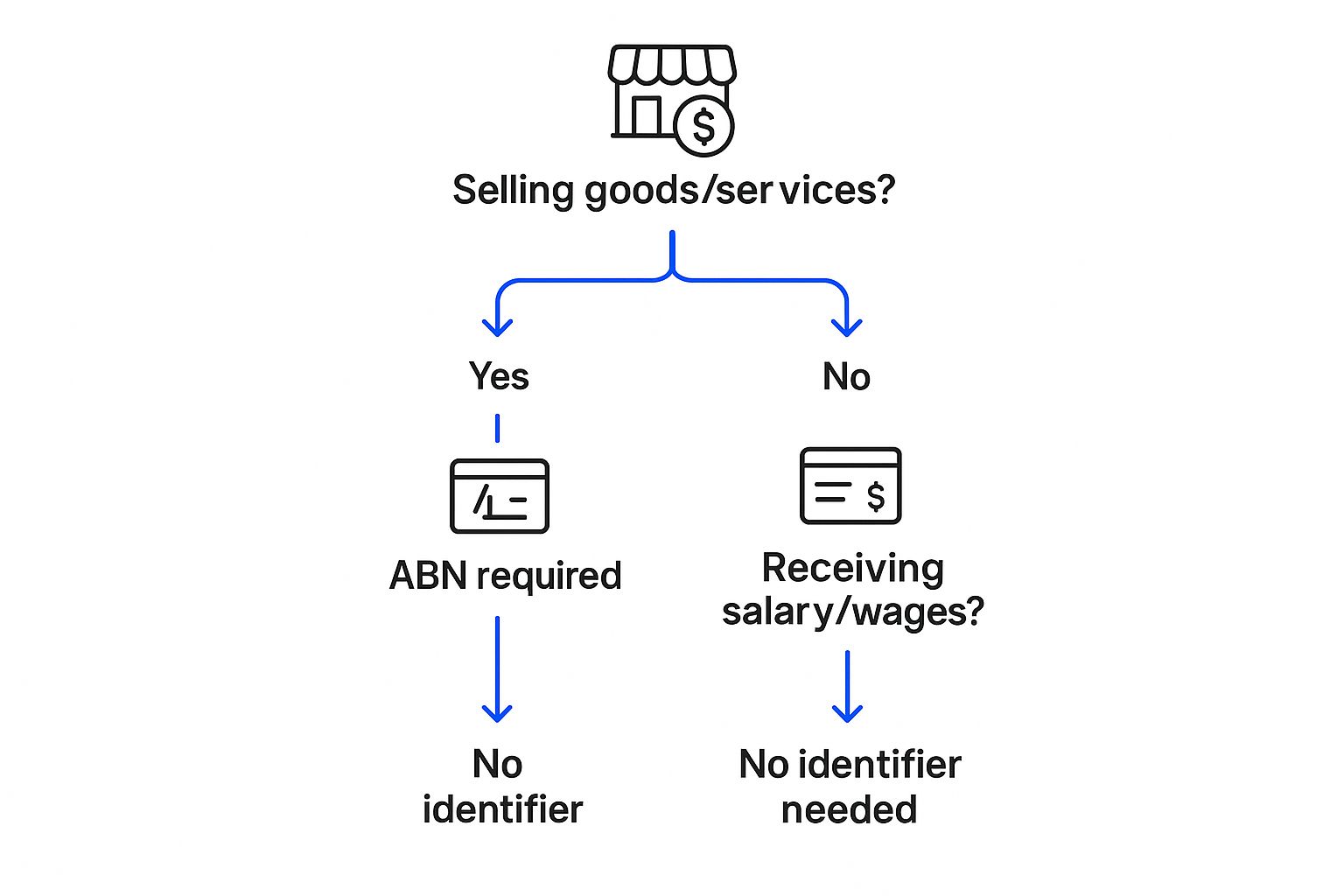
Rule of thumb: wages go with your TFN; invoices go with your ABN. If you are being paid for your time as part of someone else’s team, you are probably an employee.
GST, BAS and keeping your ABN active
An ABN does not register you for GST. You must register for GST once your GST turnover reaches $75,000, or $150,000 for non-profits, and taxi and ride-sourcing drivers must register regardless of turnover. Once registered you lodge a business activity statement; our BAS and GST lodgement team can handle that for you. Charities with an ABN also have separate ACNC reporting obligations.
The ABR regularly reviews inactive ABNs for cancellation, for example where no business income has been reported. If yours is cancelled and you start trading again with the same structure, you can usually get the same number back; see our guide on how to reactivate an ABN. If your business grows into a company, it will also need an ACN, explained in our ABN vs ACN guide.
Common mistakes and compliance risks
- Being pushed onto an ABN for what is really a job. Sham contracting is prohibited under sections 357 to 359 of the Fair Work Act, and the Fair Work Ombudsman lists maximum penalties per contravention of $19,800 for individuals, $99,000 for businesses with fewer than 15 employees and the greater of $495,000 or three times the underpayment for larger businesses.
- Leaving ABN income off your tax return. All business income must be reported alongside your wages.
- Missing the GST threshold. Monitor turnover and register as soon as you reach $75,000, or immediately for ride-sourcing.
- Putting your TFN on invoices or forms that don’t need it. Only your ABN belongs on invoices.
- Applying for an ABN for a hobby. You must be carrying on or starting an enterprise.
FAQ about ABNs and TFNs
Can I have both an ABN and a TFN?
Yes, and many people do. Your TFN is your personal tax identifier for life. If you also start carrying on an enterprise, such as freelancing or delivery driving as a contractor, you apply for an ABN for that business. As a sole trader you use your individual TFN for both your business and personal tax.
What happens if I don’t give my employer my TFN?
If you have not given your employer your TFN within 28 days, they must withhold 47% from your pay if you are an Australian resident, or 45% if you are a foreign resident. You can claim back any excess when you lodge your tax return.
What happens if I don’t quote an ABN to a business I invoice?
If the payment is more than $75 excluding GST, the business generally has to withhold 47% of it unless you give them a written statement that, for example, the work is a hobby or you are not carrying on an enterprise.
Do I need an ABN to drive for Uber or a delivery app?
If you work as an independent contractor you need an ABN. Ride-sourcing drivers must also register for GST from their first dollar of fares, regardless of turnover. Food delivery riders only need GST registration once their GST turnover reaches $75,000.
Is my ABN public?
Yes. Anyone can search the ABN Lookup website to check a business name, ABN status and GST registration. Your TFN, by contrast, is confidential and you should only give it to the ATO, your employer, your super fund, your bank and other authorised parties.
Talk to a registered tax agent
Not sure whether you should be working under your TFN, an ABN or both? Nanak Accountants can check your arrangements, register the right numbers and prepare your individual tax return with business income included correctly. Call 1300 626 258 or visit the ATO website for general information.
This article is general information only and is not personal tax or legal advice. Figures and rules were checked against ATO pages on tax file numbers, employee declarations, no-ABN withholding, GST registration and employee or contractor status, the Australian Business Register and the Fair Work Ombudsman’s sham contracting page on 7 October 2026. Rates and thresholds change, so confirm the current position before acting.
